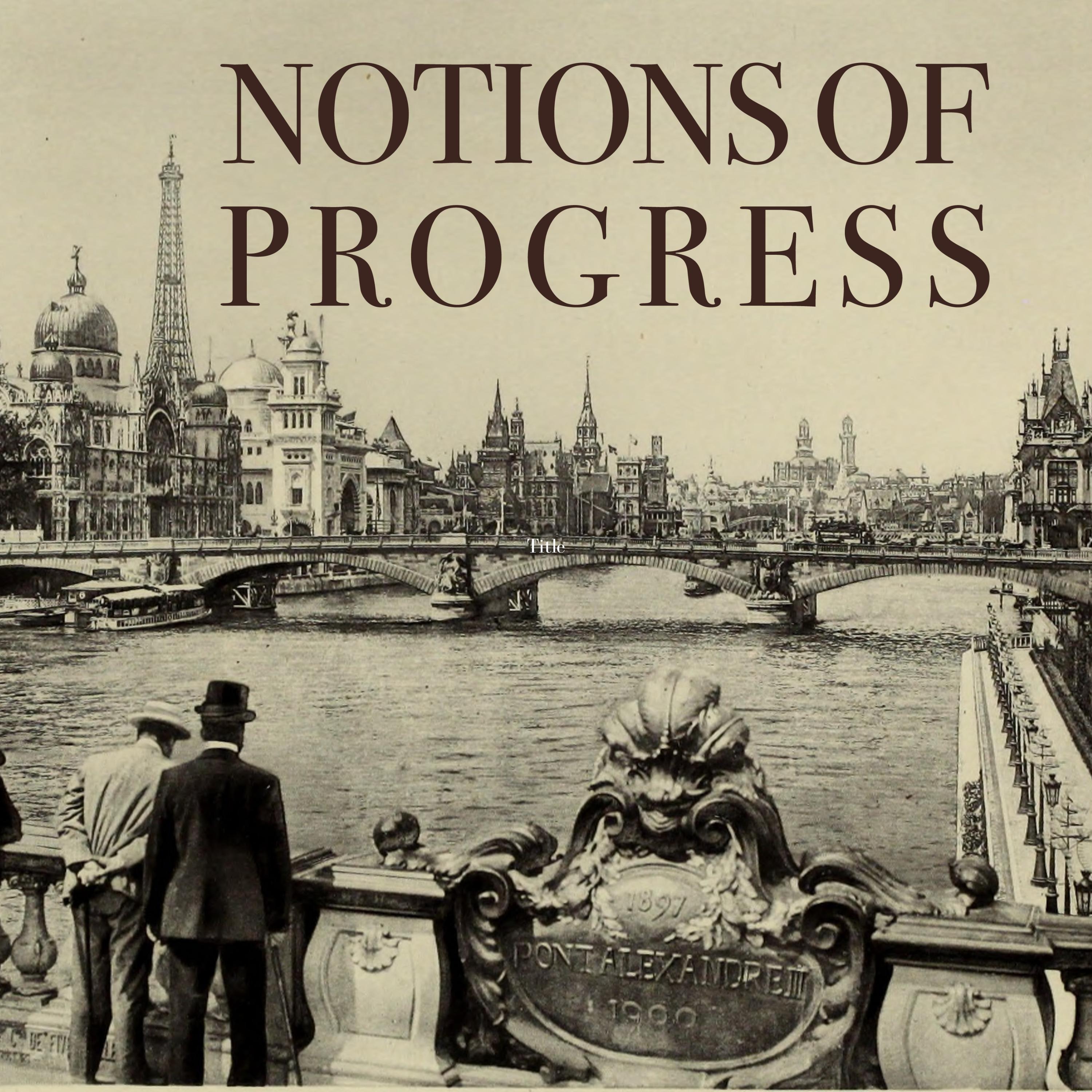
Five Faces of Progress: The Road to Anti-Progress |Prof. Tyson Retz Pt.2 | Ep. 4
Notions of ProgressShow Notes
About This Episode In this episode of Notions of Progress - Part Two, we continue exploring the fascinating evolution of progress thinking with Professor Tyson Retz, author of "Progress in the Scale of History" (Cambridge University Press, 2022). In this episode, Professor Retz discusses categories 3-5 of his framework: Relative Progress, Everybody’s Progress and Anti-Progress. He starts this opening by detailing the break from absolute progress to more current conceptions beginning in the 19th century with relative progress. It is during this period that a consciousness arises regarding the unequal costs and benefits that come with progress. This new consciousness extends to re-imagining the relationship between history and progress. These notions challenged previous frameworks that envisioned a progression of stages from “primitive” to more “evolved” civilizations along various paths. In yet another departure, Professor Retz takes us into the 20th century in detailing the rise of neo-liberal ideas around progress and the rejection of deterministic frameworks (e.g. historicism) that prescribe a fixed path for history to follow. It is here that he identifies critical totalitarian impulses that seek to control the course of history armed with the knowledge of these pre-determined forces. Lastly, Professor Retz arrives at the modern era whereby he outlines the turn in historical theories that view humankind within a much larger scale that encompasses a timeline leading back to the big bang and the inclusion of natural histories. He ends this interview on an optimistic note by highlighting the spirit beyond the enlightenment conception of progress in seeking to inspire collective action to make the world a better place.
Five Categories of Progress: Periodizations from Antiquity to the Present No Progress - Why the ancients couldn't conceive of progress as we understand it. "Societies far and wide in the ancient world believed that time destroyed things rather than improved them." (Retz, 2022, p. 13) Absolute Progress - Universal history, stadial theory (civilizations move through stages), and the emergence of progress as a "collective singular" blending scientific, moral, and human advancement. (Retz, 2022, p. 16) Relative Progress - Progress as unevenly distributed and context-dependent. "Progress for some mean[s] decline for others." (Retz, 2022, p. 6) Everybody's Progress - The tension between collective state imposition of historical direction versus spontaneous market order (e.g. Neoliberalism, the rejection of historicism). "Economic growth became the dominant historical narrative in the twentieth century." (Retz, 2022, p. 45) Anti-Progress (Contemporary) - Contemporary rejection or skepticism toward progress narratives, driven by environmental crisis, a focus on the impact of humans across geological times,deep and big history (an expansive historical view extending well beyond the emergence of human existence and encompassing a wide range of areas of exploration). (Retz, 2022, pp. 7-16, from the Introduction)
Major Themes We discuss relative progress as recognizing that advancement for some often meant decline for others, Japan's pragmatic modernization inspiring marginalized communities worldwide, movements attempting to separate progress from fixed historical paths (China's iconoclasm destroying the past to create new futures, India blending indigenous traditions with Western ideas), everybody's progress as the postwar project to measure and export development globally through neoliberal frameworks, Hayek's rejection of "historicism" and his claim that "guided progress would not be progress," the paradox that free markets require regulation to stay deregulated, how states use statistics to construct narratives of progress, the expansion of historical thinking (big history, deep history, Anthropocene) that reduces focus on human action, anti-progress as recognition that we may have progressed toward undesirable outcom
More from Notions of Progress
In this third and final part of the conversation, Marxist economist Michael Roberts brings the argument of his 2016 book The Long Depression into the present. He begins with the view that the system works as long as decisions are good, which he finds unconvincing: a system that produces for profit, he argues, delivers both vitality and grotesque inequality, and cannot continue as it is. He describes a generation now worse off than its parents and presents the postwar golden age as the exception, a period when profitability was high enough for capitalism to make concessions. Turning to the current cycle, Roberts considers whether the long depression that followed 2008 may be ending, whether AI could lift profitability for a time, and why he expects the law of profitability to reassert itself, possibly in the 2030s or later. He answers economist Robert J. Gordon on stagnation and Thomas Piketty on taxing billionaires, and closes on three futures: a renewed expansion, a longer stagnation, or, if working people do not change the system, fascist and military regimes and what he calls barbarism, drawing on the fall of Rome. About Our Guest Michael Roberts worked in the City of London as an economist for more than thirty years before retiring. He is the author of The Great Recession: A Marxist View (2009) and The Long Depression (2016), the book at the center of this conversation; joint editor of The World in Crisis (2018); author of Marx 200: His Economics (2018) and Engels 200: His Economics (2020); and, with Guglielmo Carchedi, Capitalism in the 21st Century (2023). His next book, Time Is Running Out: The World Economy in the 2020s, is expected in December 2026. He writes regularly at thenextrecession.wordpress.com. Show Notes & Timestamps 00:00 Capitalism Fails People 01:17 Welcome and Recap 01:37 Financialization and Crisis Myths 03:02 How Capitalism Works 04:06 A Generation Worse Off 06:12 Golden Age Was Exception 08:19 Inflation and Profitability Shift 10:19 Another Expansion or New Slump 12:49 Who Benefits From Profits 13:49 Working Class Alternative 16:04 Reaction and Fascism Risk 17:01 Three Future Scenarios 21:06 Rome and Barbarism Warning 23:34 Closing Thanks and Wrap
In this second of a three-part conversation, Marxist economist Michael Roberts takes the central claim from Part One — that the 2008 crash opened a long depression — back to the two historical cases on which his 2016 book The Long Depression rests. He begins with the 1870s, answering the Austrian-school argument that no depression took place and a rival monetary explanation tied to the gold standard; his reply draws on the data for Britain, the hegemonic economy of the period. He then sets out the mechanism he takes from the third volume of Marx’s Capital: capitalists invest only when it is profitable, and competition drives them to invest ever more in machinery relative to labor, which Roberts argues pulls the rate of profit down over time, held back for a while by counteracting tendencies. The same pattern, on his account, ran beneath the stock-market boom of the late 1920s and the slump of the 1930s. The episode closes on the rival crisis theories Roberts contests — policy error, unregulated finance, underconsumption, and overproduction — and on his case for profitability as the driver of booms and slumps alike. About Our GuestMichael Roberts worked in the City of London as an economist for over 30 years before retiring. He is the author of several books: The Great Recession: A Marxist View (2009); The Long Depression (2016), the book at the center of this conversation; World in Crisis (joint editor, 2018); Marx 200: His Economics (2018); and Engels 200: His Economics (2020). With Guglielmo Carchedi, he co-authored Capitalism in the 21st Century (2023). His new book, Time Is Running Out: The World Economy in the 2020s and Beyond, is forthcoming in December 2026. He writes regularly at thenextrecession.wordpress.com. Show Notes & Timestamps00:00 Profit Drives Capitalism 01:41 Setting Up Three Crises 02:38 1873 Depression Debates 05:22 Profitability Causes Slumps 07:22 Marx’s Law Explained 09:56 Organic Composition Basics 13:13 Counteracting Tendencies 15:07 Profit Waves Through History 18:32 From 1929 to War Economy 23:58 Competing Crisis Theories 28:06 Why Profit Matters Most
In this first of a three-part conversation, Marxist economist Michael Roberts joins Notions of Progress to lay out the central argument of his 2016 book The Long Depression: that the 2008 financial crash was not an ordinary recession, but the opening of a longer structural depression driven by capitalism’s own tendency toward falling profitability. Before getting there, Roberts traces his own path — from a Marxist conversion as a student to a three-decade career as an economist inside the City of London, a combination he treats as complementary rather than contradictory. He then lays out a materialist conception of history underlying his economics: social change driven by who owns and controls production, not by ideas or political leadership taken on their own. Capitalism, on his account, is real progress — rising productivity, rising living standards — and, at the same time, structurally exploitative and radically unequal. The episode closes on the specific technical definition of a “depression” that Parts Two and Three will test against the historical record: not simply a downturn, but one whose recovery never returns to the prior trend line. About Our GuestMichael Roberts worked in the City of London as an economist for over 30 years before retiring. He is the author of several books: The Great Recession: A Marxist View (2009); The Long Depression (2016), the book at the center of this conversation; World in Crisis (joint editor, 2018); Marx 200: His Economics (2018); and Engels 200: His Economics (2020). With Guglielmo Carchedi, he co-authored Capitalism in the 21st Century (2023). His new book, Time Is Running Out: The World Economy in the 2020s and Beyond, is forthcoming in December 2026. He writes regularly at thenextrecession.wordpress.com. Show Notes & Timestamps00:00 Cold Open: The Contradictions of Capital 01:03 Welcome & Introduction 03:38 Michael’s Background 08:38 A Marxist in the City of London 11:03 The Nature of Capitalism 16:25 Inequality & Systemic Change 20:35 The Long Depression Thesis 28:31 Next Time: Historical Parallels
This episode closes out a three-part conversation with Gavin Mueller (University of Amsterdam), author of Breaking Things at Work. In Part 2, Mueller traced Marx's own ambivalence toward machinery through the split between orthodox and heterodox Marxism, Frederick Taylor's theory of workplace control, the Technocracy Movement, and Norbert Wiener's early warnings to organized labor about automation. In this final part, Mueller brings that history into the present. The conversation moves from Shoshana Zuboff's early sociological research inside computerized factories to her later, better-known work on surveillance capitalism, and from there into Mueller's own reading of artificial intelligence: the argument that AI systems depend on training data gathered without most people's consent, the concept of cognitive offloading, and the rapidly growing, cross-partisan resistance movement against AI data centers. Mueller closes with what he calls Luddism's real legacy — not a rejection of the future, but the insistence that a different one is still possible.
In Episode 17, Gavin Mueller (University of Amsterdam) traced the Luddites back to the guild economy of England's Midlands. In this second installment of a three-part conversation, Mueller follows that struggle into the twentieth century: Karl Marx's own ambivalence toward machinery, and the split between Karl Kautsky's “orthodox” Marxism — which treated capitalist technology as a scientifically inevitable path to socialism — and the workers' movements that resisted that framing directly on the shop floor. Mueller traces Frederick Winslow Taylor's “scientific management” as, above all, a theory of control rather than efficiency; the short-lived but influential Technocracy Movement's vision of automation as an unstoppable social force; and mathematician Norbert Wiener's cybernetics, including his largely unheeded 1949 letter warning UAW president Walter Reuther that automation posed a genuine threat to organized labor. The episode closes on how that warning intersected with civil rights-era debates about automation's disproportionate impact on Black workers. As with the whole series, the through-line is not a settled verdict on technology and progress, but the recurring argument over whether machines serve human ends or reshape them.