Summary
In a recent episode of the podcast "Cross Party Lines," the hosts discussed multiple significant political events and the passing of notable figures, including New Zealand actor Sam Neill. Neill, remembered for his acting prowess and commitment to environmentalism, died recently, prompting reflections on his legacy. The hosts also acknowledged the death of U.S. Senator Lindsey Graham, highlighting his complex political journey from critic of Donald Trump to staunch supporter.
The podcast also covered the recent visit of Indian Prime Minister Narendra Modi to New Zealand, the first by an Indian leader in decades, which included a major gathering of the Indian diaspora. While Modi's modernization efforts in India were praised, concerns were raised regarding his controversial past during the Gujarat riots, suggesting a careful balance of admiration and criticism of his leadership.
A significant discussion point was the perceived lag of New Zealand in forming formal alliances in the Pacific, especially in contrast to Australia's proactive foreign policy initiatives, including a recent security alliance with Fiji. The hosts expressed concern that New Zealand's responses appeared reactive rather than proactive, potentially leaving the country strategically behind.
On domestic issues, the conversation shifted to New Zealand's infrastructure promises, particularly regarding the "Roads of National Significance" initiative. The hosts criticized the government for over-promising on costs and delivery timelines for various transport projects, calling for an independent budget office to ensure realistic budgeting in political campaigns. They shared anecdotes about local projects like Mill Road and expressed frustration over the gap between political promises and actual outcomes.
As the episode closed, the hosts reminded listeners about their upcoming live show featuring former Prime Minister Helen Clark and expressed gratitude to their foundation partner, Frank Risk Management. They encouraged audience engagement and discussion on these pressing political matters.
Show Notes
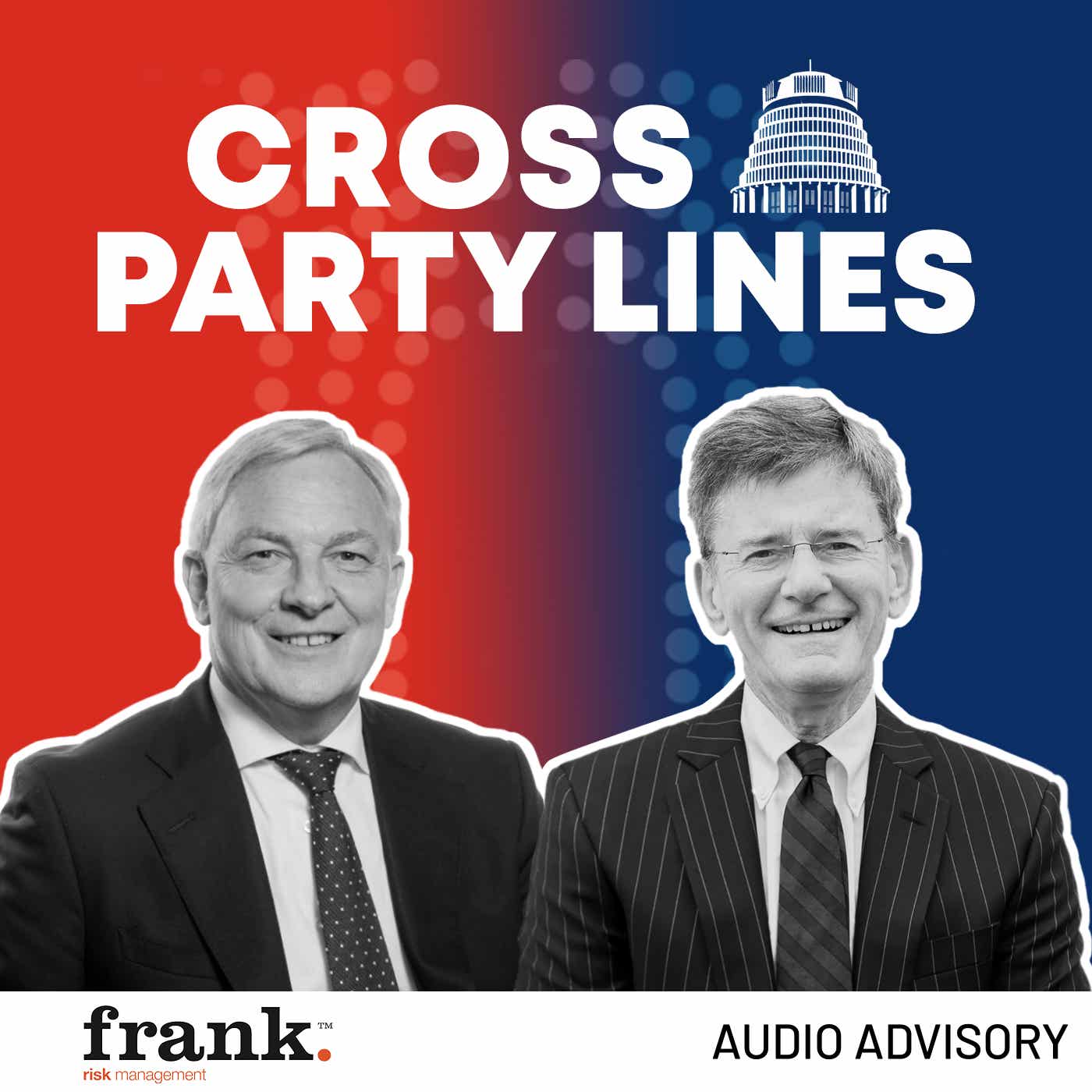
Hosted by Phil Goff and Chris Finlayson, Cross Party Lines opens with a tribute to Sam Neill — actor, environmentalist and proud New Zealander. Then it’s into a packed episode that moves from Modi’s visit to Pacific power plays, and closes with a verdict on the Roads of National Significance that is not kind. Thanks to our Foundational Partner, Frank Risk Management, the 100% Kiwi owned insurance brokerage. In this episode: * Modi in Auckland — a historic visit with an unresolved $35 billion question — Phil gives the visit its due — India is on track to become the world’s third largest economy, the FTA could do for New Zealand-India trade what the China agreement did after 2008, and Modi has genuinely modernised India and lifted millions out of poverty. And the $35 billion investment commitment — mentioned three times by Modi, described as a promise by Indian trade officials, and quietly reframed as an “aspiration” by Christopher Luxon — has the makings of the 21st century version of the Treaty of Waitangi. * The Pacific power vacuum — and how New Zealand got left flat-footed — Phil and Chris are in agreement: New Zealand has dropped the ball, Foreign Affairs has missed the moment, and Penny Wong has run rings around us diplomatically. The deeper story is the vacuum created by Trump cutting US aid by 95% and declaring climate change a hoax — the two issues Pacific Island nations care most about — while China fills the gap with construction projects and red carpet treatment for small-nation leaders. * Roads of National Significance — over promised, under costed and running out of road — The announcement that multiple Roads of National Significance have no start date, no finish date and no funding lands with a thud. Phil puts the blame squarely on Simeon Brown, who as transport spokesperson costed 17 roads at $24 billion in 2023 — a figure that has since more than doubled to $56 billion. Chris asks the question nobody has answered: why does everything cost so much in New Zealand, and why does analysis paralysis set in every time a project reaches the implementation stage?. Wide-ranging, this episode is a reminder that the decisions made in Beijing, Canberra and Washington about the Pacific are not abstract — they show up in aid cuts, missile tests and the vacuum that small nations fill however they can. Cross Party Lines exists to lift political literacy and create space for calm, good-faith political conversation. New episodes every Tuesday. If you value thoughtful debate, follow the podcast and share it with someone who might too. 🎟 Auckland live show at Q Theatre — Saturday 8 August with special guest Helen Clark. Nearly 70% sold. Get your tickets now at tapliveevents.com.
This is a public episode. If you would like to discuss this with other subscribers or get access to bonus episodes, visit crosspartylines.substack.com
More from Cross Party Lines
Hosted by Phil Goff and Chris Finlayson, Cross Party Lines returns with twelve days to go — early voting open, the rolls closed, and the campaign entering its most consequential stretch. This week: the threat to politicians’ personal safety, the Labour candidate stood down over the gang visit, a Future Generations Commissioner that Chris is openly evangelical about, and New Zealand First’s $71 billion in promises with no plan to pay for them. All thanks to our foundational partner, Frank Risk Management, the 100% Kiwi-owned insurance brokerage. In this episode: * The safety of politicians — and the democracy it protects — The episode opens on a subject both men clearly feel deeply: the attack on Australian independent MP Helen Haines, who lost both legs, is the most extreme example of a trend that Australian authorities say has seen serious death threats against politicians rise from 300 to over 1,000 a year. Speaker Brownlee is saying the same thing here. But what troubles both men most is not personal risk — it’s what the threat to accessibility does to democracy. The intimate, open character of New Zealand politics, where MPs run caravan stops and constituent clinics without security details, is one of its finest features. Lose that, and something irreplaceable goes with it. * The gang visit fallout, Kerrin Leoni and the one rule you must never break — Chris Hipkins announced the resignation of the Labour candidate for Tāmaki Makaurau after she was photographed at the Mongrel Mob pad and — more damagingly — gave inconsistent accounts of her involvement, including on a televised debate. Phil is unequivocal: Hipkins had no alternative. Chris applies the same historical verdict: John Key’s standing instruction to his cabinet was tell me everything, not a sanitised version, because he could only help you if he knew the full story. She didn’t. * The Parliamentary Budget Office, a Future Generations Commissioner and $71 billion of moonbeams — The most substantive policy discussion of the episode. The Greens have costed New Zealand First’s promises at $71 billion — and that’s before Ron Mark’s pledge to take defence to 3% of GDP. There is still no New Zealand First fiscal plan. On the Parliamentary Budget Office, both men have been calling for it all season and are genuinely heartened: Labour, the Greens and TOP have all endorsed it, National softly, and the Greens’ costing of New Zealand First’s promises is the best possible advertisement for why it matters. On TOP’s Future Generations Commissioner, Chris calls it a brilliant, practical mechanism for breaking the five-minute political horizon — especially on AI, infrastructure and climate. Phil is cautiously supportive but wants evidence it won’t become another parking lot for hard problems. Along the way: three hundred thousand eligible voters who never enrolled and Luxon saying he’s comfortable with that and a promise that next week’s episode will cover the US midterm predictions, the key electoral battlegrounds, and — depending on timing — possibly an election night special. Cross Party Lines exists to lift political literacy and create space for calm, good-faith political conversation. New episodes every Tuesday. If you value thoughtful debate, follow the podcast and share it with someone who might too. 📋 Early voting is open now. Election day is 7 November. Make sure everyone you know has voted.
Hosted by Phil Goff and Chris Finlayson, Cross Party Lines reaches its 50th episode — just over a year in, and with an audience that has grown beyond either man expected. They mark the occasion the way they mark everything: with a tribute, a historical detour, and absolutely no let-up on the campaign. Three weeks out from election day, there’s too much to get through. Thanks to Frank Risk Management, the 100% Kiwi owned Insurance Brokerage. In this episode: * Gang pads, political missteps and the skeleton in everyone’s closet — The Greens and Te Pāti Māori’s visit to a Mongrel Mob pad — photographed against gang patches — draws Phil’s bluntest assessment of the campaign: stupid, naive, and politically self-destructive in precisely the seats the Greens need to hold. But Phil won’t leave the history untouched. Muldoon funded millions into gang work schemes. Chris’s concern is different but equally sharp: in a campaign where repetition and message discipline are everything, going off-script to cozy up to organised crime in the final weeks is an act of self-indulgence that could cost the Greens two or three points — and potentially their Wellington North seat. * Peters unilateral at the UN, the right to silence and a missing fiscal plan — New Zealand voted against a World Health Organization resolution on pandemic preparedness — alongside the United States, Israel and one other country, against 154 nations. Phil is unambiguous: this was Peters playing to his anti-vax base using New Zealand’s international reputation as a chip. Chris reports that National ministers wanted to vote for the resolution. Both ask the same question: did it go to cabinet? If so, Luxon owns it. If not, the coalition is more out of control than anyone has acknowledged. * Māori seats, the TOP threshold and the defining moment that hasn’t happened yet — Phil gives his most detailed read of the Māori electorates: Labour likely to pick up three seats, Ikaroa-Rāwhiti safe with Cushla Tangaere-Manuel, Te Tai Tonga a genuine contest, Te Tai Tokerau close but leaning Labour’s way. Chris keeps a close eye on Te Tai Hauauru — formerly Tariana’s stronghold, now genuinely split — and notes Willie Jackson’s bold declaration at Adrian Rurawhe’s tangihanga that it was now Labour’s marae earned him a look that suggested otherwise. Then there’s the defining moment question: could the gang visit be this campaign’s Metiria Turei? Could there be a Peter Dunne common-sense moment that shifts 15% of undecideds overnight? Both men think the race is not yet settled, and Gerald Ford’s Poland moment — and Biden’s 2024 implosion — are offered as reminders of how fast things can move. Along the way: the 50th episode milestone and why people keep stopping Chris at airports to say they appreciate civilised disagreement; Marilyn Waring ringing to correct the OIA history and give proper credit to Mike Minogue; a tribute to Geoff Thompson, former member for Horowhenua, who passed away this week. Cross Party Lines exists to lift political literacy and create space for calm, good-faith political conversation. New episodes every Tuesday. If you value thoughtful debate, follow the podcast and share it with someone who might too. 📋 Election day is 7 November. Make sure you’re enrolled — and make sure everyone you know is too.
Hosted by Phil Goff and Chris Finlayson, Cross Party Lines battles on with Phil broadcasting through a lurgy picked up on the flight home from Australia — it’s an episode that moves from the campaign’s most mean-spirited policies to OIA reform, a hilariously hapless New Zealand First list, and the American midterms closing in on the Republicans like a freight train. All thanks to Frank Risk Management, the 100% Kiwi-Owned Insurance Brokerage. Find out more at frankrisk.co.nz. In this episode: * Foreign aid cuts, drug testing and the return of compassionate conservatism — in theory — National and ACT’s decision to slash overseas aid draws Phil’s sharpest moral language of the season: we spend 0.24% of GDP on foreign aid, the international goal is 0.7%, and the cuts will fall on humanitarian crisis relief — Gaza, Ukraine, the World Food Programme, UNHCR. Chris is equally unimpressed — and notes the whole exercise is likely to be reversed anyway, given Peters has already come out against it. On drug testing for beneficiaries, both men defer to Jonathan Coleman who wrote a lengthy Herald piece calling the policy wrong, unprincipled and ineffective. * Air New Zealand, OIA reform and the right of the citizen to know — Chris’s flight from Gisborne was cancelled, supposedly due to weather — suffice to say he wanted to know more about Labour’s consumer policy package, which mandates automatic refunds for cancelled or significantly delayed flights, levels the playing field for smaller regional carriers, and takes aim at airport monopoly pricing. On OIA reform, Chris is in full historical mode: the Official Information Act was a complete philosophical switch from the Official Secrets Act — from withholding as default to availability as default, built on the work of Ken Keith, Alan Danks and Jim McLay. What is happening now, across multiple governments but accelerating under this one, is a quiet reversal of that principle. * New Zealand First’s list, the midterms and Trump renames the ocean — Chris turns to the New Zealand First list and cannot contain himself: Ron Mark at number 16, behind Hārete Hipango and Alfred Ngaro. He applies the Hanoverian principle — anyone who looks like a potential successor gets marked down — and notes Peters describing the list as representing rejuvenation after 50 years of his own continuous political presence. Stuart Nash and Shane Jones are in there. Michael Laws features, and Chris declines to comment further on defamation grounds. On the American midterms, both men identify their must-watch races: South Carolina — a seat Democrats haven’t held since the 1990s, now within a point or two — and Kansas, which hasn’t returned a Democratic senator since 1938, and is now genuinely in play. If both flip, Democrats could reach 55 or 56 Senate seats. Along the way: Phil’s voice threatening to become a high-pitched squeal when Trump comes up; Chris being recognised at Gisborne Airport and told he looks better in person than on screen; a man on the airport bus praising Phil’s tenure as Foreign Affairs Minister; and the promise of a full American election deep-dive next week, Cross Party Lines exists to lift political literacy and create space for calm, good-faith political conversation. New episodes every Tuesday. If you value thoughtful debate, follow the podcast and share it with someone who might too. 📋 Election day is 7 November. Make sure you’re enrolled.
Hosted by Phil Goff and Chris Finlayson, Cross Party Lines opens with a tribute to former Speaker Adrian Rurawhe — a man of great humility, dignity and genuine cross-party respect — before turning to the final sprint of the election campaign: empty promises from every direction, billionaires gaming the electoral system, the minor parties’ kingmaker debate, and a Burnham bounce that might finally put Brexit on trial. All thanks to Frank Risk Management, the 100% Kiwi Owned Insurance Brokerage. In this episode: * The campaign’s hollow promises and the policies that actually matter — Chris reaches for Horace — the mountain labours and a ridiculous mouse is born — as his summary of the policy avalanche hitting voters in the final week. The BNZ nationalisation is a barefaced lie that will never happen. The Greens’ $2 train fare is potty. ACT’s Paris Agreement withdrawal would torpedo both the EU and UK free trade agreements and is equally dishonest — as Laura Clark, former British High Commissioner and now a climate advocate, pointed out bluntly on RNZ, New Zealand is already facing a complaint from a Dutch environmental group over its weakening of climate commitments. * Billionaires gaming the system and the Kingmaker debate’s tired chestnuts — The Mowbray family — New Zealand’s wealthiest — and Don Brash are publicly urging voters to give electorate votes to National but party votes to ACT, engineering a potential overhang that Phil connects directly to the German experience: the Germans had an identical MMP system, the same tactic was tried, and they were forced to change the law. Both Phil and Chris are unambiguous — this rots the system, undermines electoral credibility, and should be condemned. * Burnham’s Brexit courage and Farage on the ropes — Andy Burnham has said what no Labour leader has dared to since 2016: Brexit was born in a lie, largely propagated by Boris Johnson, it has not increased wealth, it has devastated it, and it is time for a new arrangement with Europe. Chris is delighted. Phil notes the Burnham bounce is real — Labour up to 30% in some polls, reform down to 23-25%, the Conservatives in the high teens — is exactly what real political leadership looks like, and what New Zealand has been missing. Cross Party Lines exists to lift political literacy and create space for calm, good-faith political conversation. New episodes every Tuesday. If you value thoughtful debate, follow the podcast and share it with someone who might too. 📋 Election day is 7 November. Make sure you’re enrolled and make sure everyone you know is too.
Hosted by Phil Goff and Chris Finlayson, Cross Party Lines returns to dissect party launches, Nicky Hager’s latest book, the US midterms and the Xi-Trump summit that produced two pandas and precisely nothing else. Proudly supported by our Foundational Partner Frank Risk Management - the 100% Kiwi owned insurance brokerage. In this episode: * Party launches: Labour’s energy versus National’s empty seats — Phil went to one launch and won’t make you guess which one. Audrey Young’s verdict — Labour had it all over National for sheer impact, with new policy, a new attitude and a better speech — saves Phil from being dismissed as a party hack, though he notes Hipkins’ language at the lectern raised eyebrows. Chris channels John Key’s campaign gospel: repeat, repeat, repeat, don’t deviate, don’t embellish. * Nicky Hager’s Dirty Works — useful journalism or a pop gun? — Phil delivers an even-handed assessment of Hager’s career: Hollow Men and Dirty Politics were game, set and match — documentary proof of collusion with the Exclusive Brethren and the weaponisation of the OIA and the SIS. Dirty Work, both agree, is not a smoking gun — but the documented links between the Taxpayers Union, tobacco industry funding, and the orchestrated amplification of anti-Māori sentiment are not nothing, and Chris expresses a fervent hope that Hager’s next book is about New Zealand First. * US midterms: Kansas wobbling, Texas flipping and Trump’s Faustian reckoning — Chris has been doing his homework and the picture is striking. Kansas — reliably Republican for a century — is in play. Texas, which Trump won by 13.6 points, has the Democrat ahead. Iowa farmers, hammered by tariffs and diesel costs, are reconsidering. Phil lays out the arithmetic: Democrats need four Senate seats to take the chamber; the House is almost certainly gone; and if both flip, Trump faces impeachment proceedings in his final two years while the courts continue finding his executive orders unconstitutional. Chris’s verdict on the moral of the story: if you make a Faustian deal with someone like Trump, 2026 is the year you’re held to account. Cross Party Lines exists to lift political literacy and create space for calm, good-faith political conversation. New episodes every Tuesday. If you value thoughtful debate, follow the podcast and share it with someone who might too. 📋 Election day is 7 November. Make sure you’re on the roll.