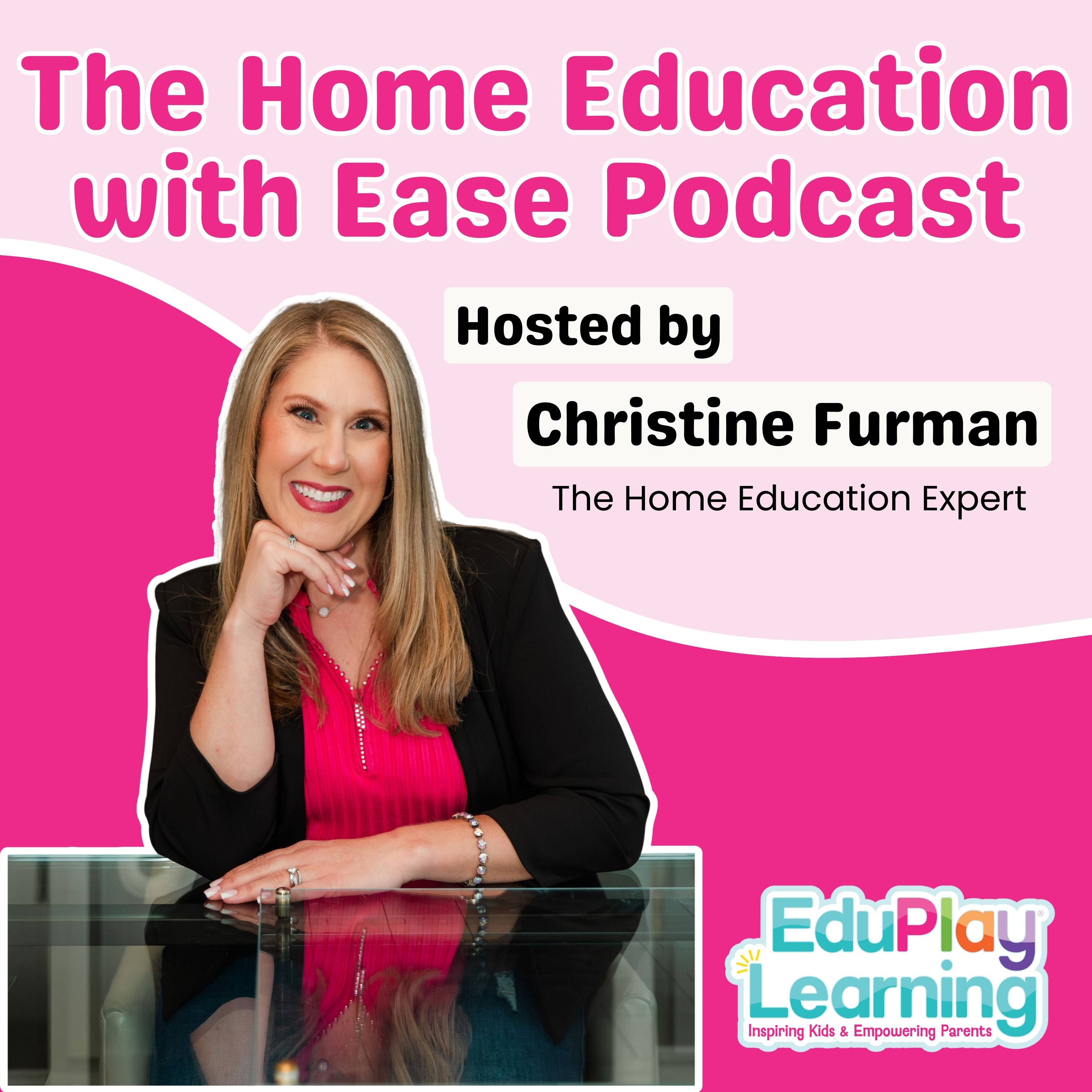
Food Dyes: What They Really Are, How They Affect Our Kids, and Simple Dye-Free Swaps Ep. 111
The Home Education with Ease PodcastShow Notes
In this episode, Christine Furman—your home education expert—dives into a timely topic as Valentine’s Day brings a wave of brightly colored treats: food dyes. Christine shares why her family chooses a mostly dye-free home, how she approaches the topic with a judgment-free, education-first mindset, and why this conversation matters for kids’ learning, behavior, sleep, and overall regulation. You’ll hear a real-life story from church treats that sparked a family conversation, plus a helpful reminder: even dye-free treats are still treats—because sugar and ultra-processed ingredients can impact kids too. Christine breaks down what food dyes actually are (synthetic chemicals made from petroleum/oil/coal tar), why they’re used (marketing and appearance—not nutrition), and how they can affect the body through detox pathways, the gut-brain connection, and neurotransmitters. She closes with encouragement to start small, observe your child’s patterns, and focus on building calm, healthy foundations that support more peaceful learning rhythms at home—without fear or perfection. Join the Conversation: Head over to the Home Education with Ease Facebook Group and answer this week’s questions: Have you ever noticed behavior, focus, sleep, or meltdown changes after certain foods or treats? What did you notice?
Share your answers with the community, ask questions, or DM Christine! Takeaways: Food dyes are synthetic chemicals made from petroleum/oil/coal tar, added for appearance—not health. Kids’ developing systems may have a harder time processing these ingredients, which can contribute to focus issues, meltdowns, hyperactivity, and sleep disruption. Even when you choose dye-free options, sugar and ultra-processed treats still affect the body—dye-free doesn’t mean “unlimited.” This is about education and awareness, not fear or perfection—families can make informed choices without judging each other. Watch for dye exposure beyond food: medications/vitamins, toothpaste, soaps, and other products can contain dyes too. A simple 1-week observation (or food diary) can help you notice patterns: sleep, food, movement, and behavior are all connected. Small shifts add up—and calmer bodies can lead to more peaceful learning rhythms at home.
Quotes: “This is about giving education and knowledge… this stuff was not taught in schools.” “It’s still sugar… regardless, food coloring or not, sugar is still going to cause these problems… but the food coloring adds another layer.” “It’s a synthetic chemical. It’s made from petroleum, oil, or coal tar. Guys, that should never go into our body.” “It has no nutritional value at all, only to make it look prettier. So it’s all marketing, it’s all to sell something.”
Resources & Links: Mentioned Products & Dye-Free Swap Ideas (from the episode): YumEarth (lollipops, gummy hearts) Blue Stripes (cacao fruit products; gummies; granola mentioned) Mott’s Fruit Snacks (dye-free option mentioned) Supernatural (dye-free sprinkles) Bettergoods (Walmart brand dye-free sprinkles mentioned) Trader Joe’s sprinkles (all-occasion sprinkles mentioned) Dandies marshmallows (dye-free option mentioned) Enjoy Life chocolate (allergy-friendly chocolate chips/baking) That’s It bars (fruit-only snack bars) Boulder Canyon avocado oil tortilla chips (Dorito-style alternatives mentioned) Watkins food coloring (no artificial dyes mentioned) Stores mentioned for shopping: Costco, Sprouts
🌟 Connect with like-minded families, build community and access resources in the Home Education with Ease Facebook Group 💞 Book a 1:1 call with Christine for personalized support and simple family swaps Connect with Christine: Email: [email protected] Facebook: Home Education with Ease Facebook Group Instagram: @thehomeeducationexpert | @eduplaylearning YouTube: EduPlay Learning YouTube Complete the EduPlay Learning Questionnaire to share your educational goals, so Christine can guide you with a plan that best fits your families needs. 🎧 Lo
More from The Home Education with Ease Podcast
How much technology is too much for our kids? And how can we help them develop healthy habits in a world where screens are everywhere? This week on the Home Education with Ease Podcast, I'm joined by children's author and mom of four, Rebecca Shinsky, for a conversation that I think every parent needs to hear! Rebecca is the author of Techie Tess Takes a Rest and Bucktooth Becky and Her Silly Headed Siblings. Her mission is to help children develop confidence, self-worth, and healthy habits through meaningful stories. We talked about the growing role technology plays in our children's lives, how screen time can affect family routines, and why it's so important to begin conversations about healthy technology habits while our children are young. I even shared a personal experience with my own kids when I noticed how differently our morning went after allowing them to start the day watching television. Rebecca shared how her family approaches delaying smartphones, setting social media boundaries, and creating opportunities for technology-free family time. We also discussed something I think is SO important: Our kids are watching us! If we're constantly checking our phones, responding to notifications, or scrolling through social media, what are we teaching our children about technology? But this conversation isn't about eliminating technology altogether. It's about helping our children understand that technology is a TOOL, not something that needs to consume their time, attention, or relationships. From simple screen-free activities and family game nights to teaching digital citizenship and advocating for changes in schools, we shared practical ways families can be more intentional. Whether your children are toddlers, elementary-aged, or teenagers, I hope this conversation encourages you to look at your family's technology habits and consider how you can create more opportunities for meaningful learning and connection. Join the Conversation: Head over to the Home Education with Ease Facebook Group and answer this week's question: At what age do you think children should have their own smartphone?
What if some of the things we consider essential to early education aren't actually what our children need most? What if more play, more movement, more time outdoors, and less academic pressure could make a meaningful difference in how our children learn and grow? This week on the Home Education with Ease Podcast, I'm joined by Jana, a mom of two, military spouse, and business owner who was born in the Czech Republic, grew up in Germany, and is now raising her children in the United States. We had such an interesting conversation about the differences between education in Germany and the United States, and I found myself thinking about how much pressure we sometimes place on our kids to meet certain milestones at certain ages. Jana shared her experiences growing up in Germany, where her early childhood education emphasized play, outdoor exploration, creativity, and storytelling before formal academics began. We talked about shorter school days, learning to read, the importance of movement, and why we need to recognize that every child develops and learns differently. But our conversation went beyond education. We also discussed the challenges of motherhood, maternity leave, finding community, screen time, sleep, attention and focus, and Jana's personal experience advocating for her son after his ADHD diagnosis and discovering concerns about his airway and sleep. One of the biggest reminders from this conversation? Our children are individuals. And instead of focusing only on what they should be doing at a certain age, we need to understand what they actually need to thrive. Whether your children attend traditional school, homeschool, or are just beginning their educational journey, I hope this conversation encourages you to ask questions, embrace meaningful learning experiences, and continue advocating for your children. Join the Conversation: Head over to the Home Education with Ease Facebook Group and answer this week's question: Do you feel like there's more pressure on young kids academically today than when we were growing up?
Have you ever caught yourself saying: “I don't have enough time.” “We're too busy.” “I don't have what I need.” “I should be doing more.” I have, and recently, I started realizing just how often those words were coming out of my mouth. After last week's conversation about shifting our mindset around money, I started thinking about abundance in a completely different way. Maybe I don't have a scarcity mindset around money…but I realized I was carrying one around time. And our kids are listening. In Episode 145 of the Home Education with Ease Podcast, I'm sharing what God has been teaching me about time, resources, generosity, and stewardship. And how I'm intentionally changing the words I use around my kids. We don't need unlimited time, money, curriculum, activities, or resources to give our children a meaningful education or create a meaningful life. Sometimes we need to stop searching for the next thing and recognize what God has already placed in our hands. We'll talk about how to reframe scarcity language, why our children are learning from the way we talk about time and resources, how to become better stewards of what we've already been given, and why one simple resource, like a book, can create countless meaningful learning opportunities. I'm also challenging you this week to notice the words don't, can't, won't, shouldn't, and don't have enough. When you hear yourself saying them, pause. What could you say instead? Maybe you have more than enough to take the next step. Join the Conversation: Head over to the Home Education with Ease Facebook Group and answer this week's question: How often do you catch yourself saying, “I don't have enough time” or “We're too busy”?
What did you hear about money growing up? “Money doesn't grow on trees.” “We can't afford that.” “That's too expensive.” For many of us, the way we think and talk about money didn't start when we became adults. It began years ago with the words, experiences, and financial habits we witnessed as children. But we don't have to automatically carry all of those same patterns into the next generation. In this week's episode, Christine sits down in person with her dear friend, financial strategist, entrepreneur, mom of seven, and four-time bestselling author Marta Sauret Greca for an open conversation about money, scarcity, abundance, stewardship, generosity, and the financial lessons we're passing on to our kids. Marta vulnerably shares her own journey, from experiencing rapid business growth and financial abundance to realizing that having more money didn't automatically mean she was stewarding it well. She shares some of the financial mistakes she's made, what she's learned from them, and how she's rebuilding with greater intention. Christine and Marta also talk about the importance of looking at what we already have, paying attention to where our money is going, being willing to pause before a purchase, and making financial decisions based on our family's priorities rather than fear or comparison. Christine shares how she teaches children about money using a simple three-jar system for saving, spending, and giving, and the conversation explores how parents can begin shifting the language they use around money. Instead of immediately saying: “We can't afford that.” What if we paused and said: “Let's look at our budget.” “Maybe that's not something we're choosing to spend our money on this month.” Or: “That's not in our budget right now. How could we save for it?” This isn't about pretending that financial limitations don't exist. It's about helping our children understand that money is a resource, choices have to be made, and we can learn to be thoughtful about what we earn, save, spend, give, and invest. The conversation also dives into faith, gratitude, generosity, entrepreneurship, family priorities, and Marta's newest collaborative book, Completely Wealthy, releasing October 1. Most importantly, Christine and Marta remind us that our past financial experiences don't have to determine our family's future. We get to decide what lessons we want to carry forward, and which patterns we're ready to change. Join the Conversation: Head over to the Home Education with Ease Facebook Group and answer this week's question: Have you ever caught yourself saying, “We can't afford that”? What could you say instead?
Does your child suddenly need a snack, a drink, a bathroom break, or anything else they can think of, the minute it's time to learn? 😂 You're not alone. Whether you're homeschooling, helping with homework after school, or introducing activities to a toddler, keeping kids focused can sometimes feel like a battle. But what if the answer isn't asking them to sit still longer? In this episode, Christine shares practical strategies she's used with her own children, in the classroom, and with the students and families she works with today to make learning more engaging, meaningful, and individualized. You'll learn how to break longer lessons into manageable chunks, incorporate quick movement breaks, use “first, then” language, give children choices, build lessons around their interests, change the learning environment, and turn academic skills into games and real-life experiences. Christine also talks about something that's sometimes harder for us as parents and educators: recognizing when it's time to stop. Pushing through frustration doesn't always result in more learning. Sometimes our kids need us to recognize the signs of mental fatigue, help them experience one more small success, take a break, and return to the skill with a fresh brain. Most importantly, remember that every child is different. What worked beautifully for one child may not work for another, and that's okay. Instead of asking, “Why won't my child focus?” this episode encourages us to get curious and ask: “What does my child need in order to learn this well?” Sometimes one small change can make a really big difference. Join the Conversation: Head over to the Home Education with Ease Facebook Group and answer this week's questions: What usually distracts your child most when it's time to learn?