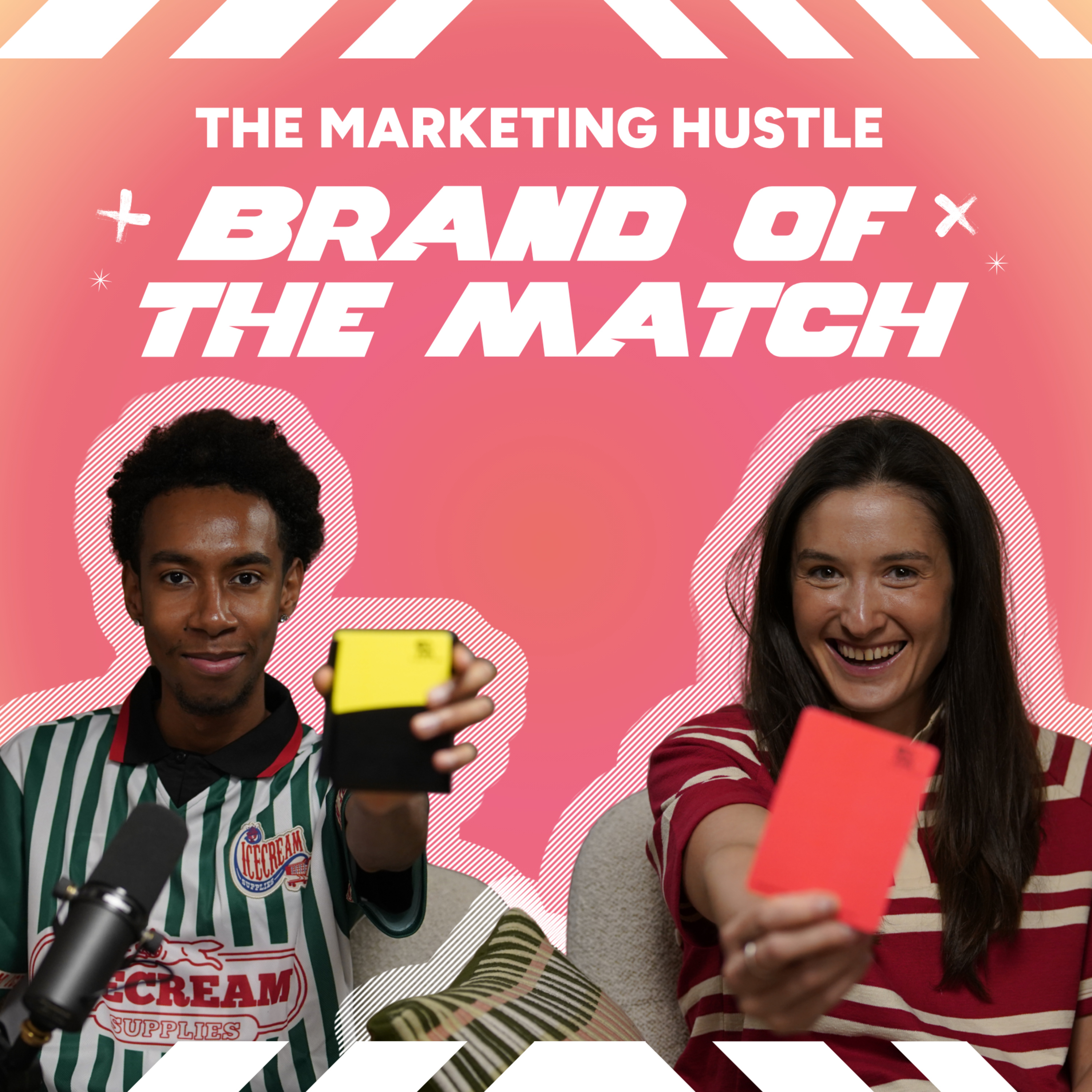
Rhode's Pimple Patches, Pip & Nut's Squirrel and Canva's Giant Billboard...Who is Champion of Out of Home?
The Marketing Hustle: Brand of the MatchShow Notes
The Marketing Hustle, Brand of the Match. Champion of OOH. Brand marketers have always argued about the best campaigns down the pub. Now Lottie Unwin and co-host Joel Bjarni Marlinarson are doing it properly, with red cards, yellow cards and a full-time whistle. Out of home covers billboards, installations and anything you see out and about. But in the age of social, OOH is now curated to travel well beyond its physical location. In the second episode of Brand of the Match, Lottie and Joel put out of home under the microscope. It's a channel as old as advertising itself, from Surreal's LinkedIn-native billboard mockups and Canva's genuine "make the logo bigger" takeover of Waterloo station, to TfL and Heineken Zero's confusing Bakerloo Line rebrand, to Rhode's headline-grabbing pimple patches at Coachella. Along the way they cover Pip & Nut's decade of the same squirrel, Lime Bike's reactive dig at London's tube strikes, Turo's shot at stealing Zipcar's audience, and Nike's provocative takeover of the London Marathon. By full time, there's only one winner. Do you agree with the result? Tell us in the comments. This episode is brought to you by Stickybeak, rapid consumer research built for FMCG marketers. Test packaging, concepts and campaigns with real people in under 48 hours. Find out more at stickybeak.co. Follow Brand of the Match: Joel Bjarni Marlinarson: Instagram & TikTok @coldestjoel, LinkedIn Joel Bjarni MarlinarsonLottie Unwin: Instagram @lottieunwinmarketing, TikTok @lottieupworld, LinkedIn Lottie Unwin Please subscribe wherever you're listening, it makes a huge difference to the show. Timestamps:00:00 - Coming up on Brand of the Match00:47 - Countdown into round two00:53 - Kick-off: Champion of Out of Home01:15 - Out of home as old as advertising itself02:31 - Joel's spectrum: from LinkedIn mockups to full-spend campaigns03:25 - Surreal's copywriting-led fake billboards04:05 - Canva's real Waterloo station takeover05:38 - TfL x Heineken Zero's Baloo line rebrand07:24 - Rhode x Coachella's pimple patch stickers10:34 - Half time: word from Stickybeak11:45 - Second half kicks off11:55 - Pip & Nut's squirrel and the case for consistency14:11 - Lime Bike's reactive tube strike ads15:11 - Turo's dig at the collapsing Zipcar18:03 - Nike's London Marathon takeover23:01 - Final whistle for this round23:17 - Pip & Nut crowned Brand of the Match23:54 - Looking ahead: the future of out of home26:45 - Outro and how to follow the show
More from The Marketing Hustle: Brand of the Match
"A personal brand is not you posting cocktails on holiday." That's the opening jab in round five of Brand of the Match.
Virality is reach beyond the people who already follow you, whether that's a video hitting a million views or an idea landing at the school gates.
Brand of the Match is back for round three, and this one's a scrap. Lottie Unwin and Joel Bjarni Marlinarson take on social campaigns: the channel everyone thinks they understand and almost nobody gets right. A social campaign isn't a TV ad reposted on Instagram. It's built for social, from the ground up, with social as the destination. This week Lottie and Joel go head to head on Apple's unhinged new TikTok tone for the MacBook Neo launch, Hair Syrup's Dragon's Den underdog story turned comment-section cult following, Sult's founder-led rise on the back of co-founder Millie Goldsmith's own audience, All Things Butter and Bold Bean's recipe feeds that have become destinations in their own right, QuickBooks Studios' surprisingly brilliant YouTube series for creators, Duolingo's retreat from the unhinged tone it invented, Blank Street, Gap, OpenAI and more! Only one brand walks away crowned Brand of the Match. This episode is brought to you by Stickybeak, rapid consumer research built for FMCG marketers. Test packaging, concepts and campaigns with real people in under 48 hours. Find out more: stickybeak.co 0:00 — Intro: how the show works, red cards, yellow cards and the whistle
Welcome to Brand of the Match, a new series from The Marketing Hustle. Lottie Unwin is joined by co-host Joel Bjarni Marlinarson (founder of Coldest Creative) to debate which brands are playing the partnership game best, red cards, yellow cards and all. This week's category: Partnerships. Lottie and Joel go head to head on Diet Coke x The Devil Wears Prada, Kit Kat's "stolen lorry" stunt, the London Marathon activations from Adidas, Nike and Hoka, Poppi's launch into Pret, Lucky Saint x Lime Bike, Unplugged x Damson Madder and Zendaya x Law Roach for On. One winner gets crowned Brand of the Match. Thank you to our sponsor Stickybeak — rapid consumer research built for FMCG marketers. Test packaging, concepts and campaigns with real people in under 48 hours.Find out more: stickybeak.co 0:00 — Intro: Lottie's background and the new co-host format 0:26 — Joel introduces Coldest Creative and the "brands as football teams" idea 0:47 — How the show works: red cards, yellow cards, the whistle and Brand of the Match 1:44 — Kick-off: Round one, Partnerships Diet Coke x The Devil Wears Prada, and why it works when partnerships are the core of the idea, not an afterthought Kit Kat's "stolen lorry" stunt and moving at social speed London Marathon 2026: Adidas, Nike, Hoka and Wild Deodorant's last-minute activation Why behind-the-scenes content is now outperforming the polished final asset 10:22 — Half-time: the Stickybeak ad break 11:35 — Second half: Poppi's launch into Pret, and whether it's a smart distribution play or a brand risk Lucky Saint x Lime Bike, and building partnerships around habits people already have Unplugged x Damson Madder's single-cabin collaboration M&S's compliments campaign and the power of employees posting before the brand does Zendaya x Law Roach for On, and the satirical "assistant" framing Jacquemus and his grandmother: legacy as a partnership hook Predictions: employee-led campaigns and the rise of "pay to access an audience" partnerships 23:05 — Final whistle and verdict 26:13 — On, with the Zendaya x Law Roach campaign, is crowned Brand of the Match 26:22 — Outro and how to follow the show
Today’s guest is Sara Tateno, founder of Happity – the platform helping parents find baby & toddler classes while powering thousands of small but mighty businesses behind them. Sara didn’t come from tech, but a second pregnancy, a house move and the panic of “how will I cope this time?” led her to spot a huge, overlooked problem: why was it still so hard to find local classes in the age of smartphones and slick consumer apps? With a management consulting background, Sara could see the commercial opportunity instantly... millions of children, hundreds of classes per neighbourhood, and class providers trying to scale with no proper booking, data or marketing tools. But the people feeling this pain were new parents without access to capital or tech skills. So she decided to become the technical founder herself. In this conversation, Sara shares how she went from BBC strategy to Google’s startup incubator for parents, discovered coding through a “bring your baby” learn-to-code group, and then enrolled in an intense 12‑week bootcamp while her husband took shared parental leave. She built the first version of Happity herself, pulled in classmates to help, and used that prototype to prove there was both a deep emotional need (maternal mental health, community, connection) and a serious global business. We talk about what it really looked like to build a remote-first, flexible company pre‑pandemic, not as a lifestyle perk, but as a way to access incredible, often “overqualified” talent who were being locked out of traditional roles because of rigid working patterns. Sara shares the reality of recruiting parents hungry for meaningful work, the uncomfortable dynamic of turning down high-calibre applicants for low-paid roles, and how that revealed just how broken the flexible work market really was. We also get into the messy bits: launching the site while her daughter was in and out of hospital with appendicitis and how those moments forced her to recalibrate boundaries around family time, school holidays and presence at home. We explore how she and her co-founder restructured their own work to protect both the business and their mental health – and why she believes founders and investors need to talk far more honestly about burnout, caregiving and sustainability. Finally, we zoom out to the industry. Sara unpacks the “cutesy” stigma around businesses focused on babies and mums, and why the term “mompreneur” has been so dismissive of entrepreneurs running genuinely large, often international operations in this space. She explains why impact community, maternal mental health and connection isn’t a side-story but the backbone of Happity’s commercial strategy, and how investor attitudes to “impact + returns” have shifted since they first started fundraising. We also dive into: How a Google incubator for parents and a remote accelerator opened doors that would otherwise have stayed shut Why learning to code changed Sara’s mindset as a founder and why “I don’t know yet, but I’ll figure it out” is the ultimate entrepreneurial skill What it’s really like to go through an intensive bootcamp with a newborn at home – and why she doesn’t romanticise it The trade-offs, mistakes and course corrections she’s made as a mum and founder (including the ones she still thinks about) Why 97% of Happity’s traffic is organic and what that says about building products that meet a truly urgent need The nuances of marketing to mums: clarity over fluff, “trusted friend” over judgement, and brutally honest usefulness over cutesy pastel brand-speak This is a powerful, unvarnished look at how Sara built a serious tech business from the most “domestic” of problems and why motherhood can be a catalyst for bigger, not smaller, ambitions.