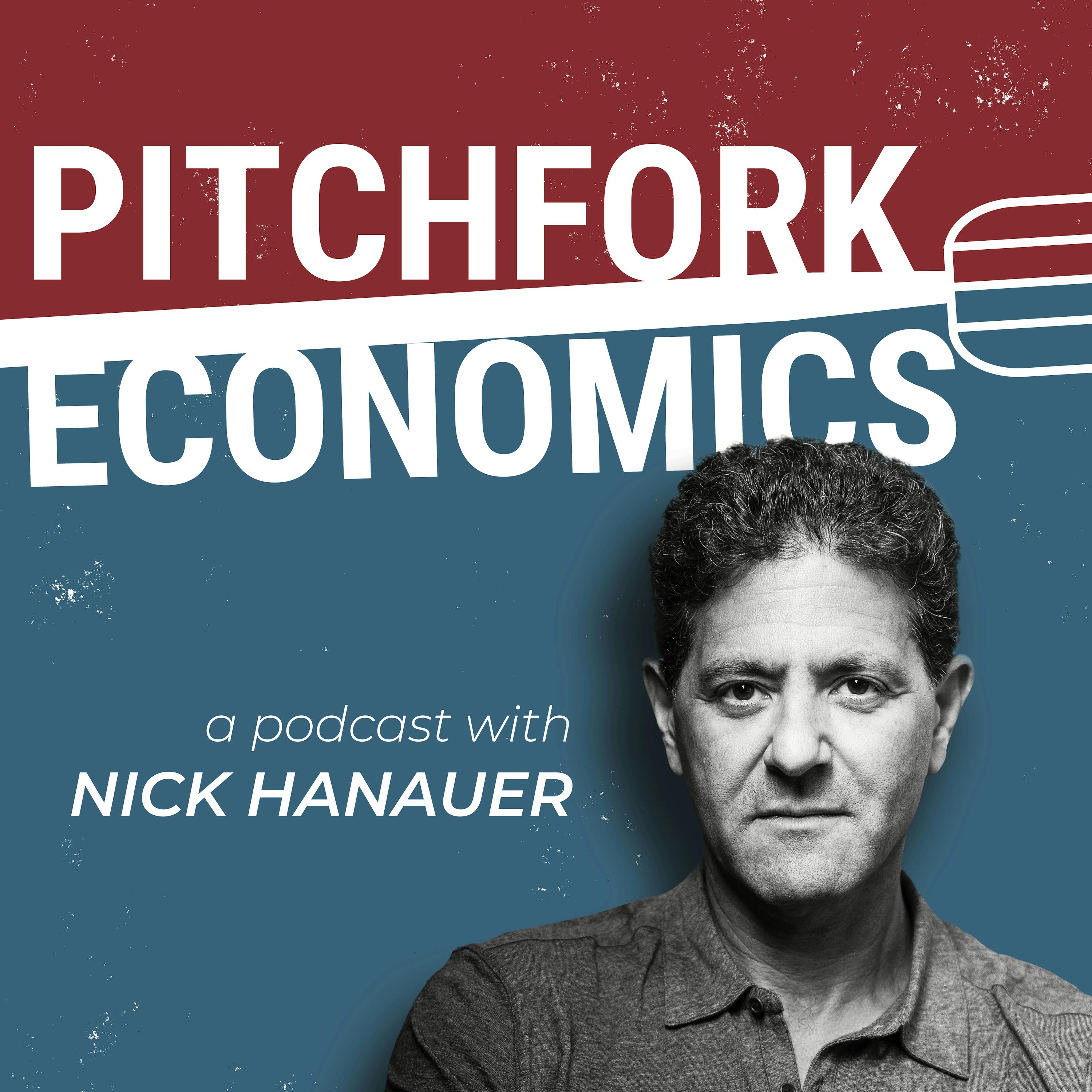
Show Notes
As inequality deepens, democratic institutions strain, and climate risk accelerates, it’s becoming impossible to ignore a basic question: What is capitalism actually for?
This week, we revisit our conversation with Harvard Business School professor Rebecca Henderson who argues that today’s economic crises aren’t the result of isolated failures, but of an economic system designed around the wrong goal—maximizing shareholder value at any cost. Drawing from her book Reimagining Capitalism in a World on Fire, Henderson makes the case that markets built around cooperation, dignity, and shared prosperity don’t just serve the public good—they often outperform extractive, low-road models, while decades of trickle-down economics hollowed out institutions, rewarded cheating over value creation, and left businesses dependent on a society they are actively undermining. Together, they ask what it would take to build a new economic paradigm—one where firms exist to strengthen the communities, democracy, and planet they rely on to survive.
Rebecca Henderson is the John and Natty McArthur University Professor at Harvard Business School, where she teaches the acclaimed course Reimagining Capitalism and explores how business can help build a more just, sustainable economy. She is the author of Reimagining Capitalism in a World on Fire, and a research fellow at the National Bureau of Economic Research, a fellow of the British Academy and American Academy of Arts and Sciences, and has served on the boards of major public companies.
Social Media:
@RebeccaReCap
Further reading:
Reimagining Capitalism in a World on Fire
TED Talk: To save the climate, we have to reimagine capitalism
Website: http://pitchforkeconomics.com
Facebook: Pitchfork Economics Podcast
Bluesky: @pitchforkeconomics.bsky.social
Instagram: @pitchforkeconomics
Threads: pitchforkeconomics
TikTok: @pitchfork_econ
YouTube: @pitchforkeconomics
LinkedIn: Pitchfork Economics
Twitter: @PitchforkEcon, @NickHanauer
Substack: The Pitch
More from Pitchfork Economics with Nick Hanauer
What happens to democracy when people can no longer afford the basics of everyday life?
Housing is still ridiculously expensive, and building more housing is absolutely part of the solution. But supply alone won’t fix a system where landlords have the power to jack up rents with the assistance of algorithms, and developers make more money building for the wealthiest in the market, rather than building homes a typical family can afford.
Industrial policy is back at the center of the economic debate. But tariffs, factories, and reshoring are only part of the story. In this 2023 conversation, development economist Isabel Estevez joins Nick and Goldy to argue that industrial policy is ultimately about choices: what we produce, how we produce it, and who benefits. She explains why a smart industrial strategy has to look beyond manufacturing output to workers, communities, climate, public investment, and the broader public good.
We like to think that if a company cheats us, steals our wages, or breaks the law, we can take them to court. Unfortunately, there’s a good chance you’ve already signed that right away.
For 150 years, the price tag made a simple and universal promise: the price you saw was the price everyone saw. Now, that promise is disappearing. This week, Lindsay Owens, President and CEO of the Groundwork Collaborative returns to discuss her new book, Gouged: The End of a Fair Price — And What That Means for Your Wallet. She explains how corporations are using algorithms, personal data, and AI to figure out not what something costs, but how much you personally are willing to pay. From Instacart’s grocery experiments to the coming world of AI shopping agents, the conversation asks a basic question: If nobody knows what the real price is, can markets actually work the way we’re told they do?