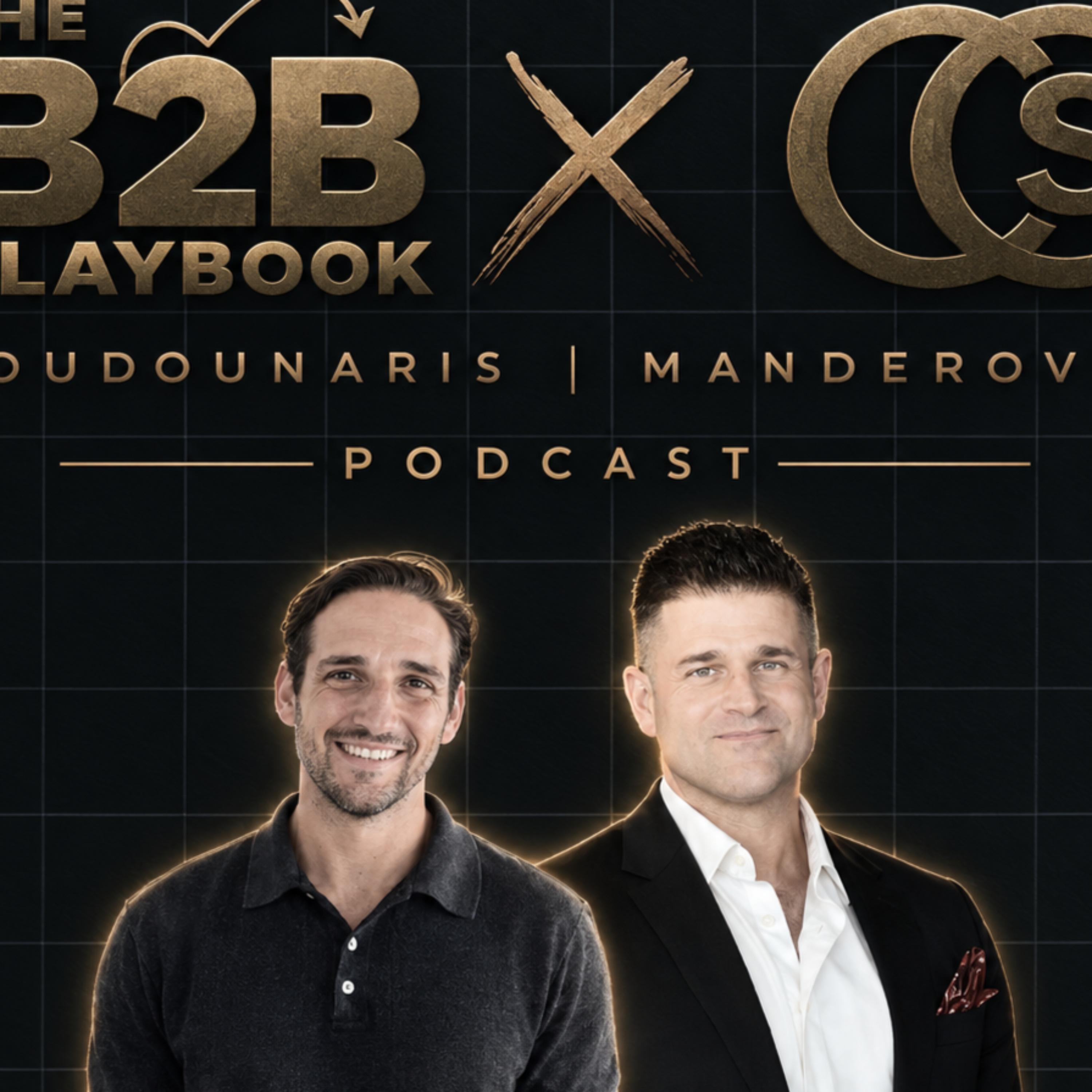
Ep 121 - What’s Next for Outbound Sales? Aaron Ross (Predictable Revenue) & Adem Manderovic (Closed Circuit Selling)
Closed Circuit Selling™ w/ Adem Manderovic + George CoudounarisShow Notes
What’s Next for Outbound Sales? Aaron Ross (Predictable Revenue) & Adem Manderovic (Closed Circuit Selling)
Outbound sales is at a crossroads.
Automation is everywhere. AI is flooding inboxes. Meetings are harder to book than ever.
So we sat down with Aaron Ross, author of Predictable Revenue and From Impossible to Inevitable, to ask one question:
What’s next for outbound sales?
Alongside Aaron, Adem Manderovic (Closed Circuit Selling, CRO School) breaks down why GTM teams misread Predictable Revenue, how outbound drifted into “meetings at all costs,” and what a modern outbound system actually looks like.
We dig into market validation, cataloguing timing signals, emotional intelligence, relationship systems, and why AI is forcing teams back to fundamentals.
If you sell, market, or run a revenue team, this conversation will change how you think about outbound.
Tune in and learn: • Why Predictable Revenue was never meant to be a “meetings engine” • How outbound broke — and how to rebuild it around market validation • Why the future of outbound is more human, not more automated
Links + CTAs
🧠 Learn how to drive revenue across your organisation with CRO School: https://theb2bplaybook.com/cro-school
🎓 Join our Demand Generation Program: https://theb2playbook.com/demand-generation-course
💼 Need help running your own LinkedIn Thought Leadership Ads? https://theb2bplaybook.com/linkedin-ads-agency
💼 ACCESS our B2B COURSES: https://theb2bplaybook.com/courses
📺 YouTube: https://www.youtube.com/@theb2bplaybook
📬 Newsletter: https://theb2bplaybook.com/newsletter/
📚 Latest content: https://theb2bplaybook.com/
Timestamps
00:00 What’s Next for Outbound Sales? 01:00 How Predictable Revenue Was Misinterpreted 03:00 Why Meetings Became the Wrong Metric 05:00 Outbound as a Market Validation Engine 08:00 Inbound vs Outbound: Why the Debate Won’t Die 11:00 The Anxiety Economy: Overreacting vs Fixing GTM 14:00 When Leaders Do More of What Doesn’t Work 17:00 Relationship Systems: The Missing Link in Outbound 20:00 The Most Underrated Outbound Move: Talk to People 23:00 When Sales Stopped Validating Markets 26:00 Adem’s Closed Circuit Selling: Timing & Cataloguing 29:00 Aligning Sales, Marketing & CS Under a CRO 32:00 Why AI Makes EQ and Creativity More Valuable 36:00 Sales as a Communication Channel 40:00 Intent Data vs Real Customer Conversations 45:00 Aaron Ross’ New Books: Income Systems & AI Selling 50:00 Winners vs Losers in the AI Revenue Era 53:00 Final Takeaways for Modern Outbound
👥 Are you responsible for revenue in a small or midsize or enterprise B2B team? Do you feel the pressure to generate more, with fewer resources, tighter timelines, and rising expectations from sales and leadership?
💰 You don’t need more noise — you need alignment. CRO School gives you the architecture, not just tactics:
🔹 Strategy — grounded in market validation, not guesswork 🔹 Templates — built for Closed Circuit execution, not funnels 🔹 Tools — that create consistency, clarity, and compound revenue
When marketing, sales, product, and success operate as one system, revenue stops leaking — and starts scaling.
This is why marketers, founders, and revenue leaders around the world are shifting to Chief Revenue School to learn the modern commercial operating system.
The bookhttps://www.amazon.com.au/Closed-Circuit-Selling-Predictable-Unpredictable/dp/B0GQ2YV52Y/
Partner pagehttps://theb2bplaybook.com/ccs-resources
More about our programshttps://theb2bplaybook.com/cro-school
More from Closed Circuit Selling™ w/ Adem Manderovic + George Coudounaris
In this video, I sit down with Jared Robin, the founder of revgenius, to unpack how he built a 100,000-plus member community by staying obsessively close to his market and betting on relationships over platforms.
In this episode, I sit down with RevOps expert Pasha Irshad to unpack why revenue is really an architecture problem, not just a sales problem. We cut through the AI noise, why your CRM ends up as a “record of optimism,” and what it actually takes to get sales, marketing, and success working as one unit. Why the hardest part of RevOps today is separating what’s real from the AI hype
In this episode, George Coudounaris with Georgia Watson, a 21-year IBM veteran, and Adem Manderovic to dig into why sales enablement keeps failing even when companies are spending big on it. We cover: • Why strategy is rarely the problem but execution almost always is • What revenue enablement actually means and why most orgs get it wrong • The real reason AI pilots fail 95% of the time • Why human skills like trust, storytelling and value articulation still win deals If you’re a sales leader, revenue leader or marketer wondering why your sellers still struggle to have commercial conversations despite all the investment you’re making in them. Tune in and learn: • Why tools and training alone don’t move the needle • How incentives and measurement drive the wrong behaviours • What world class enablement actually looks like in practice • Why the best sellers win 88% of the time no matter what they’re handed
Most B2B sales methodologies fail for the same reason. Not because the methodology is flawed but because it sits on an operating model never designed to support it. Your team trains on MEDDIC, tweaks CRM fields, and runs Friday scorecards. Six weeks later, everyone is back to booking meetings with the 5% of the market actively buying while the other 95% of your target accounts remain untouched. That silent leak is quietly killing B2B revenue engines. Closed Circuit Selling solves it the next evolution of Predictable Revenue, built from 24 years of frontline B2B selling across 12 industries. A sales methodology only works when architected around the buyer's timeline, not your quarterly targets. It must give reps a reason to engage the 95%, a structure for timing circle-backs, and a closed feedback loop that funnels intelligence back to marketing, product, and leadership. Why most methodologies break There's no shortage of strong frameworks MEDDIC, Challenger, SPIN, Sandler. Yet in nearly every B2B organisation, the methodology lives in a training deck while daily behaviour looks nothing like it. The bottleneck isn't execution. It's architecture. When sales is measured on meetings booked, that metric warps everything: reps skip discovery to hit activity numbers, qualification happens inside the meeting, and marketing gets reduced to feeding MQLs over the wall. The 5% Problem At any moment, roughly 5% of your addressable market is actively in-market. The other 95% are not they're mid-contract, pre-budget, or not ready. When your motion revolves around booking meetings, you disqualify 95% of your future pipeline before the first dial. Every skipped conversation is market intelligence your teams never receive. The 95% aren't refusing to engage they're refusing to take a meeting. They'll share who they use, what they like, when their contract ends, and what would make them switch if you're not trying to sell them in the next ten seconds. Closed Circuit Selling fixes the operating model with four pillars: 1. Catalogue the Market Reps call to understand, not to book meetings. Five questions cover current vendor, desired improvements, contract end date, evaluation timing, and switching triggers. No pitch just structured curiosity. This turns every rep into a live sensor and opens conversations with the 95%. 2. Timing Is Everything Tag every catalogued account into four buckets: Now (0–90 days), Soon (90–180 days), Later (6–12 months), Not Yet (12–24+ months). Engage 3–6–9 months before their window opens so you're the default option when they're ready. 3. Close the Feedback Loop End every catalogue call with: "Can I circle back when you're closer to renewal?" Then route the intelligence: marketing gains competitor insights, product gets roadmap signals, CS improves handovers, and leadership receives market truth. 4. Architecture Over Frameworks Once the first three pillars are running, any tactic (phone, LinkedIn, email, video) works inside the same structure. The architecture carries the team. The book https://www.amazon.com.au/Closed-Circuit-Selling-Predictable-Unpredictable/dp/B0GQ2YV52Y/ Partner page https://theb2bplaybook.com/ccs-resources More about our programs https://theb2bplaybook.com/cro-school
Your Pipeline Isn’t Unpredictable. It’s Unvalidated. Revenue leaders across SaaS and enterprise sales are describing the same tension: Pipeline coverage looks fine. CRM stages are full. Forecast calls still run. Yet confidence feels thinner than it used to. Close dates slip. Deal sizes shrink late. Forecast conversations rely more on narrative than proof. In a recent discussion, Phil Cleary, who spent over two decades leading revenue enablement at Salesforce, described the issue clearly: “The realness of the pipeline… how much of it is fabricated.” Fabricated doesn’t mean dishonest. It means structurally unvalidated. Deals can progress through stages without being stress-tested for viability. Confidence rises faster than evidence. Stage movement becomes a substitute for truth. That gap is where predictability erodes. When validation isn’t enforced by the system, pipeline can look stable while remaining fragile. Coverage ratios stay healthy. Forecasts still get submitted. Leaders still feel exposed. As Phil Cleary surfaced, the uncertainty many leaders feel isn’t coming from effort or intent — it’s coming from a validation gap. The system allows opportunities to advance without consistently proving they deserve to. At scale, this creates what many leaders call fake pipeline. Not invented deals — unproven ones. A viable deal has evidence behind it. Not enthusiasm. Not activity. Not good discovery calls. Viability requires clear answers to simple questions: Who is driving this internally — and do they have influence? What triggered urgency? What alternatives are being considered? What could stop this? What defines success post–go-live? What is the real decision path? Why now? When is the renewal or contract event? When those answers are missing, the opportunity may be real. It just isn’t forecastable. This is where Adem Manderovic and George Coudounaris introduced cataloguing within Closed Circuit Selling™. Cataloguing isn’t CRM hygiene. It’s capturing buyer truth in plain language so the organisation stops guessing. It doesn’t speed buyers up. It stops probability inflation. Phil Cleary also highlighted a critical shift in buyer psychology: Fear of Messing Up now outweighs Fear of Missing Out. When buyers fear personal or reputational risk, decision cycles lengthen, committees expand, and scrutiny intensifies. From the outside, this looks like unpredictability. Inside the system, it exposes weak validation and poor continuity. Better questioning frameworks don’t solve that. Visible commercial continuity does. Revenue volatility isn’t a skills problem. It’s a system design problem. Closed Circuit Selling™ is not a sales methodology. It is a commercial architecture. When validation, handover, delivery, and retention aren’t governed by a unified system, volatility is inevitable. When they are, confidence compounds. Your pipeline isn’t unpredictable. It’s unvalidated. Pipeline Volatility Is a Validation ProblemWhat Viability Actually MeansFOMO vs FOMUThe Bottom Line