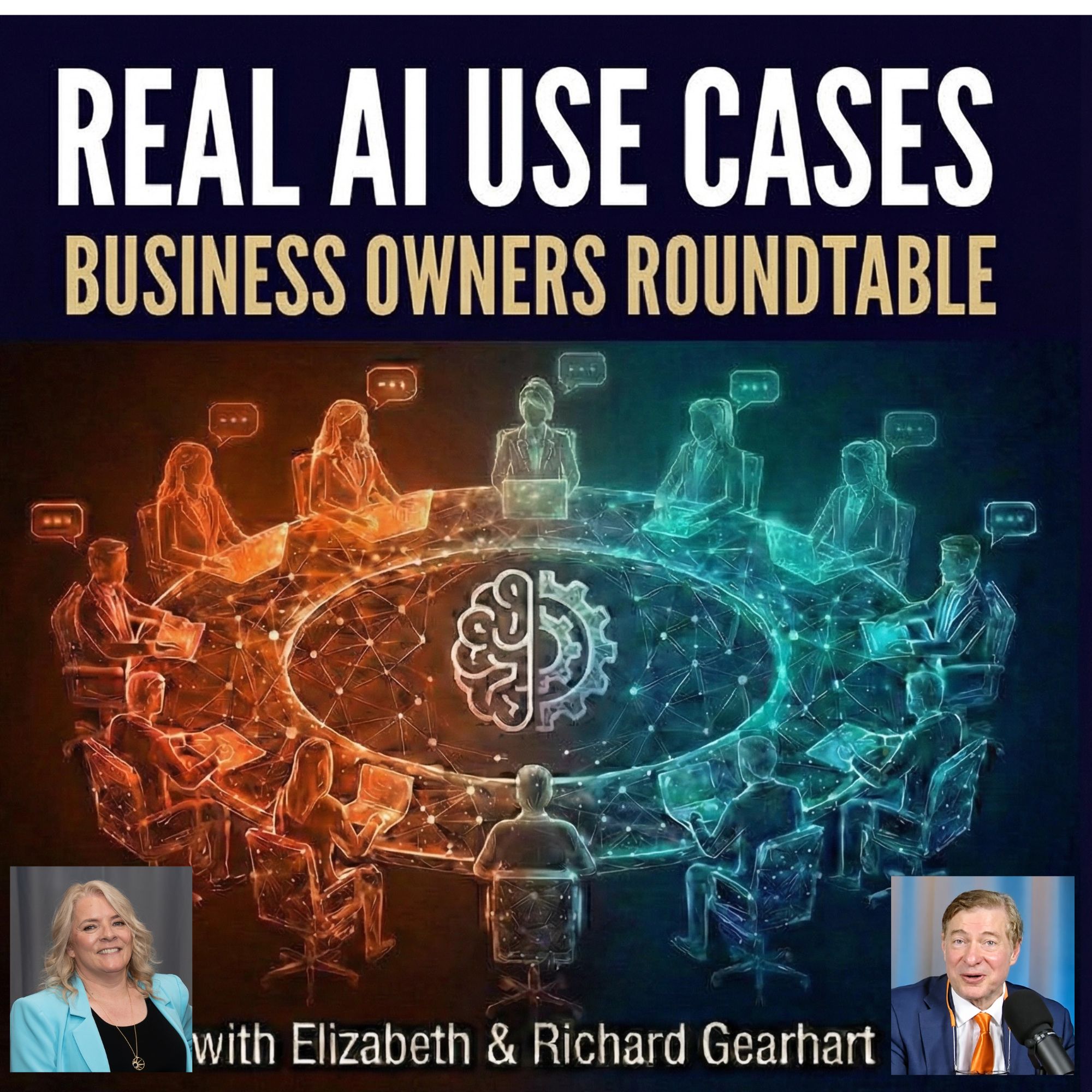
AI - Real Business Owners Reveal How They Actually Use It, and What Scares Them
Real AI Use Cases Business Owners RoundtableShow Notes
Episode 20: Real AI Use Cases – The Promise and Perils of AI in Business What happens when AI becomes your assistant, your creative partner, and potentially your replacement? In this episode of Real AI Use Cases, hosts Elizabeth Gearhart and Richard Gearhart are joined by etiquette expert Thomas Farley (Mr. Manners), business strategist Lauren Paxton, and skincare educator Eva Kerschbaumer to discuss how they're using AI in their businesses today—and the concerns that come with it. From AI-generated visuals and automated presentations to diagnostic tools and digital clones, this conversation explores practical applications of AI alongside important questions about privacy, intellectual property, employment, authenticity, and human creativity. Key Takeaways
AI can dramatically expand creative possibilities. Thomas uses AI image generation to create custom visual backdrops that would be impossible to find in stock photography. AI can streamline business workflows. Lauren transforms dictated ideas into presentations, worksheets, agendas, and other business assets, saving significant time. AI is enhancing education and diagnostics. Eva uses AI tools to help educate clients and support skin health assessments. AI clones are becoming more realistic. Elizabeth discusses her experiment with creating a HeyGen video clone for content creation and marketing. Privacy and ownership concerns are growing. The group explores how employee interactions with AI systems may become corporate intellectual property. Human creativity still matters. Prompts, questions, and original thinking remain valuable differentiators in an AI-powered world.
Featured AI Use Cases Thomas Farley: AI-Powered Visual Storytelling Thomas uses Midjourney to create highly customized visual backgrounds for his weekly "Mr. Manners Mondays" segments. AI allows him to generate scenes that perfectly match his content, helping audiences better visualize his message. Lauren Paxton: Turning Ideas into Deliverables Lauren uses AI to convert dictated thoughts and presentation outlines into polished business materials, including PowerPoint presentations, worksheets, agendas, and supporting resources. Eva Kerschbaumer: AI in Skincare Education Eva leverages AI as an educational tool for clients and uses emerging diagnostic technologies to help identify skin concerns and facilitate communication with healthcare professionals. Elizabeth Gearhart: Creating an AI Video Clone Elizabeth shares her plans to create a digital version of herself using HeyGen. The goal is to produce educational short-form videos more efficiently while exploring the future of AI-generated personal branding. Discussion Highlights Are We Training Our Own Replacements? Thomas raises concerns that employees may unknowingly be teaching AI systems how they perform their jobs. As AI learns workflows, decision-making processes, and prompts, organizations could potentially use that knowledge to automate roles or train future employees. Who Owns Your Prompts? The panel discusses whether prompts and AI workflows constitute intellectual property. Elizabeth argues that the questions people ask—and how they ask them—may become one of the most valuable forms of human creativity in the AI era. Protecting Privacy in the Age of AI Lauren explains why she invested in a closed, encrypted AI environment that keeps her information local rather than contributing to public AI training models. The Impact on Beauty Standards Eva highlights concerns about AI-generated images creating unr...
More from Real AI Use Cases Business Owners Roundtable
How are businesses actually using artificial intelligence to save time, automate tasks, and improve decision-making—and are the results worth the cost? On this episode of Real AI Use Cases Business Owners Roundtable, hosts Elizabeth Gearhart, Ph.D., and Richard Gearhart bring together business owners and AI practitioners to discuss practical applications of AI, the growing role of AI agents, and the risks of relying too heavily on automated systems. Todd Drowlette explains how AI transformed commercial real estate site selection, completing research that once took three full-time employees three weeks in just three and a half hours. Brandon Bellamy shares how he uses AI to identify comparable commercial properties and uncover new business opportunities. Sam Desany explains how he uses Claude, Codex, and multiple AI agents to turn early-stage ideas into working software through a structured process of brainstorming, refining prompts, and reviewing outputs. Richard Gearhart discusses using Microsoft Copilot to estimate business value and identify potential ways to improve it, while Elizabeth Gearhart shares how she is using AI to optimize podcast content for search and answer engines and help develop a book based on real business AI use cases. But AI productivity comes with trade-offs. The panel examines the hidden costs of AI tools and usage credits, questions whether automation always delivers a return on investment, and discusses why businesses still need human judgment, reliable sources, and careful verification. They also explore AI hallucinations, leading questions that produce biased answers, financial data privacy, overreliance on AI, and the importance of keeping a human in control of consequential decisions. Whether you're a small business owner, executive, marketer, entrepreneur, or technology professional, this episode offers practical insights into where AI can deliver measurable value—and where caution is essential. TL;DL — Too Long; Didn't Listen
Why Businesses Can't Trust AI Without Human Oversight Real AI Use Cases Business Owners Roundtable explores how businesses are using artificial intelligence today—and what happens when AI gets things wrong. Hosts Elizabeth Gearhart, Ph.D., and Richard Gearhart bring together Dr. Joseph A. Puma, Brian Fried, and John Schwind to discuss real-world AI applications, business automation, AI agents, healthcare, and the risks of trusting AI-generated answers. How can businesses use AI effectively without giving up human judgment? In this episode, business owners share practical examples of AI in action, from automating patient phone calls and researching new inventions to generating marketing images, identifying networking opportunities, and streamlining podcast production. Dr. Joseph A. Puma explains how his medical practice uses an AI phone agent to handle patient requests and appointment scheduling—but reports that approximately 70% of calls still require transfer to a live agent. The discussion raises important questions about AI automation, return on investment, and whether AI tools are delivering the benefits businesses expect. Inventor consultant Brian Fried explains how he uses AI to research competing products, evaluate market opportunities, investigate potential sales and licensing prospects, and assess inventions before investing further. He also discusses why inventors should avoid revealing confidential details of their ideas when using AI tools. John Schwind, founder and inventor of ReadiMask®, shares how his company uses AI-generated images and videos to depict real-world product applications while protecting patient privacy. He also explains how he uses Claude and ChatGPT together to identify weaknesses and check AI-generated work. Elizabeth Gearhart discusses using AI agents and Perplexity to automate podcast production and marketing workflows, while Richard Gearhart shares how AI can help identify valuable business networking connections and evaluate software investments. The roundtable also examines the limitations and risks of artificial intelligence, including AI hallucinations, inaccurate research, autonomous AI agents, cybersecurity, and the possibility of AI making mistakes in high-stakes settings. The conversation turns to AI doctors, patient safety, medical ethics, liability, and whether cost reduction is taking priority over better healthcare. The takeaway? AI can be a powerful tool for research, innovation, marketing, and automation—but confident-sounding answers are not necessarily correct. Human oversight, independent verification, privacy protection, and sound judgment remain essential. TL;DL: What You'll Learn
How are businesses using AI agents to improve sales, train employees, automate workflows, and drive business growth? On this episode of Real AI Use Cases Business Owners Roundtable, hosts Elizabeth Gearhart and Richard Gearhart welcome Paul Burani, Co-Founder & CRO at Atlas Primer to explore how companies can use artificial intelligence strategically to improve productivity while strengthening the uniquely human skills that drive business success. Paul explains how AI agents can connect CRM systems, emails, and customer conversations to improve business development and personalized outreach. He also shares how AI-powered role-play and sales training help employees practice customer conversations, develop stronger communication skills, and receive personalized coaching without waiting for a human trainer. The discussion explores how business leaders can identify the right AI opportunities, measure return on investment (ROI), automate repetitive tasks, preserve institutional knowledge, and use AI to make better decisions. Rather than adopting every new AI tool, Paul recommends starting with clear business objectives, testing solutions, and measuring results. Discover why the future of AI at work isn't necessarily about replacing people—it's about automating routine tasks so employees can focus on judgment, relationship-building, problem-solving, and other uniquely human strengths. TL;DL — Too Long; Didn't Listen
How are businesses actually using AI—and when does it create more problems than it solves? On Real AI Use Cases Business Owners Roundtable, hosts Elizabeth Gearhart, Ph.D., and Richard Gearhart join entrepreneurs and business experts for a candid discussion about practical AI applications, data confidentiality, intellectual property risks, productivity, and the real return on investment of AI tools. From using AI to research questions and verify sources to creating branded marketing materials, automating purchase-order processing, editing podcasts, and generating content, the panel shares real-world examples of how AI is changing everyday business operations. But the conversation also reveals why businesses need to think carefully before handing AI their confidential information, relying on its answers, or investing in expensive AI integrations. TL;DL: What you'll learn in this episode
How are businesses actually using AI right now—and where do humans still need to stay involved? On this episode of Real AI Use Cases Business Owners Roundtable, Elizabeth Gearhart and Richard Gearhart talk with business leaders about practical, real-world ways they are using AI for work, productivity, research, content creation, learning, automation and decision-making. TL;DR: AI can save businesses significant time, help employees learn new skills, improve writing and readability, assist with research, plan travel and even help manage complex business processes. But the conversation also highlights an important limitation: AI should not be trusted blindly. Human oversight is still critical when errors could have serious consequences, when accuracy matters, and when AI-generated content needs judgment, context and a human voice. Dr. John La Puma explains how he uses AI to manage his farm, prepare for podcasts, organize research and stay on top of email. Michael Greenberg shares how AI helps him plan trips, train new employees and create skills maps for learning new disciplines. Bill Treloar discusses using AI for website and blog brainstorming, content structure and readability analysis—while warning against publishing low-quality “AI slop.” Richard Gearhart describes using AI as a sounding board for legal ideas and communications, while Elizabeth Gearhart explains how she used Claude and Perplexity to help plan a major software transition and prevent potential upgrade problems. The discussion also tackles a bigger business question: When can an AI agent handle an entire process, and when does a human need to check its work? The answer may depend on how costly a mistake would be. A process that can tolerate a 95% success rate may be suitable for greater automation, while mission-critical tasks may still require human review. The episode explores practical AI use cases including AI agents, AI automation, AI-assisted writing, research agents, NotebookLM, email management, employee training, skills mapping, business process improvement and human-in-the-loop AI. FAQs: How are businesses using AI right now?Businesses are using AI for content brainstorming, research, employee training, process improvement, email management, readability analysis, travel planning, business planning, knowledge management and automation. Should businesses let AI work without human oversight?It depends on the consequences of an error. AI can potentially handle processes where mistakes are relatively low-risk, but humans should remain involved when accuracy is mission-critical or an error could cause significant harm. What is human-in-the-loop AI?Human-in-the-loop AI means AI performs part or most of a process while a person reviews, verifies or approves important outputs before they are acted upon. How can businesses use AI without publishing low-quality content?AI can be useful for brainstorming, research, outlining and improving readability, but businesses should have humans review and edit content for accuracy, originality, context, tone and quality before publishing it. Can AI help employees learn new skills?Yes. AI can create customized learning plans, recommend books, videos and articles, break larger skills into smaller components and help employees develop new areas of expertise. How can AI help with business process improvement?AI can analyze existing processes, identify potential problems, suggest improvements and create plans for reducing bottlenecks or preventing mistakes. Human judgment is still needed to determine which recommendations make sense for the business. What are AI agents?AI agents are AI systems that...