Show Notes
After Massasoit's death in 1660 or 1661, his son Wamsutta became sachem of the Pokonoket community and the leading sachem of the Wampanoag confederation, and early on he followed Algonquian custom and changed his name. He asked the men of Plymouth Colony, longstanding allies of his nation, to give him an English name, and they proposed Alexander. His brother Metacom also took an English name, Philip. Alexander would soon die under circumstances that deeply concerned the Wampanoags, and his brother Metacom, now known to the English as King Philip, assumed the paramount sachemship.
During the 1660s and 1670s, a series of crises would degrade the now fifty year alliance between Plymouth Colony and the Wampanoag confederation, with war narrowly averted in 1671. Then, in early 1675, the Harvard-educated Christian Indian John Sassamon would be found dead, murdered by someone. Plymouth prosecuted and executed three Wampanoag men on scanty evidence, a violation of Philip's sovereignty. Misunderstandings piled on top of outrage, and pressure built on both Philip and the Plymouth authorities to mobilize. The deputy governor of Rhode Island tried to broker peace, but events moved too fast. On June 23, 1673, the war began.
Errata: (1)Toward the end of the episode, I said that the town of Mattapoisett was "just east of New Bedford." Oops. There is a town with that name there today, per Google maps, but in 1675 the place with that name was on the water near Swansea, where the Taunton River flows into Mt. Hope Bay. (2) At another point, I said there had been "almost forty" narratives written about the war. Since there were at least 29, I should have said "almost thirty."
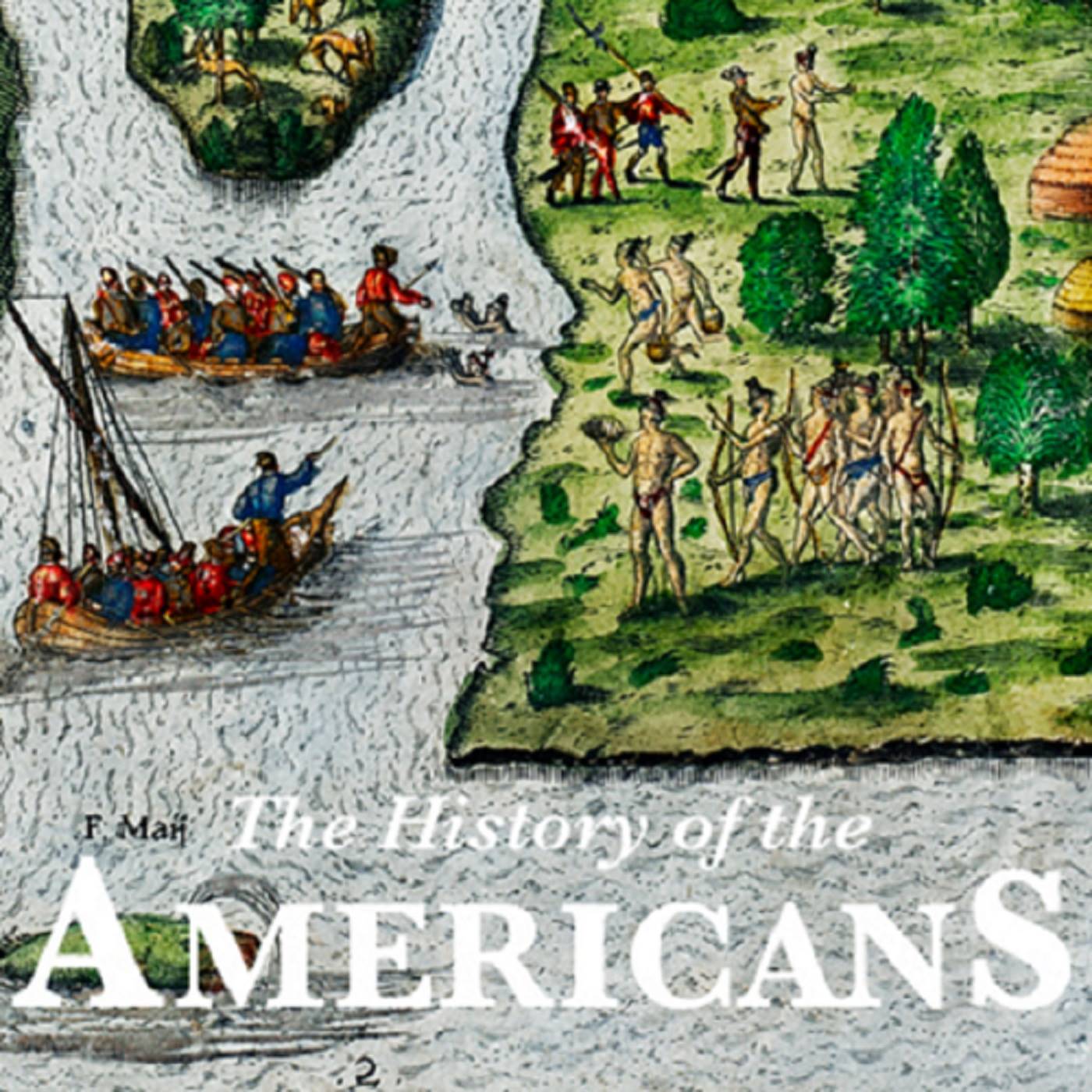
Maps of New England during King Philip's War
X/Twitter – @TheHistoryOfTh2 – https://x.com/TheHistoryOfTh2
Facebook – The History of the Americans Podcast – https://www.facebook.com/HistoryOfTheAmericans
Selected references for this episode (Commission earned for Amazon purchases through the episode notes on our website)
Lisa Brooks, Our Beloved Kin: A New History of King Philip’s War
Jill LePore, The Name of War: King Philip’s War and the Origins of American Identity
Matthew J. Tuininga, The Wars of the Lord: The Puritan Conquest of America’s First People
John Easton, A Relation of the Indian War (pdf)
Philip Ranlet, “Another Look at the Causes of King Philip’s War,” The New England Quarterly, March 1988.
More from The History of the Americans
This factoid-rich episode is a major rewriting of one of the earliest and most popular episodes of the podcast, Introduction to the Columbian Exchange, which originally aired on February 12, 2021 and then again in a revised form as episode #166 on October 11, 2024. This version includes lots of new aspects of the Columbian Exchange, and more recent scholarship on several of the topics discussed in the old episodes.
It is the 1670s. Robert Cavelier, Sieur de La Salle, having returned from exploring south of Lake Erie, made common cause with the flamboyant and visionary new governor of New France, Louis de Buade, Comte de Frontenac. Together they hatch a plan to get permission from Louis XIV to build a string of forts in the Great Lakes region and explore and settle the Mississippi River Valley. La Salle travels to France twice, and enlists the King’s first minister, the great Jean-Baptiste Colbert, to support a mission to find the mouth of the Mississippi so that France might establish a base there for the purpose of better harrassing Spain. Along the way La Salle builds a huge fort at the eastern end of Lake … Ontario, survives the second of five assassination attempts, and Frontenac demonstrates a great flair for diplomacy with the Iroquois.
It is time to get back to New France and the exploration of the middle of this beautiful country of ours. Our vehicle will René-Robert Cavelier, Sieur de La Salle, known to both his contemporaries and to history as “La Salle.” You’ve heard his name, especially if you live within driving distance of the Mississippi, but do you know what he actually did? This and the next few episodes tell La Salle’s remarkable story.
It is the spring of 1681. The “exclusion crisis,” an insurgency in Parliament proposing to exclude the king’s brother, James, Duke of York, from the line of succession, was reaching its climax. Even so, on March 4 King Charles II found time to grant William Penn a vast territory extending from the west bank of the Delaware River to a longitude equal to the then western border of Maryland. It was now William Penn’s role, as sole proprietor of Pennsylvania, to fill it up with people. He would do a remarkable job, especially under the challenging circumstances, relying heavily on his … pen. Along the way he would write a practical and moral defense of English colonialism at a time when many of the movers and shakers in London were arguing against it.
With Sir William Penn’s passing in 1671, and his deathbed admonition that his son stay true to himself, young William Penn was both financially independent and liberated from worrying that his own activism on behalf of the Quakers would hurt his family. William now owned lands that generated income of around 2000 pounds a year, or roughly the wages of 100 laborers of the time.