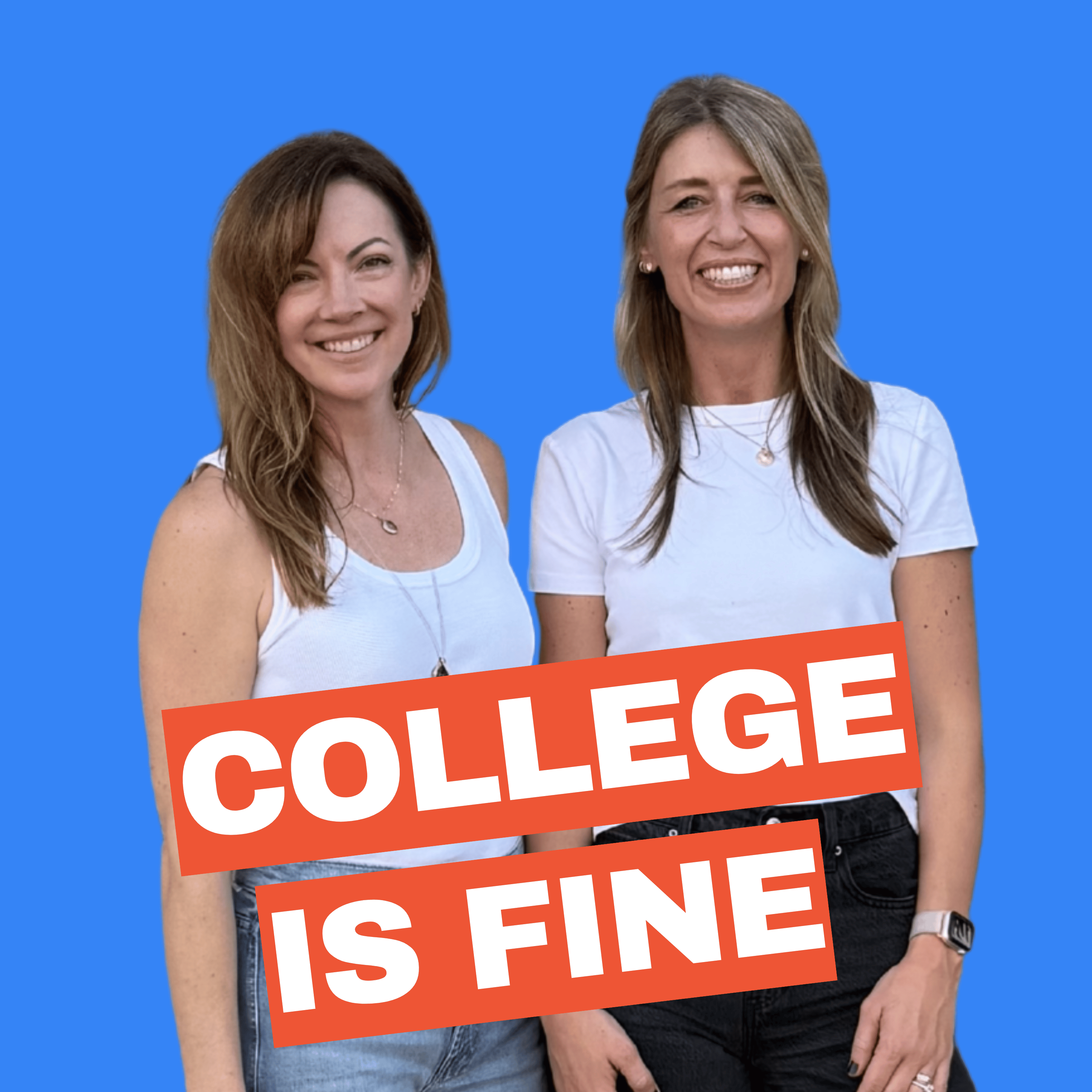
TWO TAKES on Tracking Your College Freshman - "Before It Was Stalking, Now It's Safety"
College Is Fine, Everything's FineShow Notes
In our second TWO TAKES episode, a mom and her college freshman talk about tracking, texting, and how much parents really need to know.
Ashley and Sarah met in seventh grade, so this one comes with some history. Ashley brings her son Carter — a rising sophomore at CU Boulder, an ROTC cadet, and a licensed private pilot who's already passed his instrument test. In Two Takes, we ask the parent and the student to answer the same set of questions. What happens if they disagree?
Well, it turns out that you get a pretty honest picture of what freshman year does to a family's communication habits. Ashley describes the moment tracking her son's every move stopped being reassuring and started fueling her anxiety, and how she recalibrated: "Before it was a stalking thing and now it's a safety thing." Carter, at six foot five, mostly forgets the app is on. Both agree that floundering socially for the first couple of weeks is normal — they independently rated it a 7 out of 10.
What they cover: Party details (0–10 scale): Carter says 6, Ashley says 4 — and she explains exactly where her line is Check-ins: Carter says once a week is plenty. Ashley says once or twice a day, or you don't love your mother Life360: A hard no from Carter, a "until they're forty" from Ashley Grades: Ashley wants full semester transparency, not test-by-test. Carter points out that monitoring adds stress without adding motivation — he's already invested Making friends: Why welcome week mattered more than the roommate, and why skipping Greek life didn't cost Carter a social life Expectations vs. reality: Classes were easier than expected, ROTC was harder, and the dorm was its own experience Money: Liz names it as the number one thing parents and college students fight about, and Ashley admits she has no idea where the line is
Approximate timestamps (from the raw transcript — these will shift after the edit) 00:00 — Meet Ashley and Carter 03:19 — How much should parents know about party life? 04:55 — How often should students check in? 06:40 — The Life360 question 09:20 — When tracking made a mom's anxiety worse 10:43 — Grade transparency and who's paying the bills 13:43 — Is it normal to flounder socially? 17:47 — Expectations vs. reality of first year 19:09 — Why he skipped the fraternity 21:24 — The dorm, and the strongly worded letter to CU 23:11 — The money conversation
Takeaway for parents: The oversight that felt necessary in August may be feeding your own anxiety by October. Ashley's shift — from monitoring whether he made it to class to knowing where he is if something goes wrong — is a useful frame for what year-one involvement can look like.
Takeaway for students: The first two weeks are supposed to feel uncertain. Almost nobody's friend group in October is the one they had in week one.
More from College Is Fine, Everything's Fine
Many students head to college assuming the supports they had in high school will follow them. They often don’t. Sarah and Liz sit down with Elizabeth Hamlet, a learning disabilities consultant with more than 20 years in the field and author of Seven Steps to College Success: A Pathway for Students with Disabilities, to talk about how college accommodations actually work and what students can do to prepare. Elizabeth explains why IEPs and 504 plans don’t carry over to college. She covers which accommodations students are most surprised to lose and why documentation requirements can change. She also makes the case that skills and strategies matter just as much as accommodations. Resources mentioned: Seven Steps to College Success: A Pathway for Students with Disabilities by Elizabeth Hamlet Elizabeth’s free “Tools for College Students” resources, covering time management, the SQ3R reading strategy, highlighting, and goal setting
Dr. Alexis Redding — developmental psychologist at the Harvard Graduate School of Education and author of the new book on mental health in college — joins us to talk about what's actually changed for college students over the last 80 years, and what hasn't. Spoiler: not much has changed about the experience of feeling lost, lonely, and uncertain at 18-25. What's changed is the volume, thanks to social media turning private struggle into public comparison. We dig into: Why our brains are "terrible historians" and how the peak-end rule reshapes how we remember our own hard years "Friend sickness" — the specific loneliness of being disconnected from people who know you well Why the "constellation of mentors" model is wrong, and what "mirror mentors" are instead How to actually talk to your kids (or your parents) about career uncertainty without it turning into advice-giving Why "live it forward, connect the dots backward" might be the most useful reframe for anyone who feels behind
Liz and Sarah are joined by Dr. Jill Grimes, family physician and author of The Ultimate College Student Health Handbook, to talk about what chronic academic stress actually does to your body — and why so many popular "quick fixes" for focus and sleep are making things worse. If you've ever reached for an energy drink at midnight, borrowed a friend's Adderall, or popped a melatonin gummy hoping to knock out before an exam, this one's for you.
If you've ever panicked staring at a blank resume, frozen at the word "networking," or wondered what your boss actually wants from you on day one of an internship — this episode is for you. We sat down with Jennifer Gershberg to get real, practical advice on everything from interview prep to building relationships that actually open doors. No fluff. Just the stuff they should have taught you in class.
In this episode, we’re joined by Dr. Shreya Hessler, a psychologist and professor who created a college course called Digital Detox: Doing Nothing and Doing Well. Together, we explore how constant phone and social media use impacts attention, relationships, and self-worth—especially for Gen Z. Dr. Hessler shares what happens when students unplug completely during class, and how learning to tolerate boredom and discomfort can lead to stronger connections, better focus, and more intentional choices. Rather than promoting total avoidance of technology, this conversation focuses on building awareness and creating a healthier relationship with it. We also discuss practical strategies you can try right away, like naming your phone use out loud, delaying the urge to scroll, and running small “experiments” to better understand your habits. Dr. Hessler's private practice: https://mindsetcenter.com/shreya-hessler-psy-d/ Ted Talk: https://www.youtube.com/watch?v=7zxa2xgXPJc&themeRefresh=1 Want to share your story, give us feedback or offer up an episode idea? Reach out! We'd love to hear from you. Insta: @collegeisfinepodcast Tik Tok: @collegeisfinepodcast Email: [email protected]