Show Notes
While my entire Christian faith framework begins and ends with Easter, the bones, flesh, and soul of my personality identifies with Advent. I feel Advent on the daily, even when it isn’t Advent, although the long stretches of darkness, the stars complementing it, the haunting hymns, the preparation for Christmas make me feel utterly synchronized with the season: Quiet. Waiting. Wrestling between the desire to complete all the baking and present buying and decorating, and the competing invite to savor every one of the pieces of holiday prep instead. Hygge. Worry that time is flitting by. Confidence that there is, actually, time and time to pause. Gratitude for the dark, a calibration to it in fact. A palpable tension between anxiety about reasons to repent and the reassurance in the promises to not be afraid. Swirled together like finger paints on glossy paper, Advent is roughly 30 days of urgency and waiting, anxiety and peace, vulnerability and coziness: exactly a day in the life, even when it isn’t Advent. ~~~~~ Recently, I’ve had a couple of occasions to actively reflect on Advent writ large, and specifically for each of the four Sunday’s texts. One event was for a church in Wisconsin, via Zoom, on Christ the King Sunday, the pivot Sunday between the last and the first days of lectionary years: this year, we are moving from Luke to Matthew. The group had asked me to reflect on the question, “What is the future of the Church?” I didn’t like the question. So I took liberty to change it. I preferred, I said to the gathered group, this question: “What is the identity of the followers of Jesus?” That prompt is far more in keeping with the season of Advent, with Matthew’s gospel’s agenda, and it’s driven less by capitalistic anxiety (I said we could imagine the first question being posed by some CEO at a huge board meeting) and more by curiosity and faithful confidence. We already know the future, because we believe that Jesus is risen: life, not death, wins. But that doesn’t mean that we skip about with baskets of flowers singing merry tunes on constant days of 72º and sunny, no: it means that we engage the moments of life, even the threatening, sorrowful, despairing, irritating ones, as people shaped by that promise. Those unwelcome moments don’t magically disappear, but they are reframed with a measure of hope and defiance. Early on in his gospel, Matthew tips his hand here, telling us that the angel of the Lord arrived to Joseph and said, “Do not be afraid.” Let’s be honest: the guy had reasons to be afraid. But as terrifying as that moment was for him, Mary pregnant and their names and lives at stake, there was greater reason to be assured: Mary would bear a son, one named Jesus, a name meaning ‘one who saves,’ who would also be called Emmanuel—God with us. Stretching from his birth to his death and resurrection, the story of Jesus envelopes both our need for saving—which means, in Greek, health, healing, and wholeness—and our freedom to act according to that very salvation, placing our faith in God rather than our faith in fear. That’s no schmarmy claim: that’s radical stuff right there is what it is: by definition, we Christians know the future and we act according to it. As to the “Church,” well, curiously, only Matthew uses that word, which in Greek is ekklesia, which literally means those called out, those set apart. It surfaces three times, namely in Matthew 16:18, when Jesus says that upon “this rock,” as in Petros, as in Peter (see what he did there?) he’d build his church, and in 18:17, when twice he uses the word to address what should happen when you have a beef with someone in the ekklesia. It’s important to recall that Matthew was rooted in the Jewish tradition, and so had held fast to the synagogue and the centrality of the teachings of the Torah. Now, though, post-destruction of the synagogue in 70 C.E., and post-resurrection, Matthew held fast to the ekklesia, a community that, even if in its nascent stages,
More from Never The Chameleon
Dressing your Dust Every Ash Wednesday, I am reminded of a piece I wrote not long after the death of my husband Bill: he was killed in the same accident that gave my son his brain injury. The story concerns the moments when I stood in front of my late husband’s closet, charged by the funeral home with choosing the clothes in which he’d be cremated. Two days before, this, picking out his outfit, would have been his task. He’d picked out his own clothes since he was young. Good Lord, he was still young. Didn’t matter. Today it was my task. My absurd job. My surreal chore. Even this awful request of the funeral director led my mind down paths that should not have been mine. But there I was, standing before that closet while my mind was racing down each of them. And what difference does it make? It’s laughable, really, choosing clothes that nothing but the inside of a box will see. Anyhow, he’ll be cremated, turned back into dust. Bill won’t be in a coffin for longer than the Memorial Service. Still….naked, in a coffin? Somehow that just seems…not right. I can’t for the life of me say why, but it’s not right. And so there I stood, these thoughts in my mind, these clothes before me, and his body waiting, no choice in the matter, for my selection. So. Intake of breath. If he were here, what would he choose? Ties? Clearly out. Brand new suit? Out… though he sure looked good in it. But he was being taken under, and was not the undertaker, I thought. So no suit. He was not a suit guy. He was the anti-suit guy. That helped. Jeans, then. His favorite jeans. He was far more organized than I ever will be, so I knew right where to find them. I kept them perfectly folded as I laid them on the floor. And hiking boots, of course. Of course hiking boots, still with the dust of the Alps on them. I set them next to the jeans. I grinned when I decided on the shirt. I would surely hear it, even all the way from where-ever-he-was, if I didn’t wrap him up in an Ohio State T-Shirt. “That’s The Ohio State to you,” I could almost hear him say. Since all the OSU shirts were all his favorites, it took some time to pick the right one, the perfect one for the occasion. Silly me. Of course it had to be the one emblazoned with TBDBTL. So jeans, and a TBDBTL t-shirt, and hiking boots. Is that it? I thought. Anything more? Yep. Something was missing…what was missing….? Ah. His alb. His pastoral alb. He needs his pastoral alb. And so I reached in to the closet and I found his alb, and I took it, and I held it, and I held it close. He was so honored to wear that alb. I took it off the hanger, and I folded it neatly, and placed it on the stack of clothes, and found a bag, and placed his outfit for The Day inside of the bag, and I grabbed the handles, and I walked out the door to bring him his clothes. ——————- Today is Ash Wednesday. It marks the beginning of spring. That’s what Lent means, in Latin. Spring. New beginnings. It can be a somber time, I suppose. I know of all the arguments against saying and singing Alleluia on Sundays in Lent. But as for me, give me the Alleluias. Every Sunday is an announcement of Easter, after all, of new beginnings, and I firmly believe that it is in the dark that God’s light is most clearly seen…and when we most clearly need to see it. Just as I say that Holy Saturday is the most honest day, I think Lent is the most honest season: the pivot place between death and life, despair and hope. It begins with Ash Wednesday, the day of declared dustness. We are born of dust, and we return to dust. And that’s just the way it is. We have no choice about our dustiness. But we do have choices, in-between. Like our clothes. We can choose our clothes. We can choose what to wear, what to pull on that reveals most fully who we are called to be, that makes it easier to do it and be it. We can choose the outfits we will slip on, the ones that reveal to all the world, and not just the inside of a box, what our agenda for the day will be. Sometimes
The trouble is, we can’t have just spent the season of Advent talking about, urging, setting up repentance as an expected and holy expression of faith, and then revile those who actually have an Epiphany and up and repent. That’s the thought banging around in my head on this day when the Church marks the beginning of the season of Epiphany, and our nation marks the January 6 insurrection, and meanwhile, everyone is marking MAGA’s cracks in its base. It’s a fair bet that lots of even lifelong Christians aren’t quite sure of what the purpose of the season of Epiphany is, but we might know that it has something to do with the Magi. And if we know that it has something to do with the Magi, we might know that it has something to do with them “going home by another way,” which might be as much thanks to balladeers like James Taylor and Bruce Cockburn as it is brother Matthew. If you remember, Matthew tells us that Herod had heard that the Magi were on the loose in his land, because they’d heard news of a new king of the Jews in his land, and they wanted to give him, this baby, their honor. Weak, petty, and greedy kings do not approve of rising counter powers, even if in swaddling clothes, so facetiously, Herod invited the Magi to return to his lair following their discovery of the young king, “so that I may also go and pay this new king homage.” Thankfully, after they honored the baby Jesus, and just in the nick of time, the Magi were warned to go home by another way: as Bruce Cockburn sings in his majestic song, “Cry of a Tiny Babe,” they’d “Come to pay their respects to the fragile little king/Get pretty close to wrecking everything/Cause the governing body of the Holy Land/Is that of Herod, a paranoid man.” Epiphany, you see, marks their epiphany, one which led them home and away from aiding and abetting a corrupt ruler. It still leads us into a season of our own epiphanies, a word which literally means, “to make manifest,” or “to be shown.” The season of Epiphany is a time to be open to new ways, new patterns, new realizations. It’s an inherently vulnerable time, then, because if something new is made manifest, it means that what you had thought to be true isn’t now, maybe never was, isn’t quite as fully understood as you’d assumed, or something simply hadn’t ever dawned on you before, so to speak. So there’s some engaged risk, then, involved both with encountering that truth, and with identifying a new way forward. It’s a period where you may need to admit that you were wrong, misguided, and need to change. Insofar as any of that is true, Epiphany is a season, then, that takes both mindfulness and courage. The part of this Jesus/Magi/Herod story, the catchy part that catches people, is this phrase, “The Magi went home by another way.” People are drawn to “by another way,” because it “makes manifest” the Magi’s clear rebellion to the authoritarian orders. These wise ones up and subverted, what was, for all intents and purposes, the law, and well done Magi, I’m here to say, and well done anyone else who does the same against cruel orders! But today, what is catching my attention, is less that notion than the word ‘home.’ Funny how we breeze right by “home,” taking for granted that they must have actually had a home to which they could return. ~~~~~ So it appears that there are breaks, right now, growing fractures, beginning in MAGA world. The most obvious example is Marjorie Taylor Greene’s very public defection, but those Trump tariffs are doing a number on even his most conservative ag and manufacturing supporters; health insurance spikes, traceable to Trump’s bill, are kicking in and hitting at Trump voters—perhaps most of all, if you look at red states, generally lower income states, who will be terribly affected by the increases; friends and family, even citizens and non-criminals, are being plucked off the streets by nameless faceless people; and this Venezuela (and Cuba? and Greenland?) number seems definitely not America
I preached the below yesterday on the last Sunday in the Christmas season and the morning after the Trump administration opted to illegally bomb Venezuela. First, the texts on which I depended, and then the sermon. ~~~~~ First Reading: Jeremiah 31:7-14 7 Thus says the Lord: Sing aloud with gladness for Jacob, and raise shouts for the chief of the nations; proclaim, give praise, and say, “Save, O Lord, your people, the remnant of Israel.” 8 See, I am going to bring them from the land of the north, and gather them from the farthest parts of the earth, among them the blind and the lame, those with child and those in labor, together; a great company, they shall return here. 9 With weeping they shall come, and with consolations I will lead them back, I will let them walk by brooks of water, in a straight path in which they shall not stumble; for I am as a father to Israel, and Ephraim is as my firstborn. 10 Hear the word of the Lord, O nations, and declare it in the coastlands far away; say, “The one who scattered Israel will gather them, and will keep them as a shepherd a flock.” 11 For the Lord has ransomed Jacob, and has redeemed Jacob’s people from hands too strong for them. 12 They shall come and sing aloud on the height of Zion, and they shall be radiant over the goodness of the Lord, over the grain, the wine, and the oil, and over the young of the flock and the herd; their life shall become like a watered garden, and they shall never languish again. 13 Then shall the young women rejoice in the dance, and the young men and the old shall be merry. 14 I will give the priests their fill of fatness, and my people shall be satisfied with my bounty, says the Lord. The Gospel is from John 1:1-18. 1 In the beginning was the Word, and the Word was with God, and the Word was God. 2 The Word was in the beginning with God. 3 All things came into being through the Word, without whom not one thing came into being. What has come into being 4 in the Word was life, and the life was the light of all people. 5 The light shines in the darkness, and the darkness did not overcome it. 6 There was a man sent from God, whose name was John. 7 He came as a witness to testify to the light, so that all might believe through him. 8 He himself was not the light, but he came to testify to the light. 9 The true light, which enlightens everyone, was coming into the world.] 10 The light was in the world, and the world came into being through him; yet the world did not know him. 11 He came to what was his own, and his own people did not accept him. 12 But to all who received him, who believed in his name, he gave power to become children of God, 13 who were born, not of blood or of the will of the flesh or of the will of a man, but of God. 14 And the Word became flesh and lived among us, and we have seen his glory, the glory as of a father’s only son, full of grace and truth. 15 (John testified to him and cried out, “This was the one of whom I said, ‘The one who comes after me ranks ahead of me because he was before me.’ ”) 16 From his fullness we have all received, grace upon grace. 17 The law indeed was given through Moses; grace and truth came through Jesus Christ. 18 No one has ever seen God. It is God the only Son, who is close to the Father’s heart, who has made God known.
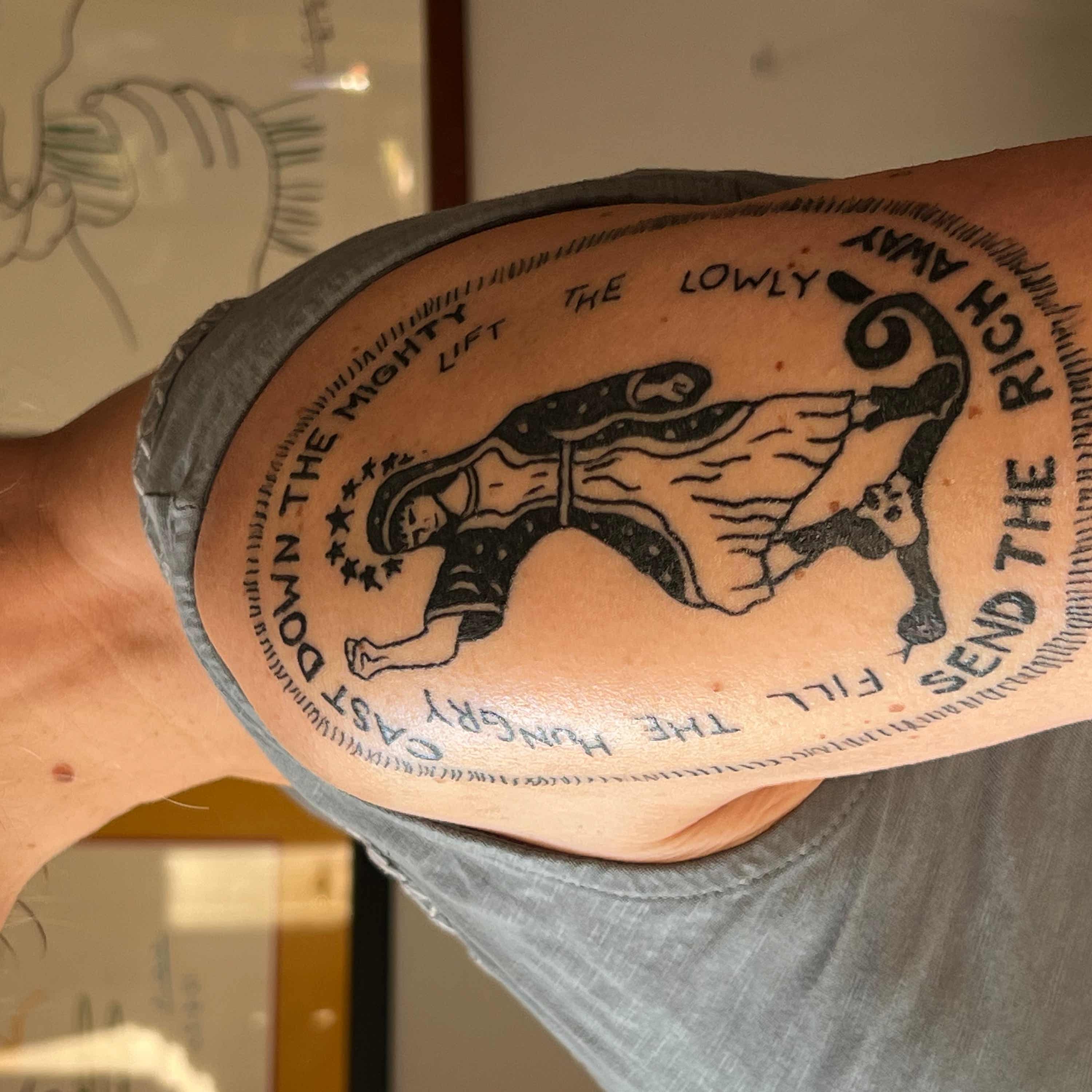
Given recent awareness of the increasing gap between the über wealthy and the rest of us, and the related power inequity too, a reflection on real-time conversations our nation is having about wealth inequity, with an assist from brother Lazarus and the nameless rich guy in Luke. This is a requested re-up of a sermon I preached last September when the passage came up in the RCL, but it references two pieces that might be timely for the third Sunday in Advent: the Magnificat, and Charles Dickens’ A Christmas Carol, so I offer it again now. ~~~~~ So when I was in late elementary school, my mama bought a hot air balloon. On our fridge, we have a picture of her positively giddy, sitting on the hood of our family’s squash-colored Buick Skylark, right after her first solo flight, a mix-of-blues thermos filled with what we were told was celebratory coffee but I have reason to be suspicious. My father had gifted my mother a ride in a balloon for her birthday, and as soon as that balloon started to fill up with air she was hooked. Her thrill was so obvious that just a week or two after her flight, the pilot—I still remember his name, Jeff Wingad—rang her up because a cheap one had just gone up for sale. It flew and all, he assured her, but some of the skirt was a bit singed, and one of the helmets was melted on the top: apparently the former owner had been super tall, and his head got a bit too close to the burner. Would she be interested? There was a lot behind that purchase: it didn’t cost much, but had been paid for by the inheritance she’d received from her own mother. And I wonder whether she could foresee certain Sundays when the wind was just right—sometimes my mom got a little tired of the tired expectations of pastors’ wives, and so when she couldn’t take it anymore, she was known to lick her finger early on Sunday morning, put it in the air to test the wind, and turn to my father and say, “It’s a good day for a balloon ride, George.” So I grew up with a hot air balloon in a trailer in our driveway, my mother occasionally in the air, and therefore a CB radio in the gondola and in that same squash colored Buick Skylark: it became known as the “Chase Vehicle,” because, well, balloonists need people to chase them, and sometimes you can’t be sure where they are when they go out of sight. You want a way to get them back to where they belong. Naturally, Mom had a CB handle: Balloonatic. My Dad, who was a preacher, had a handle too: Hot Air. It’s the “handle” part of the story, though, that came to mind as I was preparing the sermon for this morning. Isn’t it curious that one’s radio name is called “a handle?” Like, to reach someone, you have to have a handle, something to grab them by: that’s essentially the purpose of a name. Bellering out “Hey You!” in a crowd isn’t useful, but calling out “Hey Englebert!” narrows the options considerably. As you’re floating off into the great unknown, perhaps into some treacherous spaces, and people who love you can’t see you anymore, they need a handle to grab you back. They need to know your name. In Luke, we hear a story of a poor man who has a name: Lazarus, which, as an aside, means in Hebrew, “God helps.” Interestingly, Lazarus is the only named character in any parable told by Jesus anywhere, apart from him naming Abraham in this same parable. A name is not just a handle, of course: it’s a sign, a symbol that someone has worth, has dignity, deserves respect, exists. Wealthy people, see, we tend to know their names: Musk, Bezos, Cook, Gates, Trump—they have made a name for themselves. But in this story from Luke, it’s Lazarus, the poor guy, who gets a name in this tale.Even the rich guy knew his name: apparently Lazarus regularly sat on a bench outside the wealthy man’s home—benches like these were common beside the gates of the wealthy, who would help (and with some fanfare, so that they’d get recognition) the destitute who sat on them, but it seems that our rich guy had not gotten that me
Below is a fusion of some FB posts I made about Donald Trump’s obnoxious—emphasis on the ‘noxious’—words about Somali immigrants. The season of Advent would like a word. ~~~~~ Trump’s vile, abhorrent comments about the Minnesota Somali community are reflective of long-standing and normed racism toward this community, and I renounce it. In fact, I’ve had to renounce it for close to 10 years. In 2016, after my two children and I arrived in Two Harbors, and after Trump’s election, I wrote a blog in which I despaired about those who’d voted for this offensive con man: in it, as a key aside, I called out the Democrats and the Church too, for both had enabled his election. Some local Republicans found the blog, took offense, and, purely out of vindictiveness, with the sole purpose to undermine my application to the Planning and Zoning Commission to create the Spent Dandelion Theological Retreat Center, spread utterly false, completely base rumors about me. Among the untethered, unhinged gossip points, ones even intentionally spread on a local Fox talk radio station for at least two days running (on one day, the announcer even named my children, then in middle school, on air), rumors were planted, including that: ~really the ELCA is all about building mosques, and that was my true intent; ~when I lived in Sioux Falls I had harbored a terrorist from Iran; ~my OMG: Center for Theological Retreat Center was -everywhere- across the globe (they were looking at omgcenter.org, not omgcenter.com, because I wish); But the most offensive, the most troubling, the most revealing, and their main plank claim was this: I was actually intending on building not a retreat center, but rather, and I quote, a “Group Home for 30 Somalis.” I knew nothing of any of these rumors until I was ambushed with them at the local planning and zoning meeting, the publicized one at which I sought approval for my proposal for the Spent Dandelion. The place was packed, nothing but butts and elbows, because word had spread everywhere (with the solitary exception being to me), about my alleged plans. When asked if this were true, namely that I was intending on building a group home for 30 Somalis, my breath was caught. I confessed that I didn’t quite know how to answer. Most obviously, I could say that No, of course not. But then I added two things: Not only was I not intending on building a group home for 30 Somalis, I was also not intending on building a group home for 30 Norwegians either. And, I said, I was appalled at the overt racism behind the accusation. All were welcome at the Spent Dandelion, even Norwegians, but racism in any form was not. Links to the blog called “The Spent Dandelion and Truth Mattering,” with receipts—including to the on-air recordings of that Fox talk radio show—is below. We were devastated, frightened, brought up face to face with unvarnished hate, and naïve no more. ~~~~~ So yesterday, we have our convicted felon President saying of the Minnesota community, “They contribute nothing. I don’t want them in our country, I’ll be honest with you....They come from hell and they complain and do nothing but b***h.” He called them ‘garbage.’ A president, purported Christian, and convicted felon and sexual assaulter calling an entire community of citizens ‘garbage’—while pardoning a drug dealer, bombing fishermen, having pardoned convicted violent insurrectionists, and himself having been convicted of (get this) fraud—that’s next-level mind blowing bonkers. ~~~~~ There is no lie, of course, that there has been a wave of fraud cases involving the Somali immigrant community, and to pretend that that isn’t the case is to intentionally ignore an uncomfortable truth. Last year, Mr. Kayseh Magan, a US citizen of Somali decent—he served as an investigator in the Medicaid Fraud Division of the MN AG office—wrote such a thoughtful, candid, informative article in the Minnesota Reformer about how it is that these fraud cases seem to center the Somali community