Show Notes
The Sand Libraries: How Medieval Africa Inscribed Thought in Memory
There are libraries that the wind cannot erase.
In 1324, a man crossed the Sahara with a caravan so sumptuous that it shook Egypt's economy. Mansa Musa, Emperor of Mali, carried so much gold that his passage caused an inflation that lasted for decades. But the true wealth he brought back from his pilgrimage was not metallic: it was scholars, architects, books.
In this episode, we discover medieval Africa — a continent of light that the West has long forgotten.
You will enter the University of Sankore in Timbuktu, where twenty-five thousand students — a quarter of the city's population — studied mathematics, astronomy, logic. Between four hundred thousand and seven hundred thousand manuscripts were produced there. The largest collection since the Library of Alexandria.
You will meet the griots — those hereditary historians, musicians, and genealogists. A Mandinka proverb states: "When a griot dies, it is as if a library has burned." This is not a metaphor. A griot memorized the genealogies of entire villages over centuries. This system foreshadows what computer scientists call distributed memory. Information was not centralized — it was spread across a human fabric, resilient to catastrophes. You will discover Ibn Khaldun, born in Tunis in 1332, whom economist Paul Krugman called "the fourteenth-century philosopher who essentially invented the social sciences." And Al-Hassar, who invented in the twelfth century the fraction notation we still use — with the horizontal bar separating numerator and denominator.
And then the sand. Bamana geomancy, which ethnomathematician Ron Eglash described as "the most complex example of a fractal algorithm" he had encountered. These African systems were transmitted to Europe in the twelfth century. When Leibniz formalized the binary system, he knew of these traditions.
Medieval Africa had invented several ways to capture knowledge: in parchment and voice, in knots and sand. These multiple libraries — some visible, others invisible — constitute the forgotten foundations of artificial intelligence.
Sand fades, but thought endures — when it has found the right architecture to transmit itself.
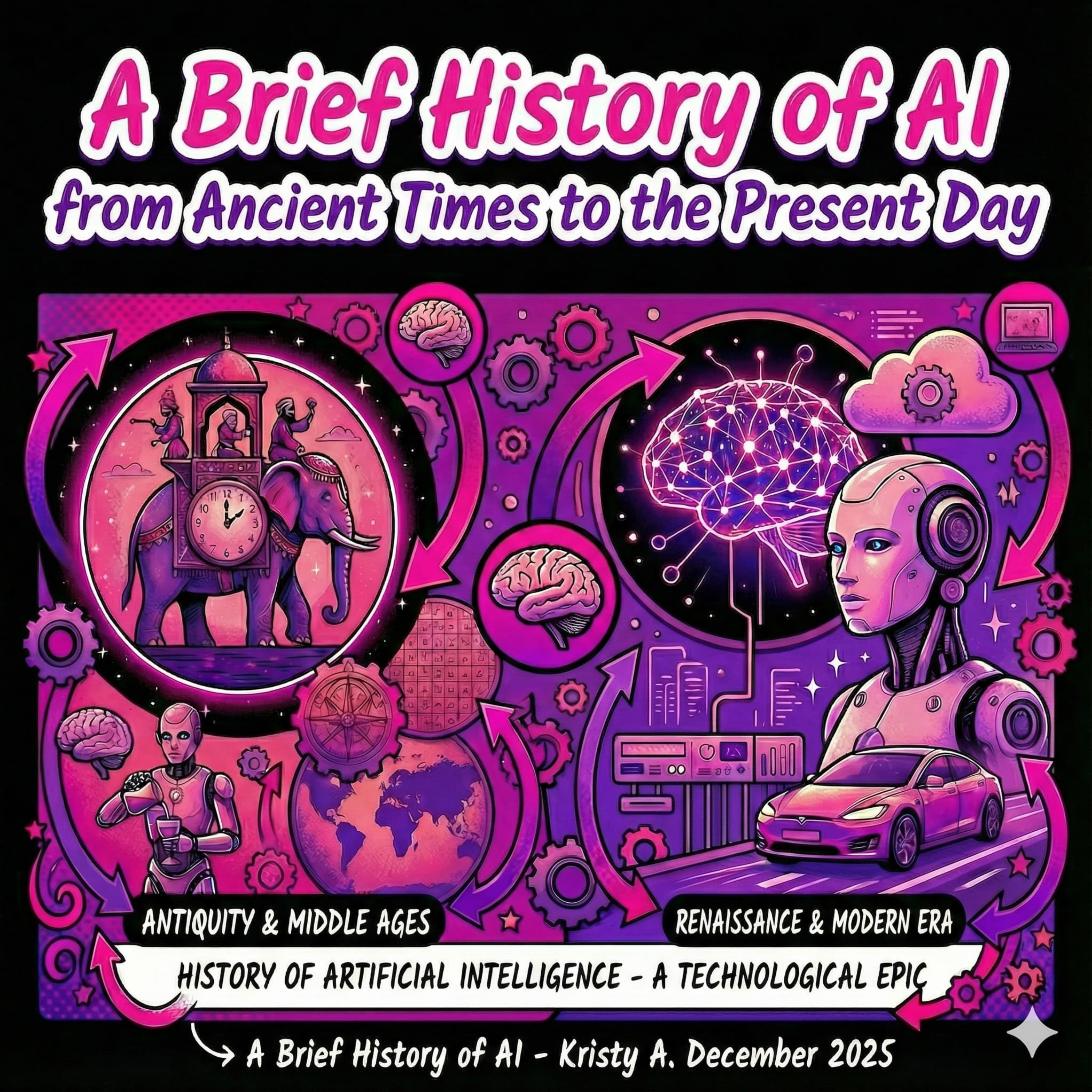
More from A brief history of AI from ancient times to the present day
What the Deep Learning Revolution Teaches Us: Conclusion and opening toward the future
Archipelago of Innovation: How Australia seeks its place in the AI revolution
Silicon Gardens: How the desert became an artificial intelligence laboratory
Rule and Exception: How Europe regulated AI and made Mistral emerge from the improbable
The New Center of Gravity: How Asia became the beating heart of global artificial intelligence