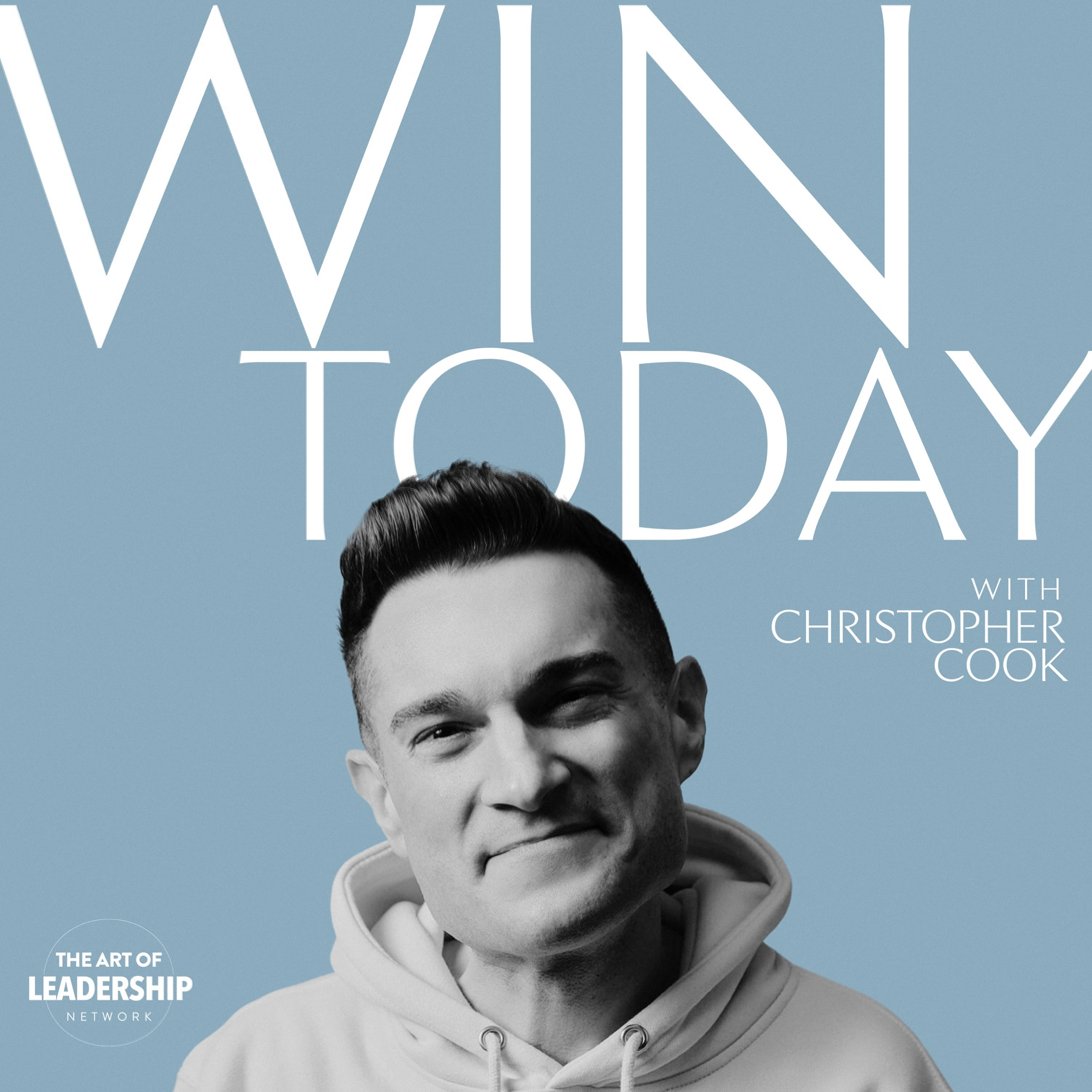
Why Are You Still Performing for the Applause You Claim Not to Need? Pentatonix's Kevin Olusola and Donovan Dee Donnell on Giving Up the Ghost and Getting Into Alignment.
Win Today: Your Roadmap to WholenessShow Notes
You already know something is off. The output is there. You're showing up, doing the work, performing at a level other people can see. But underneath all of it, there's a strain you can't quite name — a low-grade exhaustion that has nothing to do with how many hours you slept and everything to do with why you're doing what you're doing. You are working for your identity instead of from it. And no amount of productivity is going to fix a motivation problem. Pentatonix's Kevin Olusola and Donovan Dee Donnell join me today for a riveting conversation. Kevin Olusola, Grammy-winning beatboxer and member of Pentatonix, and Donovan Dee Donnell, life coach, counselor, and co-author of Designed to Succeed, join me for one of the most theologically loaded conversations this show has ever had. Kevin names something with startling precision: he gave up the ghost — not as resignation, but as full surrender to the Father at the Hollywood Bowl in 2022, performing before thousands without needing their applause because his being was finally more secure than his doing. Donovan unpacks the mechanics of fear with the clarity of someone who has lived in both the wreckage and the rebuild, walking us through what he and Kevin call the verify-purify-occupy framework, the three-move sequence for dismantling fear's claim before it ever gains a foothold. Together, they trace a thread that runs from identity through core values, through alignment and its guardrails, to the question every person of purpose will eventually have to answer: What are you willing to die for? This is not a conversation about success. It is a conversation about what happens when your motivation is finally honest enough to be sanctified. It will ask you to do something you have probably been postponing — to go to God with the actual thing, not the acceptable version of it, and let Him work with what is true. Guest Bios Kevin Olusola is a three-time Grammy Award-winning musician and beatboxer best known as a member of Pentatonix, the a cappella group that has amassed nearly five billion streams on YouTube. A Yale University graduate who came within a semester of a pre-med track, Kevin traded the expectations of his immigrant Nigerian-Grenadian family for a music career built on the unconventional combination of classical cello and beatboxing — and paid for that leap in ways that eventually led him to something more costly than a career pivot: a genuine reckoning with why he was performing at all. He is also the founder of Imagine Faith Talk, where his platform merges high-performance principles with a Pentecostal-Charismatic faith, and the author of a solo musical project, Dawn of a Misfit. Donovan Dee Donnell is a life coach, former counselor, and co-author of Designed to Succeed. A self-described introvert with an extrovert's calling, Donovan brings both the rigor of professional coaching and the honesty of someone who has navigated some dark places — including years as a stripper and a long reckoning with what it costs to build a life that isn't afraid of criticism. He is a founding collaborator on the Imagine Faith Talk platform alongside Kevin Olusola, and his coaching work centers on helping people identify the guardrails that protect alignment and do the internal work necessary to keep their motivation honest. Show Partner SafeSleeve designs a phone case that blocks up to 99% of harmful EMF radiation—so I'm not carrying that kind of exposure next to my body all day. It's sleek, durable, and most importantly, lab-tested by third parties. The results aren't hidden—they're published right on their site. And that matters because many so-called EMF blockers on the market either don't work or can't prove they do. We protect our hearts and minds—why wouldn't we protect our bodies too? Head to safesleevecases.com and use the code WINTODAY10 for 10% off your order. Episode Links Show Notes Buy my book "Healing What You Can't Erase" here! Invite me to speak at your churc
More from Win Today: Your Roadmap to Wholeness
Somewhere along the way, the performance became the person, and now you can't tell where the effort to look faithful ends and actual faithfulness begins. You know the language of sin and repentance; you can name your type, and people call you disciplined, loyal, even authentic, yet underneath sits an exhaustion that trying harder has never touched. The mask you put on to stay approved and protected has been on so long that it now feels like your face. Chuck DeGroat returns with twenty-five years of sitting with pastors, leaders, and couples whose defenses have hardened into narcissism, which he insists runs on a spectrum that includes more of us than we'd admit. About Chuck DeGroat Chuck DeGroat is a professor of pastoral care and Christian spirituality at Western Theological Seminary in Holland, Michigan, where he also serves as founding executive director of the clinical mental health counseling program. A licensed therapist, spiritual director, and former pastor in Orlando and San Francisco, he has spent more than two decades counseling pastors and leaders on the narcissistic spectrum and those wounded by them, work he wrote about in When Narcissism Comes to Church. His newest book is Who You're Becoming: The Slow and Courageous Work of Cultivating Character in a Narcissistic Age. Episode Links Show Notes Buy my book "Healing What You Can't Erase" here! Invite me to speak at your church or event. Connect with me @WINTODAYChris on Instagram, Facebook, Twitter, and YouTube.
Sitting under preaching every Sunday is not the same as knowing the Scriptures well enough to recognize when you are being led somewhere the text never meant to take you. A sermon that never confronts your sin can feel like grace, until one day you realize that your discernment and your hunger for the Lord have drifted off course a few degrees at a time. The uncomfortable question is not whether false teaching exists, but whether you would recognize it if you heard it. Philip Anthony Mitchell, founder and lead pastor of 2819 Church in Atlanta, joins me for an urgent conversation about the state of the American church. About Philip Anthony Mitchell Philip Anthony Mitchell is the founder and lead pastor of 2819 Church in Atlanta, Georgia, a congregation named for the Great Commission in Matthew 28:19, and he is known for bold, Scripture-anchored gospel proclamation and an unflinching call to spiritual maturity. He has been married to Lena since 2004, and together they have four children. His debut book, Contend, draws on the letter of Jude to call believers to stand for biblical truth in the culture while fighting for faith in the hidden battles of the heart. Episode Links Show Notes Buy my book "Healing What You Can't Erase" here! Invite me to speak at your church or event. Connect with me @WINTODAYChris on Instagram, Facebook, Twitter, and YouTube.
Dr. Les Parrott joins me for a conversation that refuses the comfort of our cultural vocabulary. As a clinical psychologist, Les insists that pain isn't the same thing as trauma, and that the difference lies in what an experience has done to your capacity to feel safe and function, not in how much it hurt. From there we press into love itself, because rescuing people from the consequences of their choices can feel like compassion while keeping them small. About Dr. Les Parrott Dr. Les Parrott is a clinical psychologist and, with his wife, Dr. Leslie Parrott, a #1 New York Times bestselling author and cofounder of the Center for Relationship Development at Seattle Pacific University. He created the Save Your Marriage Before It Starts (SYMBIS) Assessment, a premarital tool used by counselors around the world, and has given his career to helping people build healthy relationships. His newest book with Leslie, The One Year Positive Mental Health Devotional (Tyndale, October 2026), pairs biblical truth with psychological insight for anyone who has ever been kept awake by an anxious mind. Episode Links Show Notes Buy my book "Healing What You Can't Erase" here! Invite me to speak at your church or event. Connect with me @WINTODAYChris on Instagram, Facebook, Twitter, and YouTube.
You've become very good at being seen. You know how to read a room, how to offer just enough of your story to seem open while keeping the deepest thing safely out of view, how to hand the world a competent, admirable version of yourself. And still, underneath the feed and the applause and the performance you have perfected, there is an ache you can no longer explain away, because you are surrounded and you are not known. In this conversation, Ian Simkins joins me to name the quiet distance between the platform and the table, and to expose how much of our exhaustion is simply the cost of maintaining an image our bodies, our nervous systems, and our spirits were never built to sustain. About Ian Simkins Ian Simkins is the lead pastor of The Bridge Church just outside Nashville, Tennessee, where he lives with his wife, Katie, and their three sons. Shaped for years in ministry in the Chicagoland area before moving his family to Middle Tennessee, he writes and teaches out of the actual life of a local church rather than from theory. His new book, Every Table an Altar: Reclaiming Connection in a World of Division, Distraction, and Loneliness (Zondervan), was born from that community, and it makes the case that the antidote to our disconnection is not another program or platform but the ordinary, sacred practice of gathering at a table. Episode Links Show Notes Buy my book "Healing What You Can't Erase" here! Invite me to speak at your church or event. Connect with me @WINTODAYChris on Instagram, Facebook, Twitter, and YouTube.
Jonathan Eckert has spent more than three decades watching what happens to people, young and old, when comfort becomes the organizing principle of a life, and in this conversation he draws the line most of us have blurred: the line between happiness that is circumstantial, self-focused, and fleeting, and the joy the Lord actually offers, which is not the absence of struggle but the very fuel that allows us to struggle well. We talk about the frictionless world we have engineered for ourselves and what it is quietly costing our capacity to be human, about why Scripture rarely lets joy stand apart from trial, and about what it means to count it all joy when we meet trials of various kinds, not because the trial is good, but because of what the Lord forms in us when we refuse to run from it.