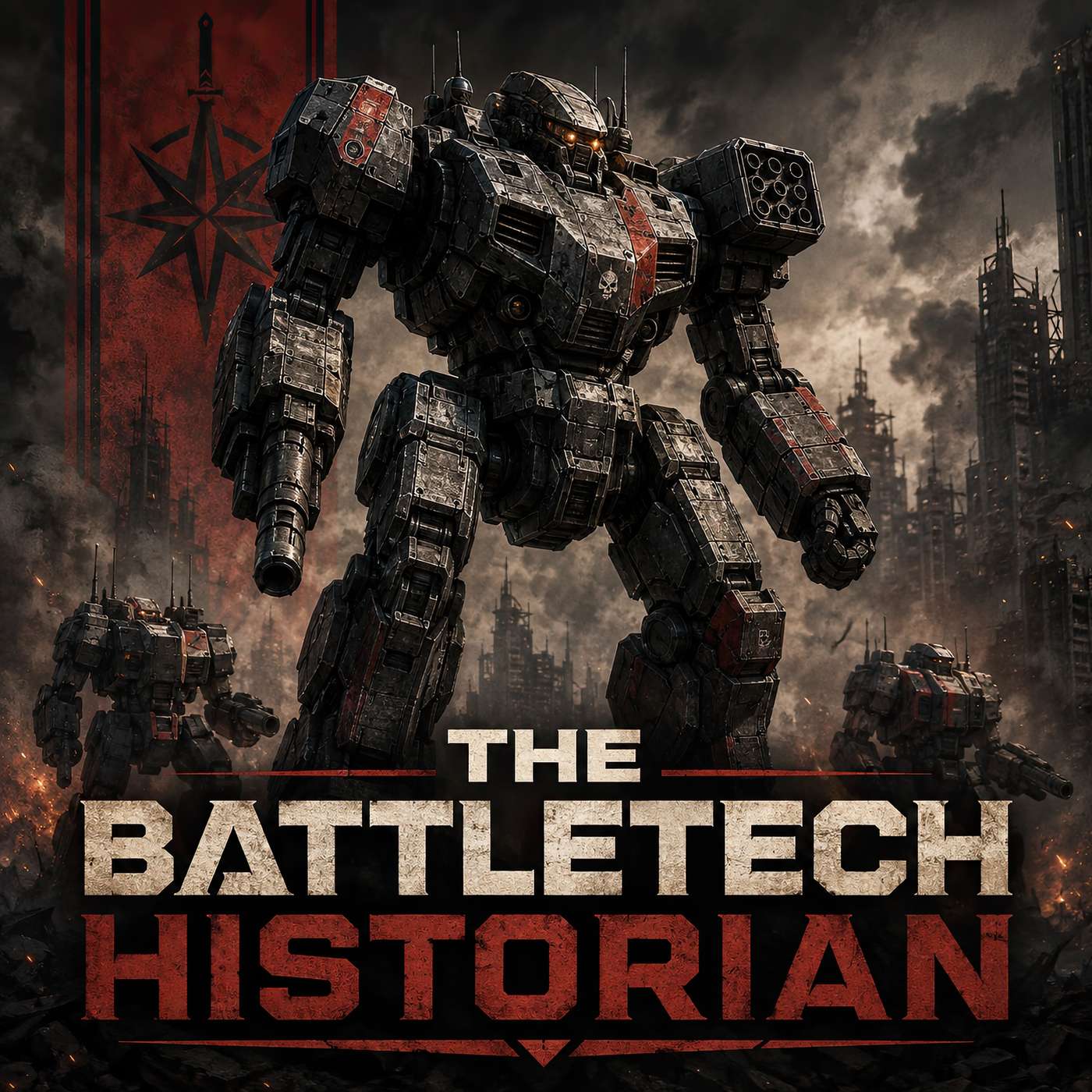
Warhammer: The Heavy ’Mech Everyone Recognizes
The BattleTech Historian: A Complete History of the BattleTech UniverseShow Notes
The Warhammer became one of BattleTech’s defining heavy BattleMechs because its silhouette and battlefield role communicate exactly what the machine is meant to do. Twin particle projection cannons provide powerful long-range fire, while additional weapons give the 70-ton design options as enemies move closer. This episode examines the Warhammer as both a military platform and a symbol of the setting. Its heavy energy armament gives it impressive striking power but creates substantial heat, forcing MechWarriors to decide when to fire aggressively and when to preserve thermal capacity. Armor and ammunition placement also make positioning important when fighting opponents capable of returning concentrated fire. Numerous variants across centuries attempted to improve protection, cooling, weapons, or electronics without abandoning the recognizable concept. The Warhammer’s fame does not come from being flawless. It comes from representing the classic BattleMech ideal: a humanoid heavy machine carrying enough firepower to threaten almost anything while demanding judgment from the pilot using it. Visit ImaginedBattlefield.com for more military and science fiction.
More from The BattleTech Historian: A Complete History of the BattleTech Universe
The Dire Wolf, Warhawk, and Executioner represent three answers to the Clan search for an assault OmniMech capable of combining overwhelming firepower with advanced technology and battlefield flexibility. The 100-ton Dire Wolf carries enormous weapons loads and became synonymous with elite Clan command, including Natasha Kerensky and other legendary warriors. The Warhawk concentrates long-range energy fire in a more specialized assault platform, using powerful weapons and targeting technology to destroy enemies before they can close. The Executioner combines assault-class mass with surprising mobility, including systems that allow a machine of its size to reposition far more aggressively than many opponents expect. This episode compares the strengths and compromises hidden inside each design. Even Clan technology cannot maximize armor, speed, cooling, weapons, ammunition, and endurance simultaneously. OmniPods allow configurations to change, but the underlying chassis still imposes choices. The perfect BattleMech remains impossible because the perfect battlefield never exists; every design is ultimately an argument about which compromises matter least. Visit ImaginedBattlefield.com for more military and science fiction.
The Timber Wolf, Summoner, Mad Dog, and Hellbringer became some of the most feared machines of the Clan Invasion because they combined heavy-BattleMech firepower with advanced mobility, weapons, and modular construction. The Timber Wolf achieved legendary status through its balance of speed, armor, long-range fire, and flexibility. The Summoner adds jump capability to a heavy chassis, giving skilled pilots unusual control over terrain. The Mad Dog emphasizes long-range missile and energy fire in a comparatively lean design, while the Hellbringer sacrifices protection to mount an extraordinary collection of weapons and electronics. This episode compares four machines that share Clan technological advantages without sharing the same battlefield philosophy. The differences matter: the Timber Wolf can adapt broadly, the Summoner maneuvers aggressively, the Mad Dog supports at range, and the Hellbringer depends heavily on striking before its limited armor becomes decisive. Together they explain why early Inner Sphere observers often believed Clan heavy OmniMechs represented an entirely different generation of warfare. Visit ImaginedBattlefield.com for more military and science fiction.
The Stormcrow, Nova, and Shadow Cat show why Clan medium OmniMechs shocked Inner Sphere commanders during the invasion. The Stormcrow combines speed, armor, and efficient weapons in a 55-ton chassis capable of fighting opponents that would normally expect an advantage over a medium BattleMech. The Nova pairs substantial energy firepower with the ability to transport Elementals, although its most aggressive configurations can generate punishing heat. The Shadow Cat emphasizes mobility and long-range striking power, using advanced technology and jump capability to attack from positions conventional medium ’Mechs may struggle to reach. This episode compares how all three designs exploit OmniMech modularity while serving very different tactical roles. Clan technology gives them exceptional performance, but ammunition, heat, terrain, pilot judgment, and logistical support still matter. Their importance lies in how dramatically they blurred established weight-class expectations. Inner Sphere soldiers accustomed to judging threat partly by tonnage discovered that a Clan medium could carry the battlefield influence of much heavier machines. Visit ImaginedBattlefield.com for more military and science fiction.
The Fire Moth, Kit Fox, and Adder demonstrate how Clan technology transformed the expectations attached to light BattleMechs. The Fire Moth combines extreme speed with OmniMech flexibility and became particularly effective at transporting Elementals rapidly across the battlefield. The Kit Fox offers a more measured balance of mobility and firepower, using modular configurations to serve reconnaissance, support, and direct-combat missions. The heavier Adder can mount weapons whose range and striking power would seem disproportionate on an Inner Sphere light ’Mech of an earlier era. This episode examines how advanced engines, lighter weapons, superior heat management, and OmniPod technology allowed Clan designers to place remarkable capability into small chassis. The same advantages could encourage overconfidence, especially when light machines were committed against massed opponents or forced into prolonged combat. These OmniMechs did not merely make scouts faster or better armed. They showed the Inner Sphere that technological efficiency could fundamentally change what a given weight class was expected to accomplish. Visit ImaginedBattlefield.com for more military and science fiction.
The Atlas is one of the most recognizable assault BattleMechs ever built, designed to look as intimidating as the weapons hidden behind its skull-like head. Created during the final years of the Star League, the 100-ton machine combines enormous armor, missile fire, ballistic punch, and close-range weapons in a platform intended to break fortified positions and dominate direct engagements. This episode examines why the Atlas became a symbol of raw BattleMech power while remaining more complicated than its reputation suggests. Its limited speed means commanders must plan how to bring the machine into decisive range, and fast enemies can exploit terrain or disengage rather than fight on its terms. Once committed effectively, however, the Atlas can absorb tremendous punishment while continuing to threaten nearly any opponent on the field. Numerous variants modernized weapons and electronics across later eras, but the fundamental identity remained unchanged. The Atlas does not need subtlety to become strategically useful; sometimes intimidation backed by overwhelming durability is itself a battlefield tool. Visit ImaginedBattlefield.com for more military and science fiction.