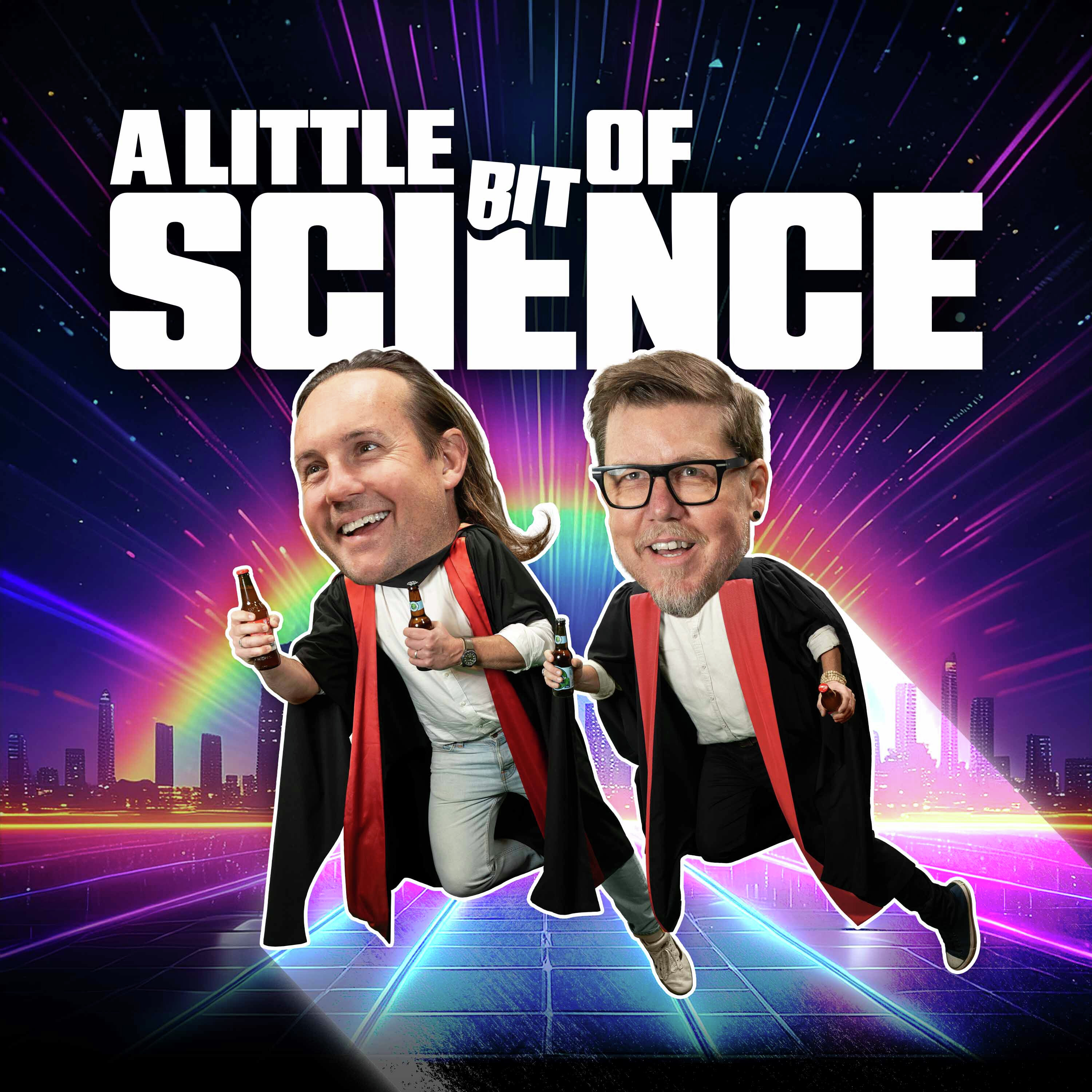
Show Notes
Deepfake scammers are now running full Zoom meetings, birds are lining their nests with cigarette butts like it’s a homewares trend, and Europe’s climate could be one ocean current wobble away from doing something dramatic. This week, Will and Rod bounce between AI crime, urban wildlife hacks, climate tipping points, and a fruit fly brain getting uploaded like it’s just another file transfer. We start in Hong Kong, where scammers used AI deepfakes to impersonate colleagues on a video call and convinced a CFO to transfer a huge amount of money. We then headed outside, where birds have started collecting cigarette butts for their nests. From there, we get serious with the ocean currents that help keep Europe mild, and why scientists are worried about what happens if that system collapses. And because the future refuses to wait its turn, we also look at a fruit fly brain mapped neuron by neuron and uploaded into a virtual simulation, plus a quick detour into hats as status symbols and tools of punishment.
CHAPTERS: 00:00 AI Zoom Scam 01:31 Show Intro and Lineup 03:02 Pipe Smoking Animal Tales 06:28 Birds Using Cigarette Butts 08:32 Nicotine as Parasite Control 11:20 School Smoking and Odd Uses 15:29 AMOC Climate Tipping Point 19:33 Uploading Brains Fruit Fly Model 23:50 Connectome Driven Fly 24:47 Virtual Embodiment Claims 25:20 Scaling Up To Mouse 26:48 Hybrid Bio Machine Futures 28:13 Hat History Detour 30:27 Hats As Social Signals
SOURCES: https://www.theguardian.com/environment/2026/apr/15/critical-atlantic-current-significantly-more-likely-to-collapse-than-thought https://edition.cnn.com/2024/02/04/asia/deepfake-cfo-scam-hong-kong-intl-hnk?_bhlid=3bc010593bc73c17aa86ed0b6e79b5ae720c787f https://www.cambridge.org/core/services/aop-cambridge-core/content/view/BE4E11BFE7F8CCF5A5A7081869710925/S0018246X26101460a.pdf/the-cultural-social-and-ideological-role-of-the-hat-in-early-modern-england.pdf https://pubs.rsc.org/en/content/articlelanding/2026/ay/d5ay01801c https://futurism.com/science-energy/birds-cigarettes-nest https://www.sciencedirect.com/science/article/pii/S0003347226000011 https://nsojournals.onlinelibrary.wiley.com/doi/epdf/10.1111/jav.01324 https://ui.adsabs.harvard.edu/abs/2024BiInv..26.1705P/abstract https://futurism.com/science-energy/research-fly-brain-matrix https://www.nature.com/articles/s41586-024-07763-9 https://pubmed.ncbi.nlm.nih.gov/39533006/ See omnystudio.com/listener for privacy information.
More from A Little Bit Of Science
This week’s episode is a reminder that science isn’t just lab coats and breakthroughs. It’s also weird human behaviour, messy systems, and the occasional moment where you realise an entire industry is making bank off… a PDF. We’re talking academic publishing as a toll road, Rapunzel Syndrome turning a fairy tale into a medical emergency, and what babies seem to expect from the world before they can even talk. First up, academic publishing. Scientists do the research, reviewers do the reviewing, universities pay for the work, and publishers still charge huge fees to publish or read it, with big players pulling in massive sums through processing charges. The kicker is that a lot of it is publicly funded, so taxpayers often pay for the research and then pay again to access it. Then we get into the human side of things, from compulsive hair eating that can become life-threatening (Rapunzel Syndrome), to experiments suggesting babies expect comfort when they cry and show stress when they don’t get it. We also touch on out-of-body experiences that don’t perform better than chance in controlled tests, and the messy reality of psychiatric diagnosis, where rigid labels don’t always match real lives.
This week’s episode: Roman concrete. The Pantheon has been standing for roughly 2,000 years with a huge dome made of unreinforced concrete, and it’s still in better shape than plenty of modern buildings. The Romans used volcanic ash and quicklime, and the chemistry seems to keep strengthening the material over time. Researchers think it may even “self-heal”, with minerals like calcite forming and filling tiny cracks as water moves through.
This week’s episode is a reminder that science news is basically three genres on rotation: animals behaving badly, humans believing wild things with full confidence, and researchers doing work that sounds like a plot twist in a sci‑fi novel. We’ve got dolphins running ocean heists, urine therapy finding new ways to stay alive online, and mice with human brain cells making everyone quietly ask, “Are we sure we’re comfortable with this?” First up, dolphins. There are reports of them stealing fish from seabirds mid-hunt, which is already rude, but it can get even stranger when you look at what counts as “food” in the ocean. This is where kleptoparasitism comes in, the polite term for stealing someone else’s meal, including forcing prey to regurgitate and then grabbing the half-digested leftovers. Then we move to urine therapy, which refuses to die on the internet despite being widely debunked. Online groups still treat it like a miracle health hack, and some people are now trying to use AI as a validation machine. When chatbots push back, they rephrase prompts or wrap them in poetry to slip past safety filters and get the answer they want. Finally, we get to the research that makes you sit back a bit. Scientists are experimenting with mice that have been given human brain cells to study brain development and neurological disease. The aim is medical insight, but it still raises the bigger question about where the ethical line sits, and how we stop “we can” from automatically becoming “we should”.
This week’s episode is a reminder that science is basically a grab bag of “that’s amazing” and “please don’t make me think about that”. We’ve got flight attendants quietly racking up cosmic radiation exposure, lasers that can “smell” disease, NASA flirting with the idea of turning plastic into food, and a deep-sea stash of radioactive barrels that looks like the world’s worst scavenger hunt.
This week’s episode is a reminder that science can make you feel tiny and powerful in the same breath. One minute we’re scanning the sky for signs of alien engineering, the next we’re looking at something that behaves like a star and a black hole at the same time, and then we’re back on Earth asking the least fun question of all: should we be building machines that can decide who lives and who dies? First up, alien mega structures. We talk Dyson spheres, the idea that an advanced civilisation could wrap its star in solar collectors and turn a sun into a power station. You wouldn’t see the structure directly, but you might detect the heat it gives off, which is why Project Hephaistos is hunting for strange heat signatures that could hint at something artificial. Then there’s the “black hole star”, which sounds made up but is very much being taken seriously. James Webb observations point to an object pumping out a ridiculous amount of energy, far beyond what normal nuclear fusion should allow. The leading idea is that it’s some kind of hybrid, where a black hole is involved in powering the light, which is not how we usually think of black holes behaving. And finally, we land back on Earth with autonomous drones, where the vibe shifts from curiosity to ethics. These systems are moving beyond remote control and into selecting and engaging targets without direct human input, which raises the big question: if a machine makes the call, who’s responsible when it goes wrong?