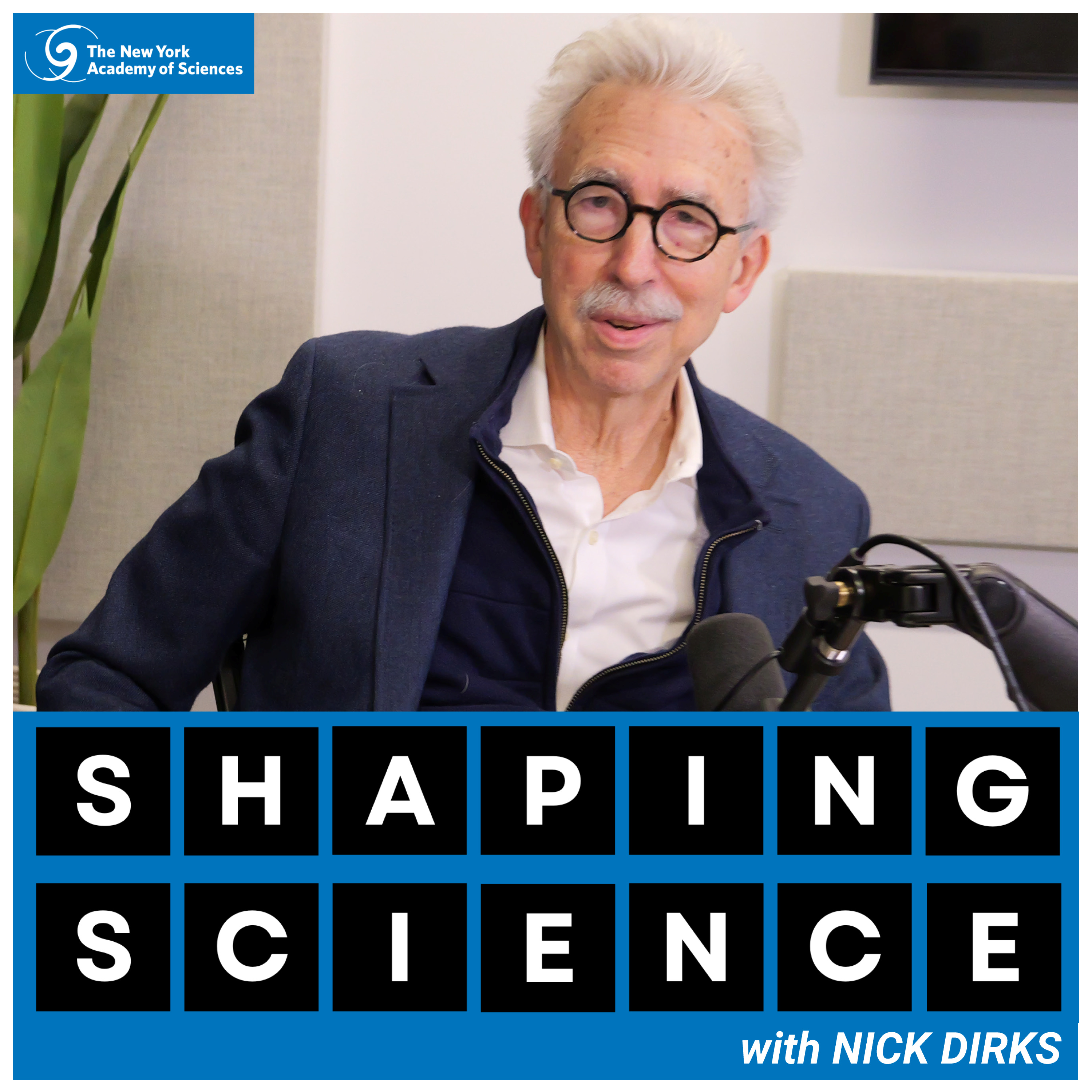
#023 Emily Eakin on the Intellectual and Philosophical Debates that Shaped a Generation and Changed the Way We Understand Language
Shaping Science with Nick DirksShow Notes
Emily Eakin, senior editor at The New York Times Book Review, whose pieces have also been published in The New Yorker, Vogue, The New Republic, The Chronicle of Higher Education, and more. She recently published her first book, ‘The Frenchmen, or My Life in Theory,’ which tells the improbable story of the prominent French philosophers that had profound and lasting influence in the 1980s and ’90s. Their impact on American education and intellectual culture was immense, with some of their ideas tying into the cultural wars of present day. ‘The Frenchmen Or, My Life in Theory’ was published in 2026 by Penguin Random House: https://www.penguinrandomhouse.com/books/317335/the-frenchmen-by-emily-eakin/ This episode of Shaping Science is made possible with the generous support of Tata Sons: https://www.tata.com/business/tata-sons 00:00 Intro 05:50 The Personal and Intellectual History of Language 13:28 A More Scientific Way of Interpreting Meaning in Language 18:40 The Intellectual Embrace of Structuralism 24:40 The French Impact on American Higher Education 28:50 The Emergence of Poststructuralist Thought 32:56 The Role of Jean-Jacques Rousseau 37:00 The Specter of Jacques Derrida 43:35 The Role of Michel Foucault
More from Shaping Science with Nick Dirks
Alek Kemeny, a member of Anthropic's Beneficial Deployments team, was trained as a quantum physicist and has spent the past year focused on a novel question: What can AI models safely do in the physical world? In August 2026, he co-led the launch of Anthropic's Model Hardware Standard, a new open specification that lets AI models like Claude read from and operate real laboratory and manufacturing equipment – including microscopes, robotic arms, liquid handlers, and lasers – through one common interface instead of relying on months of bespoke integration.This episode of Shaping Science is made possible with the generous support of Tata Sons.More about Anthropic's Model Hardware Standard.For more info, visit: nyas.org/ideas-insights/podcasts/ 00:00 Intro01:49 Leaving Academia for Industry07:53 The Advent of ChatGPT13:03 From Theorist to Experimentalist21:53 Applied AI in Enterprise Tech Sales25:47 When Claude AI Accurately Detected the Alveus in a Mouse Brain32:14 Model Hardware Standard: Claude AI and Scientific Research46:38 Devices Optimized for AI, Tangible Results, and AI Safety
Dr. Seven Rasmussen is an astrobiologist, author, educator, and science communicator whose work explores one of humanity’s oldest questions: are we alone in the universe? Dr. Rasmussen studies how planets form, evolve, and potentially support life, while also bringing these ideas to wider audiences through her writing. Rasmussen’s recent book, ‘Cloudy with a Chance of Starships,’ uses the famous Drake Equation as a starting point for exploring the odds of intelligent life beyond Earth. Cloudy with a Chance of Starships: How the Drake Equation Reveals the Odds of Life in the Cosmos was published in 2026 by Princeton University Press This episode of Shaping Science is made possible with the generous support of Tata Sons. 00:00 Intro 01:53 How Did You Become Interested in Astrobiology? 08:02 From Active Galactic Nuclei to Nuclear Astrophysics to Exoplanets 11:10 Exploring Science Fiction Writing 14:56 Writing about Science for a General Readership 18:03 What is the Drake Equation? 19:05 The Principle Issues in Cosmological Thinking 23:07 What Habitability in the Cosmos Means 29:10 The One Place on Earth that Doesn’t Have Life 33:08 Understanding Exoplanets 35:57 Finding Microbial Life Elsewhere in the Solar System 38:29 How to Become an Astrobiologist 43:34 The Need for Effective Science Communicators
Josh Lerner, a leading expert on venture capital, private equity, and innovation policy, is an economist and the Jacob H. Schiff Professor of Investment Banking at Harvard Business School. Over the past three decades, his research has shaped how governments, investors, and entrepreneurs understand the financing of innovation. Prof. Lerner’s work explores when markets succeed, when public policy fails, and what it really takes to build sustainable entrepreneurial ecosystems. His newest book ‘Rethinking Innovation’ with Jean Tirole, published earlier this year by Princeton University Press, explores how corporations have increasingly embraced the sharing of knowledge as a competitive strategy. He was also the recipient of the Academy’s inaugural Constellation Award earlier this year. This episode of Shaping Science is made possible with the generous support of Tata Sons. 00:00 Intro 02:00 The Innovation Economy and Innovation Policy 08:47 The Silicon Valley: Venture Capital, Innovation and Entrepreneurship 13:55 How Does Venture Capital Work? 20:05 Challenges Around the Innovation Economy/Ecosystem 24:53 The Global Environment Around Successful Innovation Zones 33:58 Developing Funding Mechanisms for Outside-the-Box Research 39:22 The Multi-Dimensional Role of Patents in Innovation 42:02 Regulating Innovation: Quantum Computing, AI, and Beyond 48:09 China’s Innovation Economy
Hans Peter Brondmo is a technology entrepreneur, former Google Vice President, and a leading thinker on artificial intelligence, robotics, and the future of work. He has founded several startups and held positions at Nokia in Berlin, Apple in Tokyo, and at CERN in Geneva. At Google’s X — the “moonshot factory” — he founded and led the Everyday Robots project, an ambitious effort to build general-purpose robots capable of working alongside humans in everyday environments. Across a career spanning Silicon Valley, startups, and global tech leadership, Brondmo has consistently been at the forefront of emerging technologies — from early internet marketing to social networks and now embodied AI. This episode of Shaping Science is made possible with the generous support of Tata Sons. 00:00 Intro 02:21 “Nerd Credentials” 06:40 From Toy Trains and Ham Radio to Computers and Robots 11:12 Finding Success as an Entrepreneur 13:58 Building Robots for Google: “Breaking Glass, but Not Too Much” 17:18 Pre-LLMs: The Robotic Scene in 2016 23:30 The Theory of the Robot in 2019 30:57 Parallels Between LLMs and Robotics 36:30 The Current State of Robotics 44:45 Moving Toward an AI Society
Peter Agre, MD, is a physician, molecular biologist, and Nobel Laureate in Chemistry (2003) whose discovery of aquaporin water-channel proteins transformed our understanding of how water moves through cell membranes. He is also a passionate advocate of global health, malaria research and holds the Bloomberg Distinguished Professorship at Johns Hopkins University. He is also a strong believer in science diplomacy and the role of scientists in geopolitics as described in his book - Can Scientists Succeed Where Politicians Fail? - published in 2025 by Johns Hopkins University Press. This episode of Shaping Science is made possible with the generous support of Tata Sons. 00:00 Intro 04:56 The Significance of Discovering Aquaporins 10:52 Curiosity-Driven Science: When Research Interests Meet Serendipity 16:31 From Nobel Laureate to Malaria Researcher 25:24 Utilizing Ancient Chinese Remedies 32:15 Can Scientists Succeed Where Politicians Fail? 37:17 The Role of Healthcare in the Origins of the Cuban Revolution 41:29 The Current Climate for Science Diplomacy