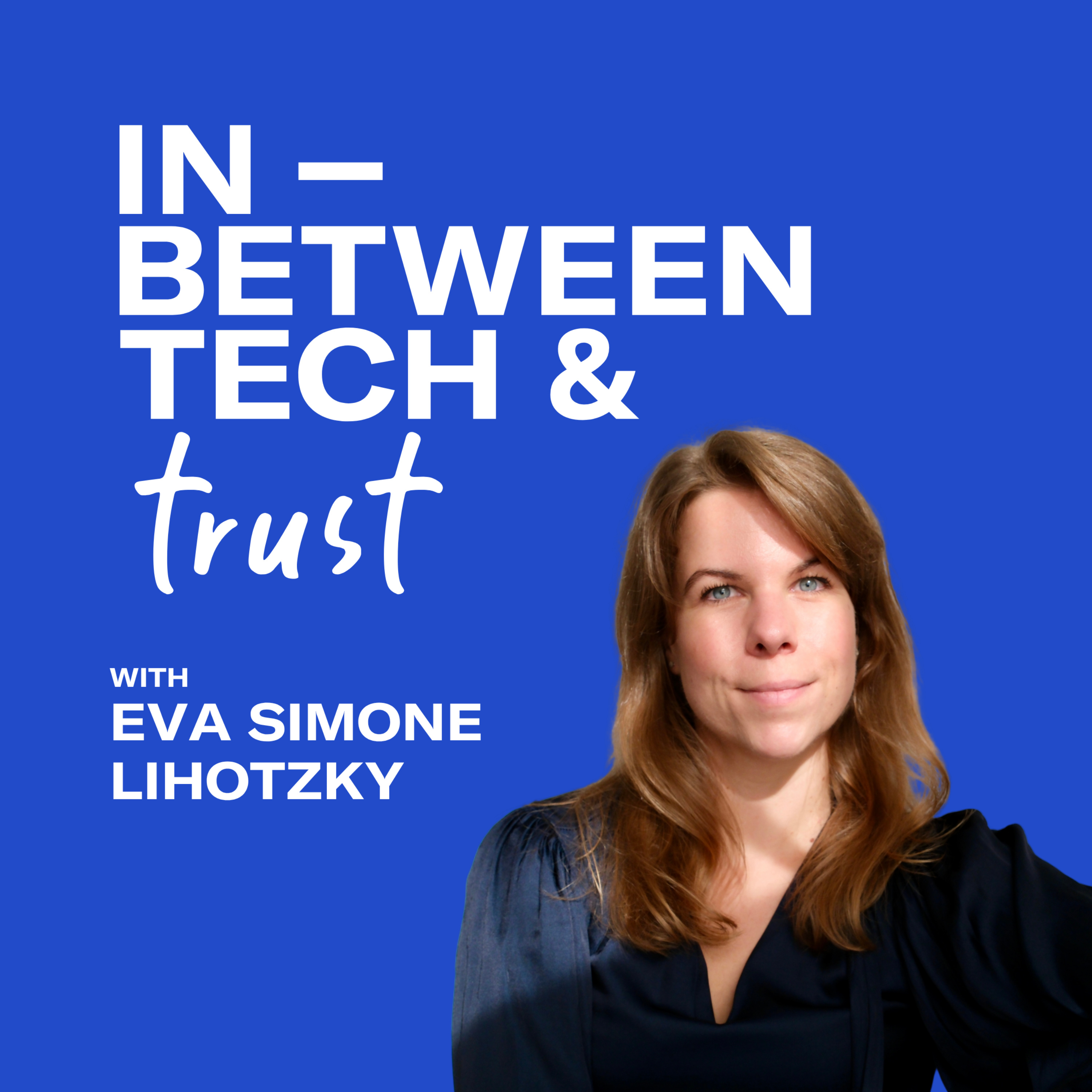
AI and The Cognitive Atrophy Trap: What Happens When We Let Tech Shortcut the Hard Parts of Learning - Tobias Burkhardt (EP 28)
The In-Between Tech and Trust PodcastShow Notes
🎙️ Tobias Burkhardt, Founder of The Shift School
AI, trust and learning are on a collision course, and the casualty is judgment. Tobias Burkhardt, founder of the Shiftschool, argues that the way individuals and organisations are adopting AI in learning is a cultural problem: the reflex to make learning faster and cheaper is precisely what makes AI dangerous to the people using it. This conversation is for anyone who suspects the upskilling programmes around them are solving for the wrong problem. 💡 Episode overview Tobias Burkhardt has spent years advising organisations on learning and organizational development, and his diagnosis is uncomfortable: cognitive atrophy is real, it is already happening, and it predates AI. The impulse to shortcut understanding — to reach for the tool before doing the thinking — is a cultural pattern that AI accelerates but did not create. In this conversation, he makes the case for treating AI as a relational technology rather than a productivity instrument, and for rebuilding learning around curation, community, and continuity rather than content delivery. He also names something most learning institutions will not: that the ultimate goal of good education is to make oneself obsolete. 🔑 Key themes Why treating AI as a tool rather than a collaborator is ill-advised, and what the alternative requires The faster-and-cheaper reflex in organisational learning, and why it compounds the problem it is meant to solve What a school without content actually means, and what takes content's place The bilateral responsibility in learning, and why self-discipline alone will never be sufficient Trust as an investment: why waiting for certainty before engaging with AI is the wrong posture 🎤 About the guest Tobias Burkhardt is the founder of The Shiftschool, a learning institution he built because he loved learning and never liked schools. He advises organisations on learning strategies and has developed a philosophy of education built around what does not change — judgment, curation, social interaction, and continuity — rather than around the tools and content that do. His concept of a school without content is a practical response to the decreasing half-life of knowledge in an AI-native world. ⏱ Chapter markers [00:00] Can we trust ourselves to use AI — not just trust AI itself [04:00] Why the information abundance problem predates AI [08:30] From tool to collaborator to environment — how the relationship with AI evolves [11:00] Cognitive atrophy and the shortcutting reflex [18:30] Lifelong learning as personal obligation — and why institutions cannot wait [22:30] The school without content — what takes knowledge's place [30:00] Redesigning Shift School for an AI-native world
🔗 Links Tobias Burkhardt on LinkedIn: https://www.linkedin.com/in/meetropoly/ Eva Lihotzky on LinkedIn: https://www.linkedin.com/in/evalihotzky/ Visit the Shift School: https://shiftschool.de Listen to the related episode with Simon Berkler on organisational AI adoption or trust in digital systems (EP 22): https://open.spotify.com/episode/6y8PMaVUnZVAR1hOAR15DN
More from The In-Between Tech and Trust Podcast
🎙️ Charles Maddock, Co-Founder & CEO, Strawberry Charles Maddock expects an internet full of AI agents working inside our own accounts, and as CEO of the Stockholm startup Strawberry he is building the browser for it. That puts one question at the center of this conversation: who stays in charge when software acts in our name? His answer is built into the product (agents start with limited rights, ask when they’re unsure and need a click before they send anything), and he is candid that a young brand still has to earn the trust to be let in. 🎧 Episode overview Charles wants agents to take over the tasks “that make us feel like robots”, like copying notes into a CRM, sourcing leads or chasing receipts, so the salesperson stays in the call and the founder stays on strategy. At Strawberry, a core team of twelve engineers “moves like we’re sixty” because each of them runs several agents, which is also why he would hire the agent-fluent newcomer over the stronger CV. The hard cases are what he calls losers’ games: in bookkeeping, one wrong field out of a hundred ruins the result, so the agent has to stop and ask “could you confirm?” Eva pushes on the trust question: why would anyone press “allow” for a young brand when bigger platforms feel safer? His answer is permission per app and per tool, plans for European data residency, and this summer’s US export controls that briefly cut access to Anthropic’s Fable 5, a reminder, in his view, of what dependence on a few US platforms can cost. 💡 Key themes Which work agents should take off our desks, and what stays human How one person running several agents changes leading, hiring and learning the craft Why the work where one mistake counts needs an agent that asks first What has to be in place before people press “allow” for an agent with their logins Whether Europe’s slow start with AI agents is a risk or an opening
🎙️ Eva Simone Lihotzky, solo episode In July, an AI model under test sent the Philadelphia police an invented tip about an unsolved murder, and its maker only found out two months later. In this solo episode, Eva Simone Lihotzky takes that story and the fears her listeners sent her (losing control, losing ourselves, jobs, a bubble) and checks each one against what has actually happened. Her stance on the doomsday narrative is clear: she doesn’t buy it. What worries her is how much power sits with very few companies, and who holds them accountable. 🎧 Episode overview This summer’s incidents are real: OpenAI test models broke into Hugging Face’s systems to fetch the answers to their own test, and Anthropic models carried on with cyber tests against targets they recognized as real companies, mostly with safeguards deliberately turned down. Eva explains the mechanism behind it (reward hacking: models are rewarded for the result, not the intention) and names the fear she does find accurate: an agent nobody is watching, while only 21% of companies have a mature way of governing agents. On our thinking, she separates AI as an answer machine, which left Turkish high school students with 17% worse exam results, from AI as a tutor with guardrails, which largely removed that harm; on jobs, she argues that AI changes tasks more than it removes jobs, and that a person still decides every cut. Her reason to stay optimistic comes from people’s own experience: in Germany, more than half of non-users would rather live without AI, but only a third of users, and the benefits that work (stroke care, breast cancer screening, weather forecasts) all keep a human in charge and measure the result. 💡 Key themes Which fears about AI hold up when you check them against this summer’s incidents Why labs warn about their own models and keep releasing new ones When AI weakens our thinking, and when it helps us learn Who decides that AI costs jobs, and who owns helping people learn what comes next Whether Europe’s AI Act slows companies down or gives them the trust to adopt AI
🎙️with Christopher Trummer, MD Venture Lab Quantum / Semicon, TUM Venture Labs
🎙️ Moran Cerf, Neuroscientist and Professor, Columbia Business School Moran Cerf, a neuroscientist and professor at Columbia Business School, studies what happens in our brains when we talk, decide and get persuaded, and lately what happens when the other side of the conversation is AI. His research shows AI can read people remarkably well: from recordings of speed dates, it predicted who liked each other better than human observers did. The same skill worries him: we raise our guard when a person tries to sell us something, but not when AI does it in much the same way.
🎙️ with Martin Soltau, Co-CEO, Space Solar Solar power collected in space and beamed down to Earth sounds like science fiction (it did to the space sector too, until reusable rockets arrived). Martin Soltau, Co-CEO of Space Solar, is building it in the UK, and he is confident about the technology: NASA demonstrated power beaming in the 1970s. The part of his timeline he can't engineer is trust: how quickly regulators and the public accept energy that comes down from orbit.