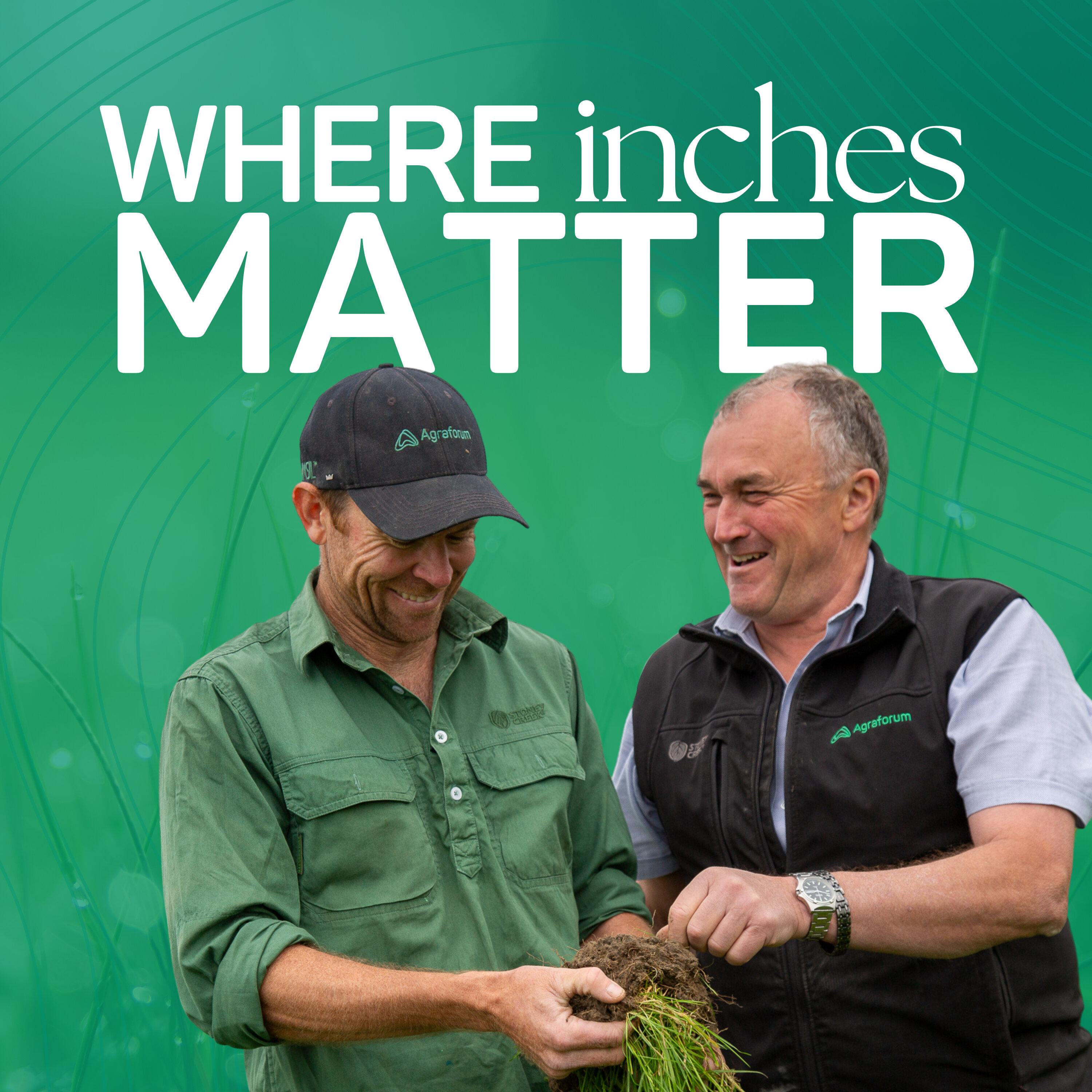
Ep 3 - How to truly read a soil test to be effective with your fertiliser
Where Inches Matter by AgraforumShow Notes
Not all soil tests are created equal and the advice you are being given maybe connected to someone also wanting to sell you fertiliser. In this episode of Where Inches Matter, host Alan Piercy from Agraforum breaks down the science behind soil testing and why it’s crucial to look into it deeper for getting the best results on your farm. Alan explains what to ask for in a soil test, including key elements like pH, CEC (Cation Exchange Capacity), and ASC (Anion Storage Capacity), which help determine how nutrients behave in your soil. Using a classic beer analogy, Alan illustrates how different soils hold onto or lose nutrients like phosphorus and sulfur. If you’re in the South Island, chances are your soil isn’t holding onto these elements effectively, meaning much of your fertiliser could be washing away before your plants even use it! He also dives into the importance of oxygen in soil structure, how plants take up nutrients, and why timing matters when applying fertilisers. By the end of this episode, you’ll have a better understanding of how to interpret your soil tests, make smarter fertiliser decisions, and ultimately improve plant and animal health. Key Topics: ✔ Why soil testing is essential (and what to watch out for) ✔ Understanding ASC and how it affects nutrient loss ✔ How oxygen impacts nutrient uptake and plant health ✔ The connection between soil fertility and animal nutrition 🔎 Want to learn more? Visit www.agraforum.co.nz for details on soil testing, fertiliser strategies, and proven methods to improve soil structure and animal health. See omnystudio.com/listener for privacy information.
More from Where Inches Matter by Agraforum
When Agraforum first started using BioN, the early paddock results looked promising. But as Dr Gordon Rajendram told Allan Piercy at the time, looking promising and proving something are two very different things. In this episode, Allan sits down with Gordon to talk through what happened next: setting up proper replicated trials, what they learnt during the first year, why water and timing made such a difference, and what the completed programme ultimately showed when BioN was put up against urea. Gordon also talks about his approach to trial design after 22 years with AgResearch, the role clover plays in the wider nitrogen story, and what the next round of BioN research is looking to answer. It’s a straightforward conversation about how BioN went from something that looked like it worked in the paddock to something Agraforum was prepared to put through proper scientific testing, and why that work is continuing. Listen to the full conversation to hear how the trials were run, what changed along the way, and what Agraforum is testing next. See omnystudio.com/listener for privacy information.
In this episode of Where Inches Matter, Allan Piercy interviews Gerhard Vermaak of Custom Chemistry, developer of BioN - a patented biological nitrogen fixation technology. Over the past three years, replicated New Zealand pasture trials have shown statistically significant results, with BioN matching or exceeding urea performance under commercial conditions. Topics covered include: • The energy equation behind nitrogen fixation • Why microbes need carbon and how photosynthetic bacteria supply it • The 1000:1 carbon-to-nitrogen relationship explained • Water rates, soil volume and macro-porosity • The role of molybdenum, cobalt and iron in nitrogenase function • Cold weather performance • Glyphosate, copper and microbial sensitivity • Why this behaves like a true slow-release nitrogen source • Patent status and global rollout This is a technical discussion grounded in field data and real farm experience. Subscribe for more episodes focused on practical, evidence-based agronomy. See omnystudio.com/listener for privacy information.
Dion Gordon manages three dairy farms in Canterbury, milking 3,500 cows across a range of soil types. What began with closer soil testing and questioning fertiliser use led to changes in how nitrogen is supplied across the farm. In this episode of Where Inches Matter, Dion talks about reducing fertiliser inputs, why BioN made sense as an alternative to urea, and how the system is still delivering the same pasture growth, with a lower footprint. Listen to the full episode now. See omnystudio.com/listener for privacy information.
In this episode of Where Inches Matter, we sit down with coastal dairy farmer Stu Russell to talk soil compaction, nitrogen decisions, and what actually changed on farm after trialling Bio-N.
In this episode of Where Inches Matter, Allan takes you straight to the paddock for a hands-on discussion about soil health, pasture growth, and the direct impact on farm profitability with South Canterbury farmer, Andrew Grant . We visit a farm near Geraldine that once struggled with highly compacted soils, heavy nitrogen use, and poor-quality pasture that the cows didn’t want to eat. But through strategic soil management and reducing synthetic fertiliser inputs, this farm has undergone a remarkable transformation. Our guest farmer shares his experience of moving away from high nitrogen and phosphorus applications, which were leading to compacted soils, poor plant nutrition, and animal health issues. Since cutting back on synthetic inputs and improving soil structure with products like Envirocare and Comcat, he has seen incredible changes: ✔ Healthier Soil Structure – The once rock-hard, compacted ground is now loose, well-aerated, and teeming with worms. ✔ Better Pasture Growth – Grass is thriving, and cows are more willing to eat it, leading to higher intakes and better milk production. ✔ Improved Animal Health – Reduced metabolic issues and lameness, with healthier cows performing at their best. ✔ More Efficient Water Use – With better soil structure, water retention has improved, meaning less irrigation is needed. We also dive into grass growth measurement techniques, including the use of plant meters and AgriNet for tracking pasture performance, forecasting, and planning silage cuts. The farmer explains how independent fertiliser advice has been a game-changer, helping him make more informed decisions without over-reliance on synthetic inputs. This episode is a must-listen for any farmer looking to improve pasture quality, cut input costs, and boost farm productivity through better soil management. 🔎 Want to learn more? Visit www.agraforum.co.nz for details on soil testing, fertiliser strategies, and proven methods to improve soil structure and animal health. See omnystudio.com/listener for privacy information.