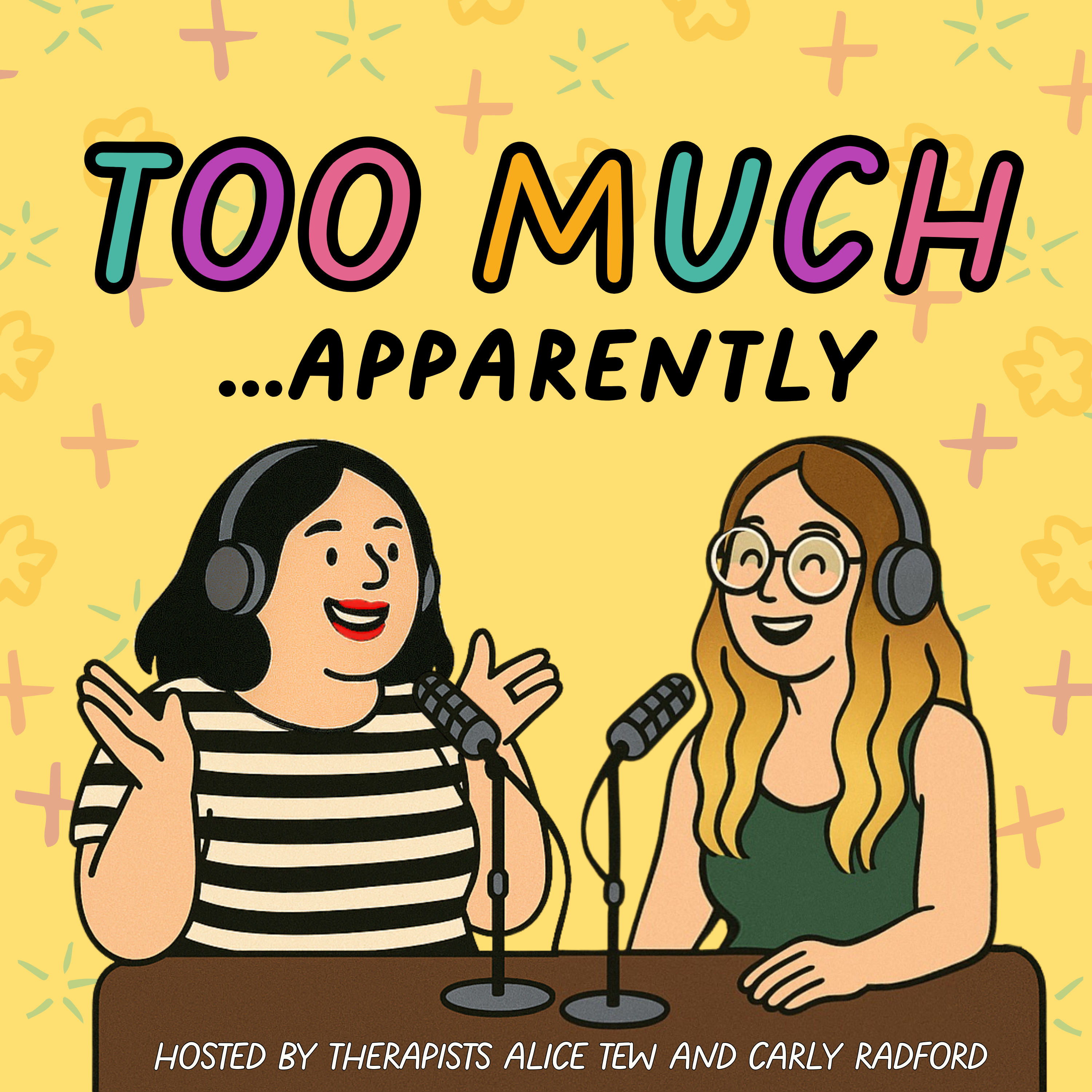
36. Too Sensitive to Run a Business - Values, Burnout & Building a Business That Actually Feels Good
Too Much, ApparentlyShow Notes
Ever felt like you’re too sensitive to run a business?Yeah. Us too. In this episode of Too Much Apparently, we (Carly and Alice — two therapists trying to build something meaningful without losing themselves in the process) get real about what it’s like to run a business when you care deeply about people, ethics, and doing things in a way that actually feels right. We explore the tension between authenticity and self-promotion, the pressure to market in ways that feel uncomfortable, and what it’s like to try and build something sustainable when your nervous system isn’t built for hustle culture. This time we talked about: 🎙️ We’ve felt this thing too (and we still do): Questioning if you’re cut out for business, feeling icky about marketing, and wondering if you’re just “too much” or not tough enough for it. 👀 What it looks like in real life: Trying to juggle all the roles of running a business, comparing yourself to people doing more, feeling pressure to say yes to everything, and struggling with the vulnerability of essentially “selling yourself.” 🧠 Why our brains do it: Strong values, empathy, fear of rejection, people-pleasing, trauma patterns, and living in a system that often rewards profit over people. 🧍🏽♀️🧍🏻 The different ways it shows up: Undercharging, overworking, avoiding visibility, burnout, conflict around money, and feeling torn between helping people and needing to earn a living. 🧰 Coping mechanisms: Setting boundaries, making intentional decisions, learning to say no, finding ethical ways to market, and building a business that works with your energy rather than against it. 🌱 How to make peace with it: Maybe you’re not too sensitive for business — maybe you just need to do business differently. Thanks for listening 💛💜🩷🩵🧡
💬 New episodes every Monday. 🎧 Follow now to join the conversation.
🧡 CONNECT WITH US 🎙️ Podcast socials: → Instagram: @toomuchapparently → TikTok: @toomuchapparently → YouTube: Too Much, Apparently → Website: www.toomuchapparently.com
👩💻 Carly Radford: → Website: www.carlyradford.com → Instagram: @the_sensitivity_therapist 👩🏻💻 Alice Tew: → Website: www.alicetew.com → Instagram: @reparentingwithalice
📩 Email us: [email protected] 🗓️ New episodes every Monday This is a podcast that says: bring your too-muchness… we’re here for it.
Disclaimer: Just a quick note to say this podcast isn’t therapy, and it’s not a substitute for professional support. We’re here to share ideas and experiences, but if you’re struggling, please reach out to a mental health professional or a support service near you.
More from Too Much, Apparently
Ever felt like you're too obsessed with becoming better to actually enjoy being you? Yeah. Us too. In this episode of Too Much Apparently, we (Carly and Alice - two therapists and recovering perfectionists with squishy brains) get real about optimisation culture, and why trying to improve every corner of your life can leave you more exhausted than when you started. We unpack our own resistance, spiral in real-time, and share what it's like to want to make something honest while also being scared it might be boring / cringe / too much / not enough. This time we talked about: 🎙️ We've felt this thing too (and we still do): Hello perfect morning routines, panic about how to "do" our time off, and secretly wanting someone to just sell us the answer 👀 What it looks like in real life: Writing a routine out to the minute (7:00, 7:05, 7:18) and dropping it within a week, trying to rest perfectly and be productive at the same time, recommending a slow-living creator with a disclaimer not to actually live like her 🧠 Why our brains do it: Fear and not-good-enough, the belief that there's an answer out there that will finally fix us, all-or-nothing thinking, and being so surrounded by it that we stop noticing (the fish doesn't know it's in water) 🧍🏽♀️🧍🏻 The different ways it shows up: Optimisation culture telling you you're living wrong, anti-optimisation culture telling you you're resting wrong, and growth optimisation telling you you're wrong as a person 🧰 Coping mechanisms: Asking "is this actually working for me in practise, not just on paper?", celebrating one new thing instead of writing the whole routine off, and noticing who the optimising really serves 🌱 How to make peace with it: You might not need a better plan, you might just need to stop treating yourself as the thing that needs fixing Thanks for listening 💛💜🩷🩵🧡 Resources mentioned The Invitation (poem and book) by Oriah Mountain Dreamer Acceptance and Commitment Skills for Perfectionism and High-Achieving Behaviors Jodie Melissa Rogers (slow-living content)
Ever felt like you’re too overwhelmed to reply? Like someone you genuinely love messaged you six days ago, you’ve thought about replying approximately 37 times... and somehow actually typing the words has become an impossible administrative task?
Ever felt like you're too fatigued to keep going, but you keep going anyway because stopping feels like failing? Yeah. Us too. In this episode of Too Much Apparently, we (Carly and Alice, two therapists and recovering perfectionists with squishy brains) get real about quitting, burnout and the "just push through" script most of us were handed without ever agreeing to it. We unpack our own resistance, spiral in real-time, and share what it's like to want to make something honest while also being scared it might be boring, cringe, too much or not enough. This time we talked about: 🎙️ We've felt this thing too (and we still do): Alice quitting her A-levels three times, Carly dropping out of college over the walk to the bus stop, both of them quitting a theatre group they genuinely loved 👀 What it looks like in real life: letting the gym membership lapse, going quiet on the group chat, building a 2am case for why that makes you lazy 🧠 Why our brains do it: productivity being tied to worth from childhood, masking as an undiagnosed or newly diagnosed neurodivergent adult, being told "just keep going" by people who mean well but don't feel what you feel 🧍🏽♀️🧍🏻 The different ways it shows up: chronic illness limiting what's possible rather than motivation being the problem, quitting something tied to your identity and grieving who you thought you'd become 🧰 Coping mechanisms: naming "if people knew the whole story, they'd understand," adding small nourishing things instead of only stripping things away, tracking energy rather than guessing at it 🌱 How to make peace with it: quitting the things that aren't right for you makes room for the things that are. Thanks for listening 💛💜🩷🩵🧡 Resources mentioned TheraSummit - Carly's talk "Beyond It's Just Anxiety: What Every Therapist Should Know About Working With Chronic Illness"
Ever felt like you’re still too much even after years of trying to understand yourself? Yeah. Us too.
Ever felt like you're too conflicted to know what the right thing even is, because you care about so many things at once that none of them feels fully doable? Yeah. Us too. In this episode of Too Much Apparently, we (Carly and Alice - two therapists and recovering perfectionists with squishy brains) get real about what happens when your values start competing with each other, and with the world you actually have to live in. We unpack our own resistance, spiral in real-time, and share what it's like to want to make something honest while also being scared it might be boring / cringe / too much / not enough. This time we talked about: 🎙️ We've felt this thing too (and we still do): Hello standing paralysed in front of 50 slugs in the rain, refusing to give money to Meta, and doing moral maths over a single tomato 👀 What it looks like in real life: buying the cheaper less-ethical option because that's the budget, wanting to cause a fuss and being scared of being the troublemaker, feeling like a class traitor 🧠 Why our brains do it: strong values held fiercely, all-or-nothing thinking, perfectionism, and living inside systems like capitalism that clash with what we care about 🧍🏽♀️🧍🏻 The different ways it shows up: internal values that fight each other versus ongoing external conflicts we can't opt out of 🧰 Coping mechanisms: capacity over perfection, deciding by the day, letting good enough actually be enough 🌱 How to make peace with it: maybe there is no comfortable place to land, and feeling the weight of your choices is a sign of a working conscience, not a broken one Thanks for listening 💛💜🩷🩵🧡