Attachment-Informed Therapy for Neurodivergent Parents: Why “Good Parenting” Can Look Different
Attach TogetherShow Notes
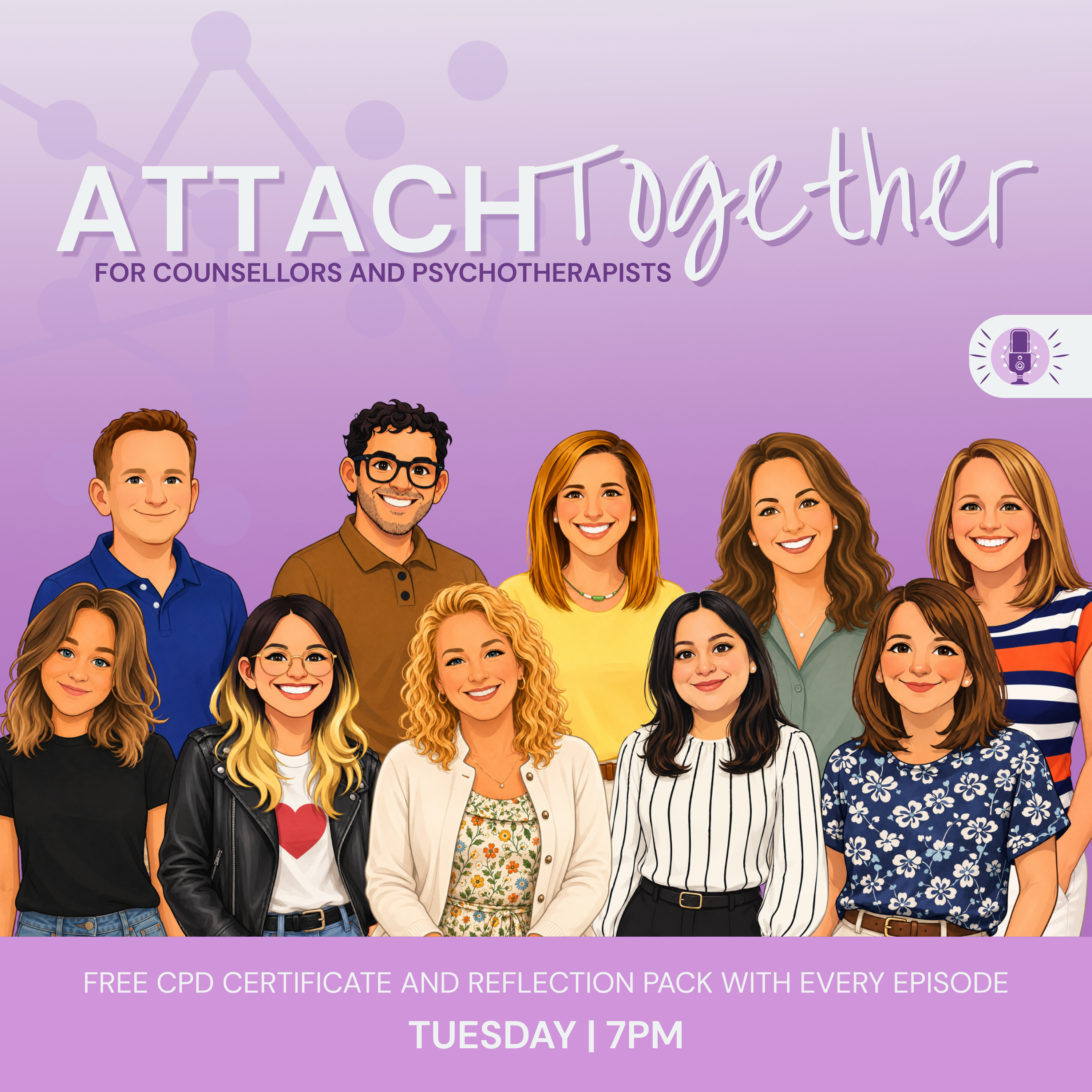
In this episode of Attach Together, Joanne Kay is joined by Lyn Coombs and Alison Cunningham to explore what therapists need to understand when working with parents of neurodivergent children. Attachment-informed therapy for neurodivergent parents is an approach that offers relational safety, curiosity and non-judgement while helping parents explore their own emotional needs, attachment responses and experiences of caregiving. The conversation considers how parents can become highly attuned to sensory, emotional and behavioural cues that others may not notice. This attunement can become a strength, but it may also leave parents feeling as though they are constantly anticipating difficulties, managing risk or “firefighting”. In this episode, you will hear about: Why believing a parent’s experience is clinically important How societal judgement can become internalised as shame The difference between loving a child and enjoying every part of parenting Why parents may grieve expectations without rejecting their child How neurodivergent parenting can affect partners, siblings and wider relationships Why talking about the child may be a necessary starting point in therapy How therapists can notice body language, dysregulation and unspoken emotion The importance of allowing anger, guilt, pride, grief and love to coexist How attachment-informed therapy for neurodivergent parents can provide a secure, accepting base Guests Lyn Coombs is an attachment-based and person-centred counsellor specialising in bereavement, domestic abuse and work with parents of neurodivergent children and carers. Alison Cunningham is an integrative counsellor who works with young people, including those with care experience, and with neurodivergent people. Common questions How can therapy support parents of neurodivergent children? Therapy can offer a place where parents do not need to minimise, edit or justify their experiences. It can help them identify their own feelings, needs and attachment responses while remaining compassionate towards their child. Can parents love their child and still feel angry or overwhelmed? Yes. Love, pride, grief, frustration and exhaustion can exist at the same time. Conflicting emotions do not make someone a bad parent. Why might a parent spend therapy talking mainly about their child? Talking about the child may help the parent process experiences they have not previously felt safe enough to express. As trust develops, their own feelings and needs may become more accessible. Chapters 00:00 Introduction to Attach Together 01:07 Meet Lyn Coombs and Alison Cunningham 02:27 Why parents need to be believed 04:43 Societal judgement and parenting blame 05:44 ADHD medication and the “marbles” analogy 07:43 Parenting styles, attachment and research 09:56 External pressures and parental guilt 11:31 Isolation and the shrinking village 13:00 Rethinking secure attachment in neurodivergent families 15:38 Parental self-doubt and intense attunement 18:00 Clinical dilemma: keeping therapy focused on the parent 19:30 Creating space for mixed emotions 22:30 Reading what is not being said 23:38 Shame, anger, grief and love 25:23 Effects on partners and siblings 26:13 Closing reflections
FREE CPD Certificate & Reflection Pack You can download the FREE CPD Certificate for this episode via our website www.optimahealthservices.co.uk and join our listener list to receive the Reflection Pack for future episodes.
More from Attach Together
What happens to attachment patterns when therapy moves from a one-to-one relationship into a group? In this episode of Attached Together, attachment-based psychotherapist and supervisor Georgina Sturmer is joined by psychotherapist, author and group facilitator Sarah Dosanjh, widely known as The Binge Eating Therapist. Drawing on Sarah’s experience of running therapy groups, support groups, courses and workshops, they explore attachment in group therapy and the extraordinary amount that can become visible when people are relating not only to a therapist, but to one another. Sarah describes the importance of creating a clear purpose for a group and preparing people for what participation will actually involve. She also shares one of the questions she asks new members: “Who are you in a group?” It is a deceptively simple question. People arrive in groups with a lifetime of experience of belonging, adapting, caregiving, staying quiet, taking up space, managing conflict and protecting themselves. For some of Sarah’s clients, people-pleasing and caregiving can create a warm and supportive group while also making it easier to focus on everyone else rather than themselves. The conversation explores what makes a therapy group different from a support group, including Sarah’s repeated invitation to notice what is happening internally even while somebody else is speaking. Georgina and Sarah also consider rupture and conflict, the therapist’s own reactions when tensions emerge, and the things that may remain unsaid when group members find disagreement difficult to tolerate. They look at the particular experience of online groups, boundaries around contact outside the group, and why an emotionally intimate connection created within therapy does not necessarily translate easily into friendship elsewhere. And then there are endings. Sarah describes what can happen when somebody announces that they are leaving: the group member whose immediate thought is, “Was it me?”, the different ways people approach goodbye, and the therapist’s own attachment responses to departures. There is also an unusually candid exploration of therapist fallibility. Sarah recalls making a comment to a group member that she intended as teasing but realised had landed with a bite. Rather than allowing the moment to disappear, she returned to it, acknowledged what had happened and invited the group to explore its impact. The episode offers a thoughtful reminder that therapeutic safety does not require a therapist to become a perfect facilitator. Rupture, uncertainty, endings and mistakes can themselves become part of the work. For therapists curious about starting a group, Sarah also shares practical observations from years of group work, from defining a clear niche and setting a start date to establishing boundaries and commitment. Above all, the conversation explores why group therapy can offer something that individual therapy cannot quite replicate: attachment patterns unfolding between peers, in real time. Optima Attachment Training: UK: https://www.optimaattachment.co.uk/ AUS: https://www.optimaattachment.com.au/ Listeners can access a CPD certificate and reflection pack for this episode here.
What happens when attachment theory is applied without enough attention to culture, faith, migration, identity or power? In this episode of Attached Together, Optima lecturer, psychotherapist and supervisor Uruj Anjum is joined by Myira Khan, an award-winning accredited counsellor, supervisor, coach, trainer, author and founder of the Muslim Counsellor and Psychotherapist Network (MCAPN). Together, they explore attachment theory and culture through an anti-oppressive lens, asking what can be missed when ideas about secure attachment are applied too literally or through culturally dominant assumptions. Myira considers attachment as something shaped within a much broader relational world. What changes when a child grows up with several caregivers rather than one primary caregiver? How might migration, displacement, racism, Islamophobia or a changing sense of home affect experiences of safety, rejection and belonging? And what happens when therapists either fail to ask about identity at all, or focus so heavily on one part of a client’s identity that the rest of the person disappears from view? The conversation also explores culturally attuned therapy with Muslim clients. Myira challenges the assumption that sharing a faith identity makes people’s experiences of that faith the same, and discusses why clients should not have to become their therapist’s teacher on Islam, culture or identity. An ethical dilemma brings these ideas into the counselling room. If a Muslim client facing loss, infertility or a difficult diagnosis says they are “leaving it in Allah’s hands”, should a therapist understand this as avoidance? Or might faith be offering hope, security and an active way of relating to something beyond the client’s control? Rather than reaching too quickly for a label, Myira invites therapists to become curious about what the belief means to that individual and what their decision to come to therapy already tells us. The episode closes with a deceptively simple challenge to therapeutic neutrality: the work happens between two whole people. Culture, identity, attachment patterns and lived experience do not stay outside the counselling room. As Myira puts it: “human first, therapist second.” Learn more about Optima Attachment Training: https://www.optimaattachment.co.uk/ Listeners can also access a CPD certificate for this episode.
What happens when an AI relationship starts to feel safer, easier or more dependable than a relationship with another person?
Dreams can reveal parts of a client’s inner world that are not always easy to reach through conversation alone. Through attachment theory, they may offer clues about attachment styles, relationships and what a client expects when they feel vulnerable or need someone.
Attachment theory child therapy looks beyond a child’s behaviour to the relationships and systems around them. In this episode of Attach Together, Georgina Sturmer and child and adolescent psychotherapist Alix Hearn explore attachment, play, intergenerational patterns, place and therapeutic relationships. What is a systemic approach to attachment? A systemic approach to attachment looks at the relationships, histories and environments surrounding a child, rather than locating difficulty within the child alone. Alix explores how family, education, culture, trauma and wider systems can shape a child’s experience, drawing on Bronfenbrenner’s ecological model to support attachment-informed formulation. In this episode Georgina and Alix explore: Why attachment needs to be understood relationally and systemically The limitations of focusing solely on a child’s behaviour Intergenerational attachment patterns and trauma Therapeutic relationships with parents and carers Play as a language of relationship in child therapy Attachment, belonging and the “more-than-human world” Place attachment and physical environments Children’s agency and choice in therapy How systems can recreate relational difficulties The ethics of very short-term therapeutic work Alix also raises an important clinical question: when a child has experienced repeated loss, disruption or relational trauma, is offering six sessions necessarily better than offering no therapy at that point? Might supporting an adult or another part of the child’s wider system sometimes be more appropriate? The discussion leaves space for practitioners to think about these questions rather than suggesting a universal answer. Common questions What is attachment theory in child therapy? Attachment theory in child therapy helps us consider how experiences of safety, connection, separation and relationships may shape how a child relates to themselves and others. How do attachment styles affect relationships? Attachment patterns can influence expectations of closeness, safety, care and connection. Alix encourages curiosity about these patterns without reducing people to fixed categories. Why consider the wider system? A child’s difficulties may make more sense when considered alongside family relationships, intergenerational experiences, education, culture, professional systems and environment. What role does play have in attachment-informed therapy? For younger children in particular, play can be a primary language through which relationship, emotion and experience are communicated. Chapters 00:00 Welcome to Attach Together 01:40 Rethinking attachment through systems and environment 04:22 Intergenerational attachment and family formulation 05:46 The circles and systems surrounding a child 09:34 Building trust with parents and carers 11:19 Working therapeutically with families 12:32 Play as the language of child therapy 17:25 Children’s agency and choice in therapy 19:16 Place attachment and the more-than-human world 23:37 Ethical dilemma: is short-term therapy always helpful? Resources Alix Hearn: alixhearn.co.uk Book: Places of Safety: How Attachment Shapes Our Parenting Optima: OptimaAttachment.co.uk Listeners can also access a CPD certificate to record their professional learning.