Show Notes
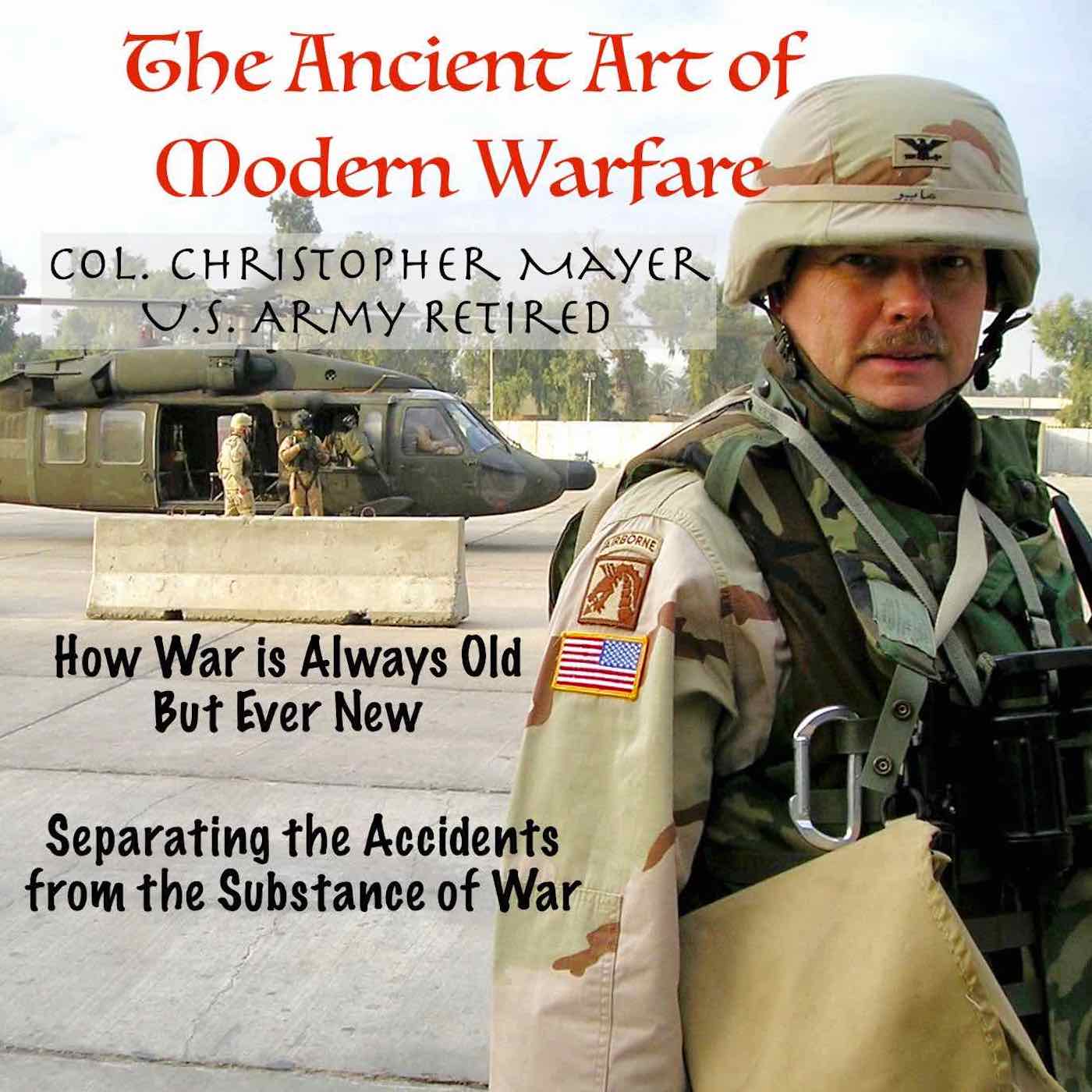
In my closing podcast summarizing the Ancient Art of Modern Warfare I review key points from Episodes 91-96 about peace, with an application to current events. When we are trying to figure out conflict termination the take-away should be that peace after war depends on:
Jus ad bellum and jus in bello. The material evils of war are only justified to correct an injustice so great that the continued harm of that injustice is worse than the harm caused by that war. The cure cannot be worse than the disease. Jus in bello limits those harms and makes the restoration of peace easier. Being feared but not hated. This goes with Jus in Bello. Deliberate actions that cause unnecessary death and destruction, particularly to the civilian population and cultural/religious works, can inflame passion and hatred among the civilian population. The result can both extend the conflict and instill long-lasting resentments which plant the seeds of future war. Jus post bellum: Establishing or re-establishing justice. Victory is not peace. It does not correct the injustices that justified the war. Victory, or the point where both sides are so exhausted that they accept a truce, is merely a necessary pre-condition for building a peace that addresses the root causes of the injustices that led to armed conflict.
Sadly, these are largely ideals, rarely practiced throughout history. They are derived from the numerous examples in the history of warfare which disregarded these concepts and the far fewer examples in which they were practiced, leading to a more sustainable peace. Although this is the last episode covering the fundamentals that I think every citizen should know about war, the podcast will continue, but more on that next week.
Music: Copeland, A., and the US Marine Corps Band, Fanfare for the Common Man (2000), Library of Congress recording
More from The Ancient Art of Modern Warfare
It seems to be popular to publish lists of five, seven, or more items that represent whatever the author thinks it is important for others to know. For this episode, I decided to go along with this trend. I came up with seven deadly sins in fighting a war. These sins, things never to do, apply to the decision to go to war – this includes the decisions associated with defending one’s nation when attacked.
Is Just War Theory still relevant to war and war fighting in the world today? Are the criteria of Just Cause, Right Intent, Legitimate Authority, and Proportionality, and Last Resort tools to restrain nations from going to war, or have these principles been twisted into excuses for going to war. This is part of the argument Pope Leo XIV makes in his recent Encyclical, Magnifica Humanitas, in which he is reported to say that Just War Theory is outdated. Is this true? If so, what does it mean? That is the subject of this episode of The Ancient Art of Modern Warfare.
Every August and September, the U.S. atomic bombing of Japan in 1945 seems to be a topic of discussion. This year, I decided to take that on and place it into the Just War framework, specifically jus in bello, or justice in the conduct of war. Just War Theory is a recurring topic in this podcast series. I believe that this framework is critical as a restraint on war and to establishing a just and lasting peace after war. (I still intend on addressing Pope Leo’s statement that Just War Theory is outdated.) This episode builds on information my guests and I presented in previous episodes, and particularly Episodes 13-16, and Episode 17 which described Just War Theory in theory and practice. As a side note, the web service that hosts these podcasts informed me that the episodes of the Ancient Art of Modern Warfare now have 50,000 downloads. I know that many podcasters get this for a single episode. Since I don’t do this for the clicks, but just to share my thoughts on war, I was somewhat impressed that so many people bothered to download my thoughts. Thank you.
The common definition of a mercenary is a soldier paid to fight in an armed conflict for a country that is not his or her own. The terrorist organization Hizballah operates in Lebanon, fighting against Israel, with financial, material and organizational support from Iran, and frequently under the direction of the Iranian Revolutionary Guard Corps. Under the common definition, could Hizballah be considered mercenaries fighting for Iran? Royce de Melo, Doug Brooks, and I discuss this question in this episode of the Ancient Art of Modern Warfare.
Is war rational? The great philosopher of war, Carl von Clausewitz, was a product of three schools of education: the classical tradition of Aristotle, the enlightenment philosophers such as Kant, and the practical experience of Napoleon. Each of these three challenged and opposed the other two. His work, On War expresses this tension and opposition. In his effort to develop a comprehensive theory of war, he had to deal with the many instances where the reality of war seemed to defy any coherent framework, where the things which should happen in war are contradicted by what actually happens. (This fits with his assigning the element of probability and chance to the military leg of his famous triad.) “Consequently,” he wrote, “it would be an obvious fallacy to imagine war between civilized peoples as resulting merely from a rational act on the part of their governments…” If it did, he concluded, then in the end, war would never need to be fought. But wars are fought. Is war itself then, irrational?