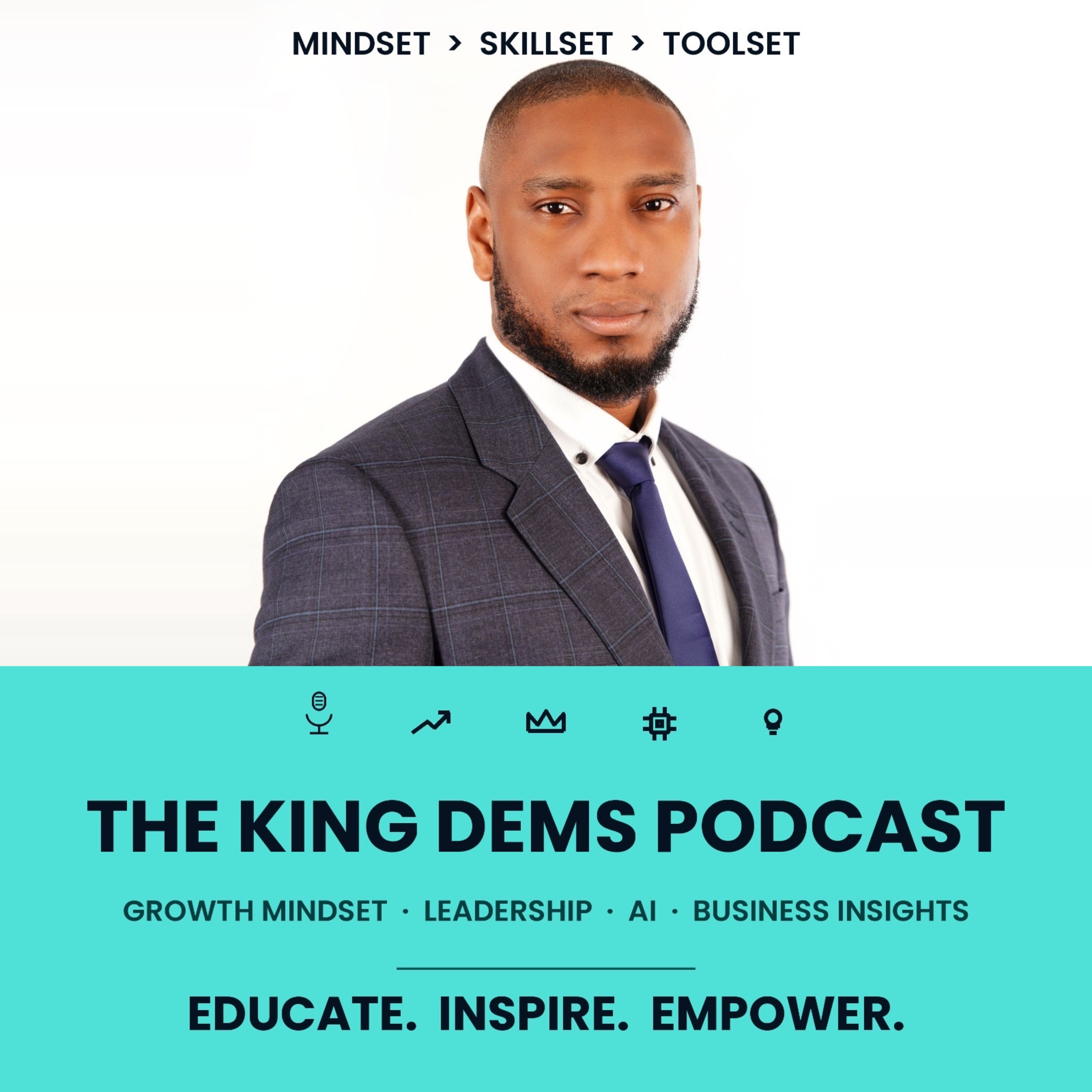
She Left Audit at KPMG, PKF Littlejohn and RSM to Rebuild How Finance Works | Esther Adeogun
King Dems Podcast | Growth Mindset, Leadership, AI and Business InsightsShow Notes
Most finance teams start closing the month before the month has even finished.
Cop a copy of my new book NOW: https://ademolaodewade.com
Turn audit and finance expertise into paid advisory work — Ethos (paid link): https://agent.askethos.com/refer/nd01w7e2eelw
AI labs pay highly-skilled experts — Mercor (paid link): https://t.mercor.com/neABb
Build the design partner deck in minutes — Gamma (paid link): https://try.gamma.app/f2d4kygskm1h
Esther Adeogun spent over a decade in audit and assurance across KPMG Nigeria, WYZE, Sapro, PKF Littlejohn and RSM UK, working between Lagos and London. She audited multinationals with US, Canadian and Australian parent structures. She then left professional services to found Valdore Systems and Intelligence Limited (VSIL), a pre-product platform building what she calls an intelligent operating layer: financial intelligence, controls and real-time visibility embedded directly into business workflows rather than applied after the fact.
The pattern that convinced her was not jurisdictional. Across Lagos, London and multinational engagements she kept meeting the same problem. Organisations had invested heavily in software, yet finance teams still ran on spreadsheets, manual reconciliations and judgement applied outside the system. Some of her design partners begin their July month-end work in the second or third week of July in order to report to management by 4 August. That is time taken away from professional judgement and scepticism, and Esther argues the gap between activity and visibility is the thing worth closing, not the accounting concepts underneath it.
In this episode:
The one sentence she would give a Fortune 500 CEO: an intelligent operating layer embedding financial intelligence, controls and real-time visibility into business workflows The exact shift from auditor to founder, moving from "what went wrong" to "why did the system allow this to happen in the first place" Why real-time reporting does not overturn the historical cost concept, and what she actually means by real-time What SAP, Oracle and Microsoft would say in response, and where the design philosophies genuinely diverge Where AI earns its place, and the deterministic, rules-based work that should stay conventional software "Consulting is largely constrained by people and time" and why that pushed her to SaaS instead of another consulting firm The four eras of accounting: paper, spreadsheets, ERP, and AI-assisted decision-making Whether the Big Four look the same in 2035, and why she thinks firms evolve rather than disappear Nigeria rewards technical skill, the UK rewards relationships, and what that cost her to learn Why she no longer believes progress is linear, and what experimentation replaced it with Rapid fire: the biggest misconception about AI, the biggest misconception about accounting, and the technology she is watching Her legacy test: not to be remembered for building software but for helping build better businesses
More from Esther: LinkedIn (personal): linkedin.com/in/esther-adeogun-0b9118125
LinkedIn (company): linkedin.com/company/valdore-systems-intelligence-ltd
Hosted by Ademola Odewade — chartered accountant, author of Human-Led, AI-Powered Finance (foreword by Professor Dave Ulrich), and Founder of K-Dems Consulting.
The King Dems Podcast. Growth Mindset, Leadership, AI and Business Insights. Ranked in the global top 2% of podcasts.
Diary of a CFO. Finance leadership, unfiltered. Ranked in the global top 2.5% of podcasts.
This description contains paid links. We may earn a commission at no extra cost to you.
#AIinAccounting #ContinuousAssurance #DiaryOfACFO #KingDemsPodcast
More from King Dems Podcast | Growth Mindset, Leadership, AI and Business Insights
Your customers are not lying in your surveys. They simply do not know why they do what they do.
The voice you hear when you speak is not the one your team hears.
Why Transformation Programmes Fail — The Inner Game of Organisations Most transformation programmes fail because the organisation is quietly protecting the very thing you are trying to change. Cop a copy of my new book NOW: https://ademolaodewade.com Turn transformation experience into paid advisory work — Ethos (paid link): https://agent.askethos.com/refer/nd01w7e2eelw AI labs pay highly-skilled experts — Mercor (paid link): https://t.mercor.com/neABb Build the culture diagnostic deck in minutes — Gamma (paid link): https://try.gamma.app/f2d4kygskm1h Zhanna Zhuravleva grew up in Georgia and lived through war as a child, then built her career across Russia, Israel and the UK. She completed two master's degrees — finance and human resources — followed by postgraduate study, and taught finance, management and philosophy at a university in St. Petersburg. She started in industry as a Kaizen team leader and went on to lead HR and cultural transformation across organisations of more than 1,000 people in 40 countries. She is a Chartered Fellow of the CIPD, has run over 3,000 sessions with leaders, and founded Awake Conscious Play, a school of conscious leadership and leadership transformation. Early in her career she ran a textbook transformation — designed framework, defined KPIs, strong governance. Six months later almost nothing had changed. The organisation was not governed by its processes; it was governed by informal power. Everything since has been built on that finding. The 30% improvement in employee satisfaction and 10% reduction in turnover she reports came from no single initiative — a culture hub that put interns and juniors into the improvement process, people partners trained in coaching, and one-to-ones where the feedback actually changed the next decision. In this episode: Change fluency — why transformation is not a project with a start date and an end dateThe "inner game": why a fintech's people-first programme stalls because the tension is giving leaders their identity Three signals that tell you inside a week whether a culture is healthy — quality of disagreement, speed of bad news, and the gap between the official story and the underground story Diagnosis before prescription: the first 30 days run across Ken Wilber's four quadrants, not a rush to launch programmes Three types of values — declarative, conscious, unconscious — and which layer actually decides Why Meta making AI token consumption a performance metric produced engineers burning tokens instead of better decisions WEF Future of Jobs: 170 million roles created against 92 million displaced — recalibration, not replacement"AI is electricity with intelligence" — why this is an electricity moment rather than an internet one The 4D Compass for building trust: self, soul, soft, spiritWhy engagement surveys measure compliance — a purple, tribal culture scores high on engagement and low on trust What she protects if the HR budget is halved: leader development, and a culture diagnosis every year The mistake founders make at 100 employees — still leading as though there are 20Zhanna's recommendation for every CEO is Spiral Dynamics by Don Beck and Christopher Cowan. Her conscious leadership programmes — including Lila, the transformational game she has adapted for leaders and runs offline and online — are at: https://awake-play.co.uk/ Upcoming cohorts: https://awake-play.co.uk/upcoming Connect with Zhanna on LinkedIn: https://www.linkedin.com/in/zhanna-zhuravleva-chartered-fcipd-03a0a622a/ Hosted by Ademola Odewade — chartered accountant, author of Human-Led, AI-Powered Finance (foreword by Professor Dave Ulrich), and Founder of K-Dems Consulting. The King Dems Podcast. Growth Mindset, Leadership, AI and Business Insights. Ranked in the global top 2% of podcasts. Diary of a CFO. Finance leadership, unfiltered. Ranked in the global top 2.5% of podcasts. This description contains paid links. We may earn a commission at no extra cost to you.
Business valuation isn't a multiple of EBITDA. Cop a copy of my new book NOW: https://ademolaodewade.com Turn expertise into paid advisory work — Ethos (paid link): https://agent.askethos.com/refer/nd01w7e2eelw AI labs pay highly-skilled experts — Mercor (paid link): https://t.mercor.com/neABb Build the buyer deck in minutes — Gamma (paid link): https://try.gamma.app/f2d4kygskm1h Mark Mills OBE started Cardpoint plc from scratch in 2000. Two years later it floated on AIM at a £7 million valuation. By 2006 it was turning over £100 million a year on £19.8 million of EBITDA, and he exited in 2007 at £175 million. He now sells other people's businesses. One owner was told his company was worth £3 million. Mark sold it for just over £10 million. Nothing changed in the accounts — what changed was who the business was presented to, and why they needed it. In this episode: - Why bids from strategic buyers don't resemble a multiple of EBITDA - The £3m-to-£10m sale, and the buyer maths that produced it - Rule one of any business model: recurring income — learned from a payphone business that died in the 1991 recession - How Mark and his CFO reverse-engineered £100m of revenue onto a sheet of paper, then landed within 2% - Why "in three years" is a useless target and "by 31 August 2029" is not - Solving a working capital problem by finding a bank with too much physical cash - The one metric he never ignores when assessing a company for sale - FARM — why people work for Fun, Achievement, Recognition, then Money, in that order - Selling to strangers, and why referrals cannot scale a business - What AI actually changes about client acquisition and KPI monitoring - Realistic exit timelines: 12 to 30 months, not six Mark's book is Making Your Mark: How I Built a Fortune From £1.50 — and You Can Too. He offered listeners a free signed copy — email him at [email protected] with your address and he'll send one out. More from Mark: www.mark.co.uk · linkedin.com/in/markrichardmills Hosted by Ademola Odewade — chartered accountant, author of Human-Led, AI-Powered Finance (foreword by Professor Dave Ulrich), and Founder of K-Dems Consulting. The King Dems Podcast. Growth Mindset, Leadership, AI and Business Insights. Ranked in the global top 2% of podcasts. Diary of a CFO. Finance leadership, unfiltered. Ranked in the global top 2.5% of podcasts. This description contains paid links. We may earn a commission at no extra cost to you. #BusinessValuation #ExitStrategy #DiaryOfACFO #KingDemsPodcast
How can leaders use AI without weakening the judgement, creativity and critical thinking that leadership requires? Dr David Rock explains what neuroscience reveals about decision-making, cognitive bias, uncertainty and human performance. This conversation is for leaders navigating a world of rising information overload, faster technology and increasing pressure. Dr Rock, Co-Founder and CEO of the NeuroLeadership Institute, coined the term neuroleadership and has spent decades translating cognitive science into practical tools for organisations and executives. In this episode, you will learn: Why leadership creates three recurring cognitive challenges: capacity, self-regulation and social cognitionWhy intelligent leaders can still make poor decisions under pressure How uncertainty affects the way people think, regulate emotion and understand others Why David argues that AI should keep the human in the lead, rather than outsourcing critical judgement Why recognising your own cognitive bias is harder than most leaders assume How the SEEDS framework helps teams identify recurring categories of bias How the SCARF model explains Status, Certainty, Autonomy, Relatedness and Fairness Why useful leadership frameworks require both scientific credibility and practical simplicity