Show Notes
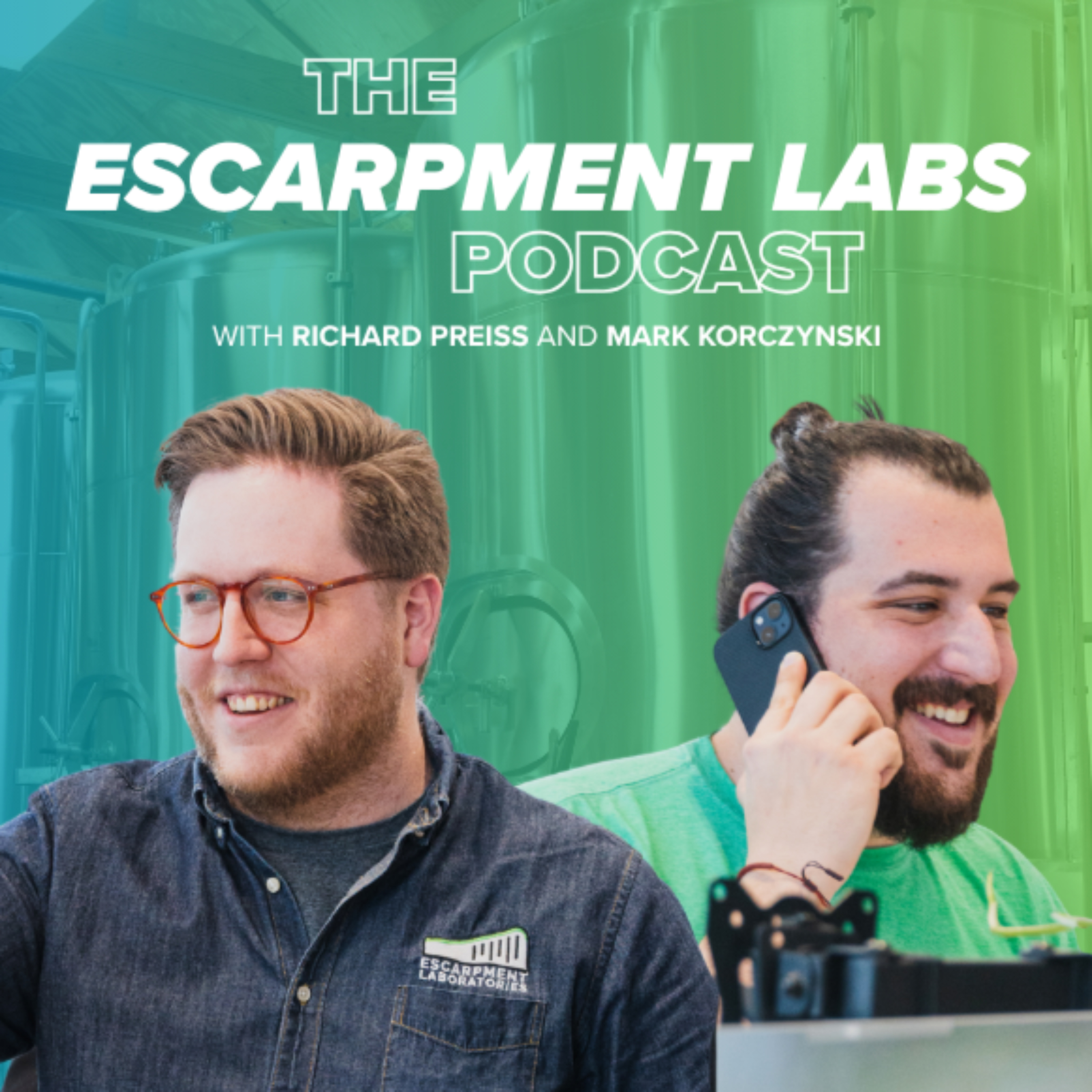
As brewers look to cut costs and improve consistency, yeast repitching is one of the highest-ROI process upgrades you can make. In this beginner-focused episode of The Escarpment Labs Podcast, Mark and Richard break down why repitching works — and more importantly, how to start repitching without a lab, microscope, or complicated equipment. We cover the non-negotiable fundamentals: How to choose a healthy “source batch” (freshness matters more than you think)
The simplest harvest setup (a sanitized hose + a humble bucket)
The single most important step to prevent off-flavours and repitch disasters
If you’ve been repitch-curious but unsure where to start, this episode is your green light.
Featured in this Episode: Follow along with our "Yeast Management & Repitching Guide" here. We've created this guide to be a comprehensive resource to learn how to repitch the right way — saving money, improving consistency, and keeping your beer quality high. Learn more about our Yeast Quality Control
More from The Escarpment Labs Podcast
Are the "golden rules" in your brewhouse actually rooted in science, or are they just leftover dogma from 40 years ago? Many traditional brewing guidelines were completely true back when malts were less modified, yeast handling was imprecise, and hop processing was in its infancy. But thanks to modern maltsters, hop breeders, and yeast scientists, many of those old rules no longer apply. In this special Mythbusters-inspired episode, Mark and Richard turn off the Yeast Lightning Round timer and take the time to bust common brewing myths once and for all. We tackle: Myth 1: Three Hop Additions: Do you really need early, middle, and late kettle additions for optimal hop aroma?
How can breweries leverage their fermentation expertise, equipment, and brand loyalty to expand beyond beer without losing their core identity? The craft beverage landscape is evolving fast, and more breweries are becoming "CPG curious." Whether exploring non-alcoholic options, functional pre/pro/postbiotic drinks, energy beverages, or protein trends, moving into new categories brings real operational and brand challenges. In this episode, Richard sits down with Sara Heitmann (Brand Marketing & Strategy) and Dan Beaudoin (Product Development & Food Manufacturing, ex-AB InBev) from Birdway CPG. Together, they break down what craft breweries can learn from the wider consumer packaged goods world, examining case studies of non-beer fermentation ventures, product expansion pitfalls, and how brewery skillsets naturally translate into broader food and beverage innovation. In this episode, we cover: What to Brew (and What to Avoid): Evaluating brand extensions—from waters and functional pre/postbiotics to energy drinks and "protein-maxxing."
Are your yeast nutrients giving your fermentation precision support, or are they overloading your kettle with heavy metals and unpredictable mineral shifts? Many commercial worts are naturally deficient in zinc (<0.15 ppm), leading to sluggish fermentations and yeast stress. However, many off-the-shelf nutrients were originally formulated for wine or distilling rather than beer—sometimes adding massive doses of calcium or unwanted pro-oxidant metals like iron and copper. In this episode, Mark and Richard open up the laboratory vault to share findings from a multi-brewery study evaluating 47 samples across 16 commercial craft breweries. We break down: Precision Zinc Delivery: How Yeast Lightning reliably lifts zinc deficient worts (+0.125 ppm avg. increase) straight into the ideal 0.2-0.3 ppm sweet spot.
Why do yeast pitch rates vary so drastically between brewing shifts, even when everyone is using the same hemocytometer? Manual microscopic cell counts are standard practice, but they take time, carry operator bias, and can fall short when slurry densities change across strains. If you've ever faced stalled fermentations or batch-to-batch flavour shifts, inconsistent pitching volume might be the hidden culprit. In this episode, Mark and Richard are joined by Nick Brown (Brewing Sales Specialist at Aber Instruments) and Matt Cummings (Brewmaster at Equals Brewing) to explore capacitance technology — a real-time method for measuring viable yeast biomass directly in the line or tank. We cover: The Limits of the Scope: Where manual cell counts, slurry weight, and optical density fall short in a fast-paced production cellar.
Why does a beer taste squeaky clean at final gravity, only to turn into a slick, buttery mess three weeks after it hits the can? Diacetyl and its sneaky, odourless precursor (alpha-acetolactate) remain every brewer’s absolute worst quality control nightmare—especially during peak production season when cellar turns are tight. While dropping ALDC enzyme into the fermenter has become standard practice, relying on it as a silver bullet without fixing underlying yeast nutrition can leave your beer vulnerable to hop creep and post-packaging spikes. In this episode, Mark and Richard break down the complete cellular biochemistry of diacetyl prevention, ALDC limitations, and cellar-tested QC checks. We explore: The Precursor Trap: How alpha-acetolactate hides in clean-tasting beer and oxidizes into buttery diacetyl after packaging.