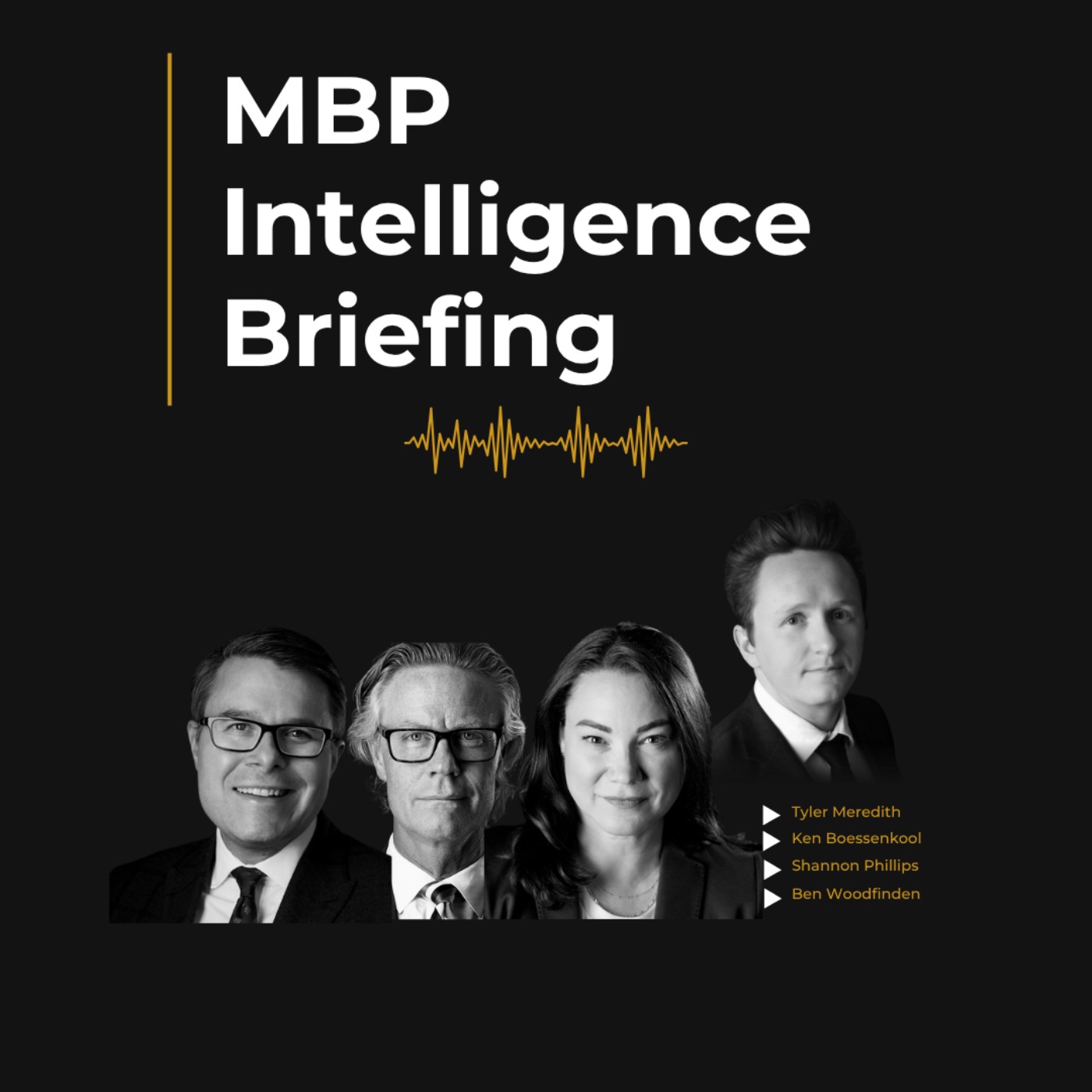
COMPLIMENTARY FULL EPISODE - MBP Ep 12: Intelligence Briefing – 2025 Policy Wrap-Up and What to Watch in 2026 (Complimentary Episode)
MBP Intelligence BriefingShow Notes
In this year-end episode, Ben Woodfinden is joined by Ken Boessenkool, Tyler Meredith, and Shannon Phillips for a wide-ranging policy roundtable reflecting on the most consequential, overlooked, and misguided policy developments of 2025, alongside a forward-looking discussion of what to watch in 2026. The conversation focuses on structural policy shifts across fiscal rules, defence spending, climate policy, healthcare reform, democratic institutions, and housing. The episode also examines how geopolitical uncertainty, particularly related to the United States, is reshaping Canada’s fiscal, monetary, and defence posture. This marks the final episode of 2025, with the show returning in early January 2026. In this episode, they discuss: • The most consequential policy shifts of 2025 across fiscal rules, climate, defence, and housing • How geopolitical uncertainty reshaped Canada’s defence spending and fiscal posture • The evolving role of democratic institutions, including the Senate and referendum politics • Diverging provincial approaches to healthcare reform and federal constraints • What policy risks and opportunities to watch as Canada enters 2026
Key Takeaways On the Most Significant Policy Developments of 2025 • PHILLIPS: Continuity under a Liberal government preserved health, social, and childcare programs despite expectations of major change • MEREDITH: Separating operating and capital spending permanently expands federal fiscal capacity • BOESSENKOOL: Ending the consumer carbon tax marks a major retreat from market-based climate policy • WOODFINDEN: Canada’s rapid shift toward higher defence spending represents a structural policy realignment On Defence Spending, Fiscal Rules, and Political Alignment • WOODFINDEN: Defence spending has moved from political taboo to broad consensus • MEREDITH: New fiscal rules have reduced concern about deficits and debt financing • PHILLIPS: Defence budgets create opportunities for workforce development beyond procurement • BOESSENKOOL: Political fragmentation has lowered resistance to large-scale defence investment On the Senate and Democratic Institutions • BOESSENKOOL: Moving away from a technocratic Senate could significantly alter governance • MEREDITH: An independent Senate has increased scrutiny but slowed legislation • WOODFINDEN: The Senate’s real test may come under a future Conservative government • PHILLIPS: Civil society has a role in shaping how partisanship functions in democratic institutions On the “Worst” or Most Misguided Policy Developments • MEREDITH: Ontario’s symbolic megaprojects reflect a lack of economic strategy • BOESSENKOOL: Alberta’s lowered thresholds for recall and referendums empowered destabilizing actors • PHILLIPS: Book bans and separation referendums highlighted symbolic and counterproductive policymaking • WOODFINDEN: Canada’s repeated transit failures reveal systemic infrastructure weaknesses On Looking Ahead to 2026 • WOODFINDEN: Co-hosting the FIFA World Cup risks high public costs for limited return • MEREDITH: U.S. monetary policy leadership changes could destabilize global markets • BOESSENKOOL: Provinces will increasingly diverge on healthcare reform • MEREDITH: The federal government is likely to defend the Canada Health Act if private payer models expand On Underrated Policy Developments • MEREDITH: Automatic benefits enrollment simplifies access and improves delivery • PHILLIPS: Crackdowns on fraudulent career colleges protect workers and students • BOESSENKOOL: The personal support worker tax credit functions as a targeted wage subsidy • WOODFINDEN: Housing outcomes are increasingly diverging by city and region YouTube Video Credits: CBC News, CTV News, Global News, 4K Films By Adnan, Videoscape, Pierre Poilievre, balcony et-al, Luis Vega, Shape Properties, GommeBlog, Exploring Stunning Landscapes From Above, Motion Array
Hosted on Acast. See acast.com/privacy for more information.
More from MBP Intelligence Briefing
This week on the MBP Intelligence Briefing, Shannon Phillips is joined by Ken Boessenkool and Tyler Meredith to examine the prospects for corporate tax reform ahead of the November 5 federal budget. The panel examines calls for a sweeping review against targeted measures to encourage investment, then turns to Alberta’s referendum results, the rejection of separation and the implications of the province’s immigration questions for Premier Danielle Smith and Ottawa. In this episode: Corporate Tax Reform & the Federal Budget: With Ottawa facing fiscal pressures, the panel debates whether broad tax reform is politically and economically practical. Tyler examines Canada’s investment competitiveness and the risk that uncertainty could delay capital spending; Ken calls for specific, actionable proposals rather than another open-ended review. They discuss provincial coordination, the mega deduction, investment tax credits and whether a review focused on fairness, sustainability and simplicity would deliver what business advocates expect. Alberta’s Referendum & Canadian Unity: Following Albertans’ vote against separation, Shannon, Ken and Tyler assess the result and Danielle Smith’s political position. Ken argues that Albertans can disagree with federal politics while remaining committed Canadians, and questions the premier’s approach to the separatist movement. The panel considers the referendum’s constitutional questions and the implications for Alberta–Ottawa relations. Immigration Questions & Political Fallout: The panel examines Alberta’s referendum questions on immigration, temporary residents and access to public services. Shannon discusses temporary-resident numbers, the province’s earlier efforts to attract newcomers and the practical implications of proposed restrictions. Ken questions using referendums to make complex immigration policy, while the conversation explores federal–provincial tensions, electoral strategy and the responses of Alberta’s political parties. The MBP Intelligence Briefing is completely free to listen to and watch, and completely ad-free. Subscribe wherever you listen or watch, and share the show with someone who follows Canadian politics and public policy. Hosted on Acast. See acast.com/privacy for more information.
This week on the MBP Intelligence Briefing, Shannon Phillips is joined by Ken Boessenkool, Tyler Meredith and special guest Claire Seaborn, a lawyer with Torys LLP and former senior federal government advisor, to examine whether Bill C-39 can accelerate major project approvals without compromising environmental protections or Indigenous consultation. The panel also discusses Alberta's October 19 referendum, Prime Minister Mark Carney's campaign appearances and the implications for Canadian unity. In this episode: Bill C-39 & Building Canada Strong: The federal government's proposed overhaul of major project approvals, including its one-year federal decision timeline, streamlined permitting and changes to environmental assessments. Claire Seaborn explains why the process could still take more than two years, the importance of coordinating federal departments and the potential for increased litigation. The panel examines Indigenous consultation, species-at-risk protections, government capacity and whether faster approvals will provide the certainty investors need to move projects forward. Alberta's Referendum & National Unity: With Albertans preparing to vote on October 19, the panel examines the separation question and nine additional referendum questions covering immigration and constitutional changes. Shannon, Ken and Tyler discuss Prime Minister Mark Carney's rallies in Calgary and Edmonton, Premier Danielle Smith's position, the growing opposition to the nine questions and the political implications for Alberta's separatist movement. They also consider voter turnout, regional support for separation and what the results could mean for Canadian unity. Shannon Phiilips speaks at the Southern Alberta Council on Public Affairs (SACPA). https://www.youtube.com/watch?v=MPHo4TqmlAg The MBP Intelligence Briefing is completely free to listen to and watch, and completely ad-free. Subscribe wherever you listen or watch, and share the show with someone who follows Canadian politics and public policy. Hosted on Acast. See acast.com/privacy for more information.
This week on the MBP Intelligence Briefing, Shannon Phillips is joined by Ken Boessenkool and Tyler Meredith to discuss Ottawa’s latest overhaul of defence procurement, the sweeping changes proposed under Bill C-39, and the political implications of the Parti Québécois forming a minority government. In this episode: Defence Procurement & Crown Corporation Reform: Ottawa’s plan to transform the Defence Investment Agency into a Crown corporation, and whether the new structure will accelerate military procurement, strengthen Canada's domestic defence industry and improve coordination across government. The panel debates the risks of adding another layer of bureaucracy, the role of private-sector expertise and whether Prime Minister Mark Carney can overcome entrenched institutional resistance. Bill C-39 & Building Canada Strong: The federal government's proposed changes to major project approvals and labour legislation, including a one-year federal review timeline, expanded ministerial powers and potential challenges involving Indigenous consultation and environmental protections. The panel examines the Liberals' accelerated parliamentary process, Conservative support for the legislation, the likelihood of amendments and whether the Senate could delay passage before the end of the year. Quebec Election Results & National Unity: The Parti Québécois wins 59 seats and forms a minority government, raising renewed questions about Quebec sovereignty and the possibility of another referendum. The panel discusses the collapse of the Coalition Avenir Québec, the emergence of Éric Duhaime's Conservatives, the changing political landscape in Quebec and what the election results could mean for federal-provincial relations and the Carney government. The MBP Intelligence Briefing is completely free to listen to and watch, and completely ad-free. Subscribe wherever you listen or watch, and share the show with someone who follows Canadian politics and public policy. Hosted on Acast. See acast.com/privacy for more information.
This week on the MBP Intelligence Briefing, Shannon Phillips is joined by Ken Boessenkool and Tyler Meredith for a wide-ranging discussion on the Pacific Link Pipeline and LNG investment, the choices facing Ottawa ahead of the federal budget, and a busy election season in Alberta, Quebec and British Columbia. In this episode: • Pacific Link Pipeline & Alberta: Ottawa’s designation of the Pacific Link Pipeline as a project of national interest, how a 35–43.7 billion publicly backed pipeline could be financed, the risks to Alberta and Ottawa, CCUS and royalty questions, and whether expanding pipeline capacity can help diversify Canadian energy exports beyond the United States. The panel also looks at what the announcement means for Alberta’s October 19 referendum and the national unity debate. • Federal Budget: What Ottawa needs to balance as it prepares its next budget, from investment and competitiveness to affordability and rising borrowing costs. The panel looks at Canada’s changing interest-rate environment, the pressures created by higher yields, and why increasingly attractive risk-free returns could make it harder to unlock the private investment Canada needs. • Election Season: With voters heading to the polls in Quebec, Alberta and British Columbia, the panel looks at which results could matter most to Ottawa. They discuss the changing political landscape in Quebec, the implications of Alberta’s referendum, what a change of government in B.C. could mean for federal-provincial relations, and the potential consequences for upcoming health-transfer negotiations. The MBP Intelligence Briefing is completely free to listen to and watch, and completely ad-free. Subscribe wherever you listen or watch, and share the show with someone who follows Canadian politics and public policy. Hosted on Acast. See acast.com/privacy for more information.
MBP Intelligence Briefing has relaunched with a new format, now completely free to listen to and watch, and completely ad-free. This week, Shannon Phillips is joined by Ken Boessenkool and Tyler Meredith for a wide-ranging discussion of the federal government’s new labour legislation, the future of Canada’s largest airports and the newly called BC election. In this episode: Labour Reform: The government’s proposed changes to the Canada Labour Code, new guardrails around Section 107 and back-to-work intervention, and what the changes mean for organized labour, employers and future labour disputes. Canada’s Airports: Ottawa’s plan to open Canada’s largest airports to private investment, the role Canadian pension funds could play, what it could mean for airport fees and public revenue, and the challenge of getting accountability and regulation right. B.C. Election: The rapidly changing political landscape as British Columbians head to an October election, the challenges facing David Eby and the B.C. Conservatives, and how affordability, Donald Trump and the federal government could shape the campaign. MBP Intelligence Briefing is now completely free to listen to and watch, and no ads. Subscribe wherever you listen or watch, and share the show with someone who follows Canadian politics and public policy.