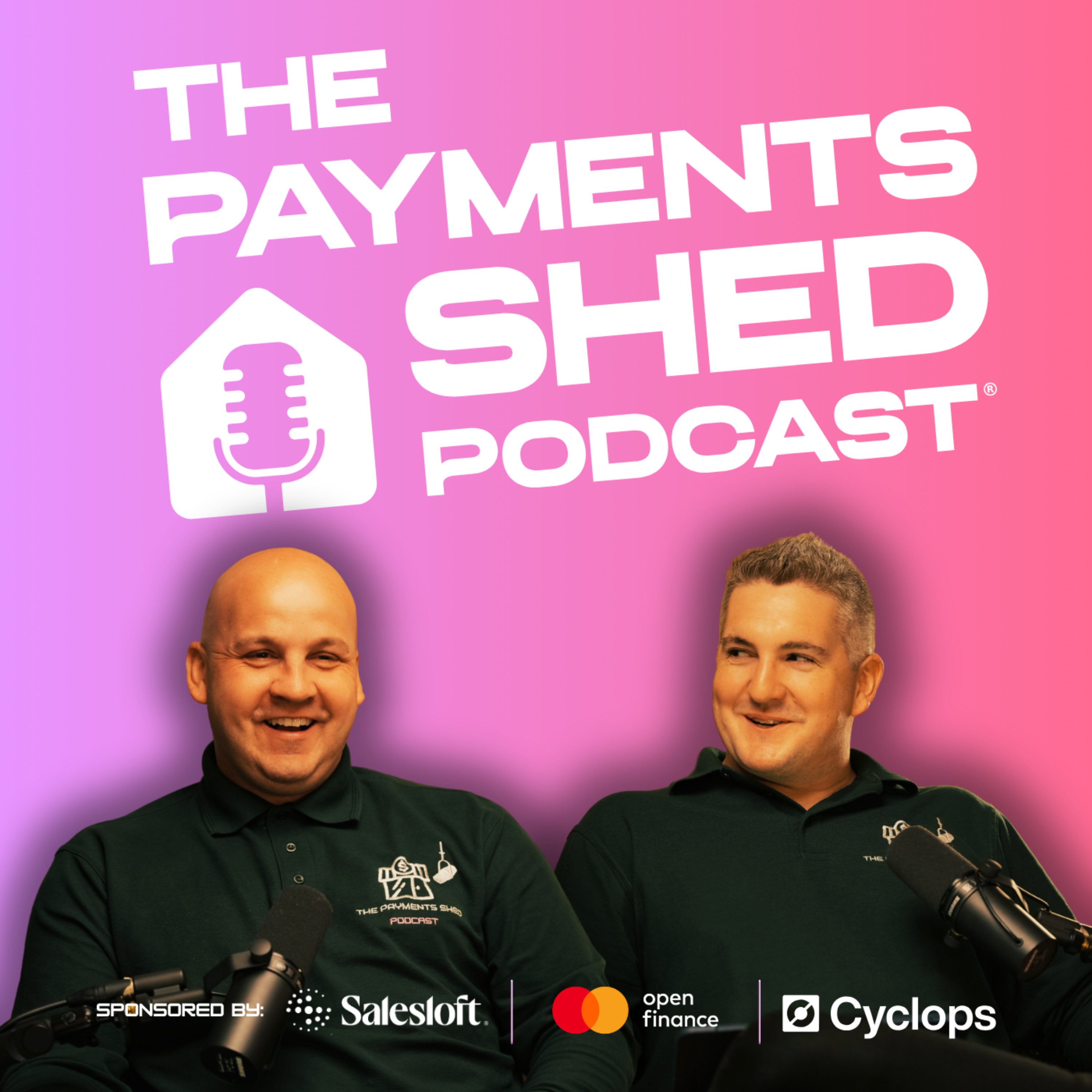
Ep. 114 - Bootstrapped and Unapologetic: Building payments orchestration for different verticals, with Fyntek
The Payments ShedShow Notes
In the latest episode of The Payments Shed Podcast, recorded live from New York City, Grant Evans and Justin Hanna are joined by Alexander Rea, Founder and CEO of Fyntek, for a conversation exploring what it takes to build a bootstrapped payments orchestration business in one of the most complex corners of the US payments market. Alexander shares why he chose to build Fyntek in the US rather than follow a more traditional UK or European fintech path, and why he decided to do it without venture capital. They unpack the realities of bootstrapping in a category dominated by heavily funded competitors, the trade-offs that come with growing without a VC war chest, and how that decision has shaped everything from Fyntek's product roadmap to its sales strategy. The conversation then gets into the verticals Fyntek has chosen to specialise in, particularly iGaming and sweepstakes. Alexander explains why these businesses face fundamentally different payment challenges, from acceptance rates and chargebacks to cascading, alternative payment methods and banking relationships, and why a general-purpose orchestration platform isn't always built to handle the complexity. They also explore the differences between building payments infrastructure in the US and Europe, including ACH, state-by-state gaming regulation, banking relationships and the challenges international founders can face entering the US market. Alexander shares where regulation helps, where it creates friction, and what merchants themselves could be doing to push the industry forward. Finally, they discuss what it means to compete as a bootstrapped company against orchestration providers with significant outside funding, why Fyntek has prioritised solving specific vertical problems rather than trying to be everything to everyone, and why Alexander is now putting greater focus on visibility, storytelling and building his own profile alongside the business. Plus, Alexander steps up for The Payments Shed's legendary Shelf of Shame to tackle one assumption about building a payments company that raising a big VC round supposedly fixes. *** The Payments Shed Podcast is sponsored by Cyclops. Cyclops helps payments companies offer crypto acceptance, stablecoin settlement and payouts through one unified infrastructure platform. Find out more: https://cyclops.finance/ *** The Payments Shed Podcast is sponsored by Salesloft. Salesloft uses agentic AI to turn buyer, conversation, deal and forecast data into clear actions that help revenue teams sell smarter. Find out more: https://www.salesloft.com *** The Payments Shed Podcast is sponsored by Mastercard Open Finance. Mastercard Open Finance enables businesses to use consumer-permissioned financial data to create more connected and personalised financial experiences. Find out more: https://www.mastercard.com/global/en/business/open-finance.html *** The Payments Shed Podcast is partnered with PCN. PCN is a global boutique recruitment agency connecting leading talent and businesses across fintech, cybersecurity, SaaS, e-commerce and Salesforce. Find out more: https://teampcn.com/ *** Disclaimer: Views expressed are those of The Payments Shed Podcast hosts and guests, not their respective employers. Nothing discussed constitutes investment, legal, tax or financial advice.
More from The Payments Shed
Should you build your own payments stack?Merchants usually hear one of two answers. Use one big PSP for everything, or use an orchestrator with dozens of PSPs underneath.Shane Curran thinks more merchants should own it themselves.In this episode of The Payments Shed Podcast, Sarah Stapp is joined by Shane Curran, Founder and CEO at Evervault, to take the other side of the orchestration versus ownership debate.Shane explains why orchestrators struggle in smaller local markets, how cross-border fees can turn a few basis points into 2% or 3%, and why he would add PSPs one country at a time.They discuss:• What Evervault does, and the story behind the name• Winning Ireland's top science prize as a teenager, then leaving college after three days• Growing up in developer chat rooms, and how security caught his interest• Why card payments are where Evervault spends most of its time• The cost of a card data breach• Where orchestration platforms fall short on flexibility and control• Why orchestrators end up looking like PSPs• How Tebex brought its payment performance in Brazil back in line• Why global merchants want more control over their infrastructure• Regulation, sovereignty and domestic processing• Cross-border fees versus domestic interchange• Picking a primary PSP, then working through markets one by one• The infrastructure decision Shane would put on the Shelf of ShameShane on why the orchestration model is hard to sustain:"In the long run, it's just really hard to build an orchestration platform because you're basically building a PSP without the money movement."His advice is to build in-house from day one, because many companies end up making that move eventually.🎧 Watch the full episode of The Payments Shed Podcast to hear the complete conversation with Shane Curran, Founder and CEO at Evervault, hosted by Sarah Stapp. *** The Payments Shed Podcast is sponsored by Cyclops. Cyclops helps payments companies offer crypto acceptance, stablecoin settlement and payouts through one unified infrastructure platform. Find out more: https://cyclops.finance/ The Payments Shed Podcast is sponsored by Salesloft. Salesloft uses agentic AI to turn buyer, conversation, deal and forecast data into clear actions that help revenue teams sell smarter. Find out more: https://www.salesloft.com The Payments Shed Podcast is sponsored by Mastercard Open Finance. Mastercard Open Finance enables businesses to use consumer-permissioned financial data to create more connected and personalised financial experiences. Find out more: https://www.mastercard.com/global/en/business/open-finance.html The Payments Shed Podcast is partnered with PCN. PCN is a global boutique recruitment agency connecting leading talent and businesses across fintech, cybersecurity, SaaS, e-commerce and Salesforce. Find out more: https://teampcn.com/ Disclaimer: Views expressed are those of The Payments Shed Podcast hosts and guests, not their respective employers. Nothing discussed constitutes investment, legal, tax or financial advice.
In the latest episode of The Payments Shed Podcast, filmed live from Money20/20 USA 2026 in Las Vegas, Sarah Stapp is joined by Ugne Buraciene, Group CEO of payabl., for a special Walk & Talk exploring why payments have become increasingly complicated for merchants, how expectations of payment providers are evolving and why the next big opportunity in payments innovation could be everything that happens after checkout. For years, merchants have been encouraged to adopt more payment methods, integrate additional providers and introduce new technologies to improve performance. But has all that choice actually made payments harder to manage? Ugne takes us inside the growing complexity of the modern payments ecosystem, exploring how fragmented infrastructure, multiple relationships and disconnected financial tools can create operational challenges for businesses trying to scale. The conversation then turns to the shift towards more connected and consolidated payment solutions. With payabl.one bringing acquiring, business accounts and cards together into a single platform, Sarah and Ugne explore why merchants may increasingly favour simplicity and integration over managing multiple specialist providers. They discuss the commercial and operational benefits of bringing financial capabilities together and whether the industry's traditional best-of-breed approach is beginning to lose its appeal. A major focus is what merchants will actually expect from their payment providers in 2027. Simply processing transactions is no longer enough for businesses operating across multiple markets, currencies and sales channels. Sarah and Ugne also unpack the changing relationship between merchants and payment providers. As businesses demand more sophisticated financial capabilities, the role of the payment provider is expanding beyond transaction processing. The discussion then shifts to one of the most overlooked areas of payments innovation: everything that happens after checkout. While much of the industry's attention has traditionally focused on payment acceptance, conversion rates and the customer experience, merchants face an entirely different set of challenges once a transaction has been completed. They also explore where merchants should focus their attention to make the biggest operational improvements. With so many moving parts across the payments lifecycle, identifying the right priorities can be difficult. Plus, Ugne takes on The Payments Shed's legendary Shelf of Shame, challenging one of the persistent frustrations in merchant payments that the industry should have addressed long ago. *** The Payments Shed Podcast is sponsored by Cyclops. Cyclops helps payments companies offer crypto acceptance, stablecoin settlement and payouts through one unified infrastructure platform. Find out more: https://cyclops.finance/ The Payments Shed Podcast is sponsored by Salesloft. Salesloft uses agentic AI to turn buyer, conversation, deal and forecast data into clear actions that help revenue teams sell smarter. Find out more: https://www.salesloft.com The Payments Shed Podcast is sponsored by Mastercard Open Finance. Mastercard Open Finance enables businesses to use consumer-permissioned financial data to create more connected and personalised financial experiences. Find out more: https://www.mastercard.com/global/en/business/open-finance.html The Payments Shed Podcast is partnered with PCN. PCN is a global boutique recruitment agency connecting leading talent and businesses across fintech, cybersecurity, SaaS, e-commerce and Salesforce. Find out more: https://teampcn.com/ Disclaimer: Views expressed are those of The Payments Shed Podcast hosts and guests, not their respective employers. Nothing discussed constitutes investment, legal, tax or financial advice.
In the latest episode of The Payments Shed Podcast, filmed live from Money20/20 USA 2026 in Las Vegas, Kara Parkey is joined by Dan Owens, Chief Strategy Officer at Oceanpayment, for a special Walk & Talk exploring how payment orchestration is reshaping the relationship between merchants and payment providers, why traditional merchant loyalty is being challenged and what it really takes to build a defensible payments business. For years, payment service providers and acquirers have relied on deep technical integrations to build long-term merchant relationships. But as orchestration platforms make it easier for merchants to connect with multiple providers through a single integration, the competitive landscape is changing. Dan takes us inside the evolving role of PSPs within the orchestration ecosystem, exploring why providers are increasingly looking to orchestration platforms as a route to distribution and how they can distinguish genuine new business opportunities from simply migrating existing transaction volumes. The conversation then turns to one of the biggest questions facing payment providers: are merchants becoming less sticky? Historically, the complexity and cost of switching payment providers created a natural barrier to merchant churn. With orchestration removing much of that friction, Kara and Dan explore what actually keeps merchants loyal when changing providers becomes easier, and whether performance, commercial value and service quality are replacing technical integration as the foundations of long-term relationships. A major focus is the difference between being connected to a merchant and being chosen to process their transactions. Kara and Dan also unpack what makes a payments business genuinely defensible in an increasingly competitive market. As merchants gain greater flexibility and control over their payment infrastructure, providers need to demonstrate why they deserve transaction volume rather than relying on the difficulty of switching. The discussion then shifts to Oceanpayment's OP Link proposition and the opportunity to simplify payments for international travellers visiting mainland China. With China's digital payments ecosystem heavily centred around local wallets, Western visitors can face challenges accessing familiar payment experiences. Plus, Dan returns to The Payments Shed's legendary Shelf of Shame. Having previously challenged the industry's use of the term "alternative payment methods", he turns his attention to the orchestration ecosystem and what the industry continues to get wrong as merchants gain more control over their payment choices. *** The Payments Shed Podcast is sponsored by Cyclops. Cyclops helps payments companies offer crypto acceptance, stablecoin settlement and payouts through one unified infrastructure platform. Find out more: https://cyclops.finance/ The Payments Shed Podcast is sponsored by Salesloft. Salesloft uses agentic AI to turn buyer, conversation, deal and forecast data into clear actions that help revenue teams sell smarter. Find out more: https://www.salesloft.com The Payments Shed Podcast is sponsored by Mastercard Open Finance. Mastercard Open Finance enables businesses to use consumer-permissioned financial data to create more connected and personalised financial experiences. Find out more: https://www.mastercard.com/global/en/business/open-finance.html The Payments Shed Podcast is partnered with PCN. PCN is a global boutique recruitment agency connecting leading talent and businesses across fintech, cybersecurity, SaaS, e-commerce and Salesforce. Find out more: https://teampcn.com/ Disclaimer: Views expressed are those of The Payments Shed Podcast hosts and guests, not their respective employers. Nothing discussed constitutes investment, legal, tax or financial advice.
When did you first learn how money works? For most of us it wasn't at school.Children pick up money habits early, yet many still leave school without being taught how to manage it. And the first real lesson often comes on a credit card in their twenties.So how do you teach a nine-year-old to earn, save, spend and give?In this episode of The Payments Shed Podcast, Grant Evans and Justin Hanna are joined by Louise Hill, Founder and CEO of GoHenry, to talk about building the youth fintech category and her campaign for financial education in schools.Louise explains how GoHenry got past the assumption that kids can't have debit cards, why she asks her team to see the exact clause whenever someone says the rules forbid something, and what she learned when her own name kept appearing on the company's list of single points of failure.They discuss:• Launching early ecommerce sites for Next Directory, John Lewis and Debenhams• The personal problem behind founding GoHenry in 2012• Convincing banks, regulators and card schemes that kids' cards were a real market• Raising money through crowdfunding on Crowdcube• Expanding to the US, acquiring Pixpay and merging with Acorns• Moving from COO to CEO• Why so many children still leave school without money skills• The campaign for compulsory financial education in UK primary schools• Making financial education engaging with Money Missions• The role parents play in kids' money habits• Kids' side hustles and the youth economy• What still needs to change for women in fintech leadership• The two money myths Louise puts on the Shelf of ShameLouise also has a simple case for letting kids handle real money early:"Better a £5 mistake aged eight than a £5,000 mistake on the credit card aged 28."
In the latest episode of The Payments Shed Podcast, filmed live from Money20/20 USA 2026 in Las Vegas, Sarah Stapp is joined by Mike Ward, CEO of Mica, for a special conversation exploring why the payments industry continues to operate across fragmented rails, whether stablecoins really solve the problems they're promising to fix and why the future of payments could look very different if we rethink how transactions are authorised and priced. From traditional cards and bank accounts to stablecoins, loyalty points and digital wallets, the payments ecosystem has become increasingly complex. Every new way to pay seems to introduce another integration, another set of rules and another layer of cost. Mike takes us inside Mica's vision for bringing different forms of value together through a single payment rail, challenging the assumption that every payment method needs its own dedicated infrastructure. The conversation begins with the growing fragmentation of payments infrastructure. Sarah and Mike explore why the industry continues to build separate systems for different types of value and whether stablecoins genuinely address the challenges of speed, fraud and flexibility. They also unpack Mica's Multi-Tender approach, examining how a consumer could combine loyalty points, coupons and a debit card within a single authorisation rather than treating each as a separate transaction. A major focus is the idea of removing reusable payment credentials from the authorisation process altogether. Card numbers, tokens, vaults and the infrastructure required to protect sensitive credentials have become fundamental parts of the modern payments ecosystem. Sarah and Mike also tackle the evolving relationship between banks, stablecoins and emerging payment infrastructure. While stablecoins are often positioned as an alternative to traditional financial institutions, Mica is exploring a model that keeps issuers involved in the payment journey. The conversation then turns to one of the industry's most established commercial models: percentage-based transaction pricing. Why should a £2,000 purchase cost significantly more to authorise than a £100 transaction when the underlying technical process may be largely the same? They also examine who benefits from the existing pricing model and where resistance to change might emerge. As merchants continue to scrutinise payment acceptance costs, Sarah and Mike discuss whether separating transaction value from processing fees could fundamentally change the economics of payments, and what it would take for a different commercial model to gain traction. Plus, Mike takes on The Payments Shed's legendary Shelf of Shame, challenging one of the industry's longstanding approaches to payment authorisation that he believes deserves to be left behind. *** The Payments Shed Podcast is sponsored by Cyclops. Cyclops helps payments companies offer crypto acceptance, stablecoin settlement and payouts through one unified infrastructure platform. Find out more: https://cyclops.finance/ The Payments Shed Podcast is sponsored by Salesloft. Salesloft uses agentic AI to turn buyer, conversation, deal and forecast data into clear actions that help revenue teams sell smarter. Find out more: https://www.salesloft.com The Payments Shed Podcast is sponsored by Mastercard Open Finance. Mastercard Open Finance enables businesses to use consumer-permissioned financial data to create more connected and personalised financial experiences. Find out more: https://www.mastercard.com/global/en/business/open-finance.html The Payments Shed Podcast is partnered with PCN. PCN is a global boutique recruitment agency connecting leading talent and businesses across fintech, cybersecurity, SaaS, e-commerce and Salesforce. Find out more: https://teampcn.com/ Disclaimer: Views expressed are those of The Payments Shed Podcast hosts and guests, not their respective employers. Nothing discussed constitutes investment, legal, tax or financial advice.