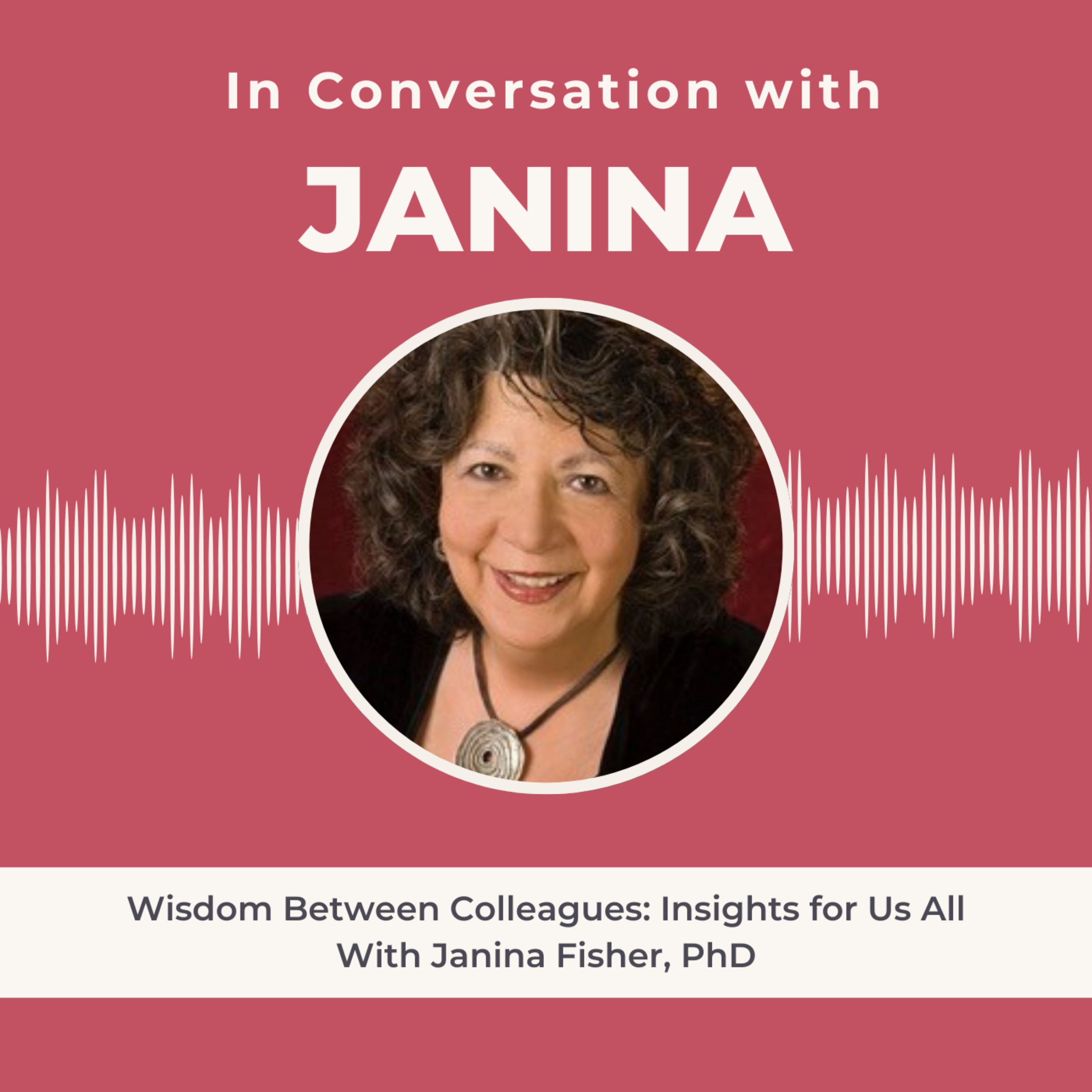
All Communication is Communication
In Conversation with Janina Fisher: Wisdom Between Colleagues; Insights For Us AllShow Notes
A thoughtful exploration of neurodivergence, creativity, and the transformative power of seeing clients not as problems to solve, but as people whose worlds are worth entering. In this engaging and deeply insightful conversation, Janina Fisher sits down with drama therapist and neurodivergence specialist Liz McDonough to explore what becomes possible when therapists let go of assumptions and learn to follow the client’s lead. Drawing on nearly two decades of experience working with autistic and neurodivergent children, teens, and young adults, Liz shares how play, creativity, special interests, improvisation, and even puppets can become powerful pathways to connection, emotional expression, and healing. Together, Janina and Liz challenge traditional ideas about communication, emotional processing, and therapy itself. They discuss why many neurodivergent clients struggle in conventional talk therapy, how therapists can move beyond agendas and expectations, and why curiosity is often more important than expertise. Through stories of puppet characters, improv groups, video games, and beloved fictional worlds, Liz demonstrates how meaningful therapeutic work happens when clinicians enter the client’s world rather than asking the client to enter theirs. This conversation is a reminder that healing does not always begin with words. Sometimes it begins with a shared interest, a playful moment, or the willingness to see communication in forms we might otherwise overlook.
Key Takeaways: Meet clients where they are Special interests are therapeutic resources Communication is bigger than words Play creates safety What looks like resistance may be communication Growth happens through co-creation, not correction Curiosity is more valuable than certainty
www.lizmft.com Liz McDonough, LMFT, is a therapist, drama therapist, educator, consultant, and speaker specializing in supporting neurodivergent individuals and the professionals who work with them. Drawing on a unique background that bridges a theatrical career in New York with more than two decades as a licensed marriage and family therapist, Liz is known for her creative, strengths-based approach to helping neurodivergent people thrive in school, the workplace, and their communities. A late-diagnosed ADHDer herself, Liz combines lived experience with clinical expertise, bringing warmth, humor, and practical insight to her teaching and consulting. She has presented nationally at conferences including the Psychotherapy Networker Symposium and the AAMFT Systemic Therapy Conference, and works with educators, therapists, and organizations to create more accessible, inclusive, and joyful environments. Liz holds a B.A. in Drama from NYU's Tisch School of the Arts and a Master's degree in Counseling Psychology from the California Institute of Integral Studies. She has taught at the graduate level, supervised associate therapists toward licensure, and provides neurodiversity consultation internationally. Liz lives in Durham, North Carolina, where she's often singing, hiking, or dreaming up her next creative idea—sometimes all at once.
More from In Conversation with Janina Fisher: Wisdom Between Colleagues; Insights For Us All
What if the behaviors we label as “maladaptive” are actually brilliant strategies for survival? And what if the most powerful thing a therapist can offer isn't a technique, but the experience of being genuinely cared for? In this thought-provoking episode of In Conversation with Janina Fisher, Janina sits down with trauma therapist, somatics practitioner, researcher, and activist Mariah Rooney to explore the intersection of trauma, healing, justice, and the transformative power of human connection. Together, Janina and Mariah challenge some of the mental health field's most deeply held assumptions—from the limitations of evidence-based treatments and rigid therapeutic protocols to the ways diagnostic labels can pathologize the very adaptations that helped people survive. Drawing on their clinical experiences, they explore why genuine warmth, attunement, and even delight in a client can be profoundly healing, and why progress isn't always something that can be measured on a checklist. Their conversation also moves beyond the therapy room, examining how systemic injustice, institutional practices, and unsafe environments shape trauma responses. They question what it really means to be regulated when hypervigilance may be necessary for survival, and why therapists must understand the realities clients return to after each session. This episode is a compelling invitation to rethink trauma treatment, not simply as a process of changing behaviors or reducing symptoms, but as an opportunity to honor survival, restore connection, and create conditions for healing both individually and collectively. Key Takeaways: Survival strategies aren't necessarily symptoms of dysfunction The therapeutic relationship is more than a vehicle for treatment Evidence-based doesn't always mean effective for everyone Healing doesn't always look like measurable progress Even positive change can feel threatening Trauma treatment cannot be separated from social context Healing must extend beyond the therapy room
What if, instead of trying to silence our inner critic, push away painful feelings, or overcome distress, we simply became curious about what those experiences are trying to tell us? In this special episode of In Conversation with Janina Fisher, Janina offers something a little different—a guided meditation inviting listeners to slow down, turn inward, and gently explore the many parts of themselves. Drawing on her compassionate, parts-based approach to trauma healing, Janina guides us in noticing our thoughts, emotions, and bodily sensations as communications from different parts of ourselves. As we begin to recognize how these parts interact—how a critical thought might trigger shame, or how feelings of hopelessness might awaken another part that wants to fight back—we can start to understand our internal experiences with greater curiosity and less judgment. Rather than trying to change or silence these parts, Janina invites us to make room for them, recognizing that even our most distressed or critical parts have stories to tell and deserve to be heard. This meditation is a small gift from Janina to her listeners, an opportunity to pause, reconnect with yourself, and practice meeting all your parts with kindness and compassion. We hope you'll return to it whenever you need a moment of understanding, connection, or gentle self-reflection.
What happens when talking about our pain keeps us circling the same story instead of helping us move through it? In this engaging episode of In Conversation with Janina Fisher, Janina sits down with clinical psychologist and psychodrama expert Dr. Tian Dayton to explore the power of experiential therapy—and why sometimes healing requires more than talking about what happened. Tian introduces some of psychodrama’s most powerful techniques, including role reversal, doubling, and the empty chair, and explains how they can help clients move from talking about a relationship or experience to engaging with it in the present moment. By stepping into another perspective, clients may discover feelings, insights, and possibilities that weren’t accessible through the familiar story alone. Janina and Tian explore the difference between repeatedly retelling painful experiences and revisiting them within a safe, supported therapeutic environment. Rather than remaining trapped in the role we have always occupied, experiential work can interrupt old narratives, bring the body into therapy, and allow emotions such as grief or anger to be felt and move through us. Their conversation also explores the healing potential of groups, co-regulation, grief work, and the simple but powerful experience of encountering another person rather than remaining alone with our internal world. Tian shares how psychodrama and sociometry can create connection through shared experience, allowing group members to become therapeutic resources for one another. Ultimately, Janina and Tian arrive at something larger than any one therapeutic method: healing is not a destination. We don’t finish our healing once and for all, and we don’t need to wait until some future moment to finally be “there.” Growth happens through experience, relationship, practice, and learning to return again and again to the present moment. Key Takeaways: Telling the story isn’t always the same as healing from it Psychodrama helps clients move from talking about an experience to engaging with it Role reversal can open perspectives that talking alone may not reach The body and emotions need a place in therapy Groups can become powerful sources of connection and co-regulation Experiential work can be especially powerful for grief and unresolved relationships Healing isn’t something we finish—it’s an ongoing process Sometimes the most powerful therapeutic interventions are also the simplest About Tian Dayton Dr. Tian Dayton is a clinical psychologist, internationally recognized expert in psychodrama, trauma, addiction, and Adult Children of Alcoholics, and the author of numerous books on trauma, recovery, relationships, and experiential therapy. A board-certified trainer in psychodrama, Tian has spent decades bringing psychodrama, sociometry, and experiential approaches into trauma and addiction treatment. She taught psychodrama at New York University for eight years and has trained generations of clinicians in methods that engage not only the thinking mind, but the body, emotions, relationships, and lived experience. Her work includes the development of Relational Trauma Repair (RTR), an experiential model integrating psychodrama and sociometry with contemporary understandings of trauma and relational healing. Tian’s Website: https://www.tiandayton.com/ Books by Tian Dayton: Growing up with Addiction: How Adult Children of Addicts Can Heal Family Trauma, C-PTSD, and Codependency https://www.amazon.com/dp/1785046497?lv=shuf&channelId=500&plpRedirect=mhFallback# Other books can be viewed at author’s website: https://relationaltraumarepair.com/endorsements/ The Living Stage: A Step-by-Step Guide to Psychodrama, Sociometry and Experiential Group Therapy Sociometrics: Embodied, Experiential Processes for Healing Trauma and Addiction The ACoA Trauma Syndrome Emotional Sobriety Trauma and Addiction The Soulful Journey of Recovery Treating Adult Children of Relational Trauma
What if the relationships we long for most are also the ones that activate our deepest protective patterns? In this warm and insightful episode of In Conversation with Janina Fisher, Janina sits down with attachment expert and longtime Somatic Experiencing trainer Diane Poole Heller to explore how our earliest relationships shape the way we connect, protect ourselves, and respond to intimacy throughout our lives. Together, they discuss why healing trauma doesn’t automatically heal attachment wounds—and why understanding attachment intellectually is very different from changing the patterns held in the body. Diane explains how early experiences can show up as the impulse to withdraw, cling, distrust, or even push away the very love and connection we desperately want. Most importantly, their conversation offers a hopeful message: secure attachment can be learned. Through awareness, co-regulation, corrective experiences, and practice, we can gradually build a greater capacity for intimacy, repair, trust, and receiving care. Drawing from clinical work as well as her own experience learning to receive love rather than deflect it, Diane brings attachment theory out of the abstract and into the lived, embodied moments where relationships actually happen. As she and Janina explore, healing isn't simply about understanding our patterns—it's about practicing something different until our nervous system begins to believe it too. Attachment patterns aren’t fixed overnight
What happens when the person we most want to feel safe with is also the person who triggers our deepest wounds? In this insightful episode of In Conversation with Janina Fisher, Janina sits down with pioneering couples therapist Dr. Ellyn Bader to explore why intimate relationships can so easily activate old wounds—and why those same relationships can also become powerful opportunities for growth. Together, they unpack how childhood trauma, fear of intimacy, and unresolved disappointments can keep couples trapped in the same conflicts, even when both partners desperately want connection. Ellyn shares how her Developmental Model of Couples Therapy helps partners move beyond blame, understand what each person brings to the relationship, and learn to stay connected without abandoning themselves. Janina and Ellyn also explore what therapists need to understand about working with couples, why individual therapists should be careful about taking sides, and how collaboration between couples and trauma therapists can open new pathways toward healing. This episode offers a compassionate and nuanced look at relationships not simply as places where our wounds are activated, but as places where growth, differentiation, and healing can become possible. Trauma can make intimacy feel threatening. People may deeply desire closeness while simultaneously becoming fearful or dysregulated when it occurs.