Human Sovereignty and the Architecture of Discernment
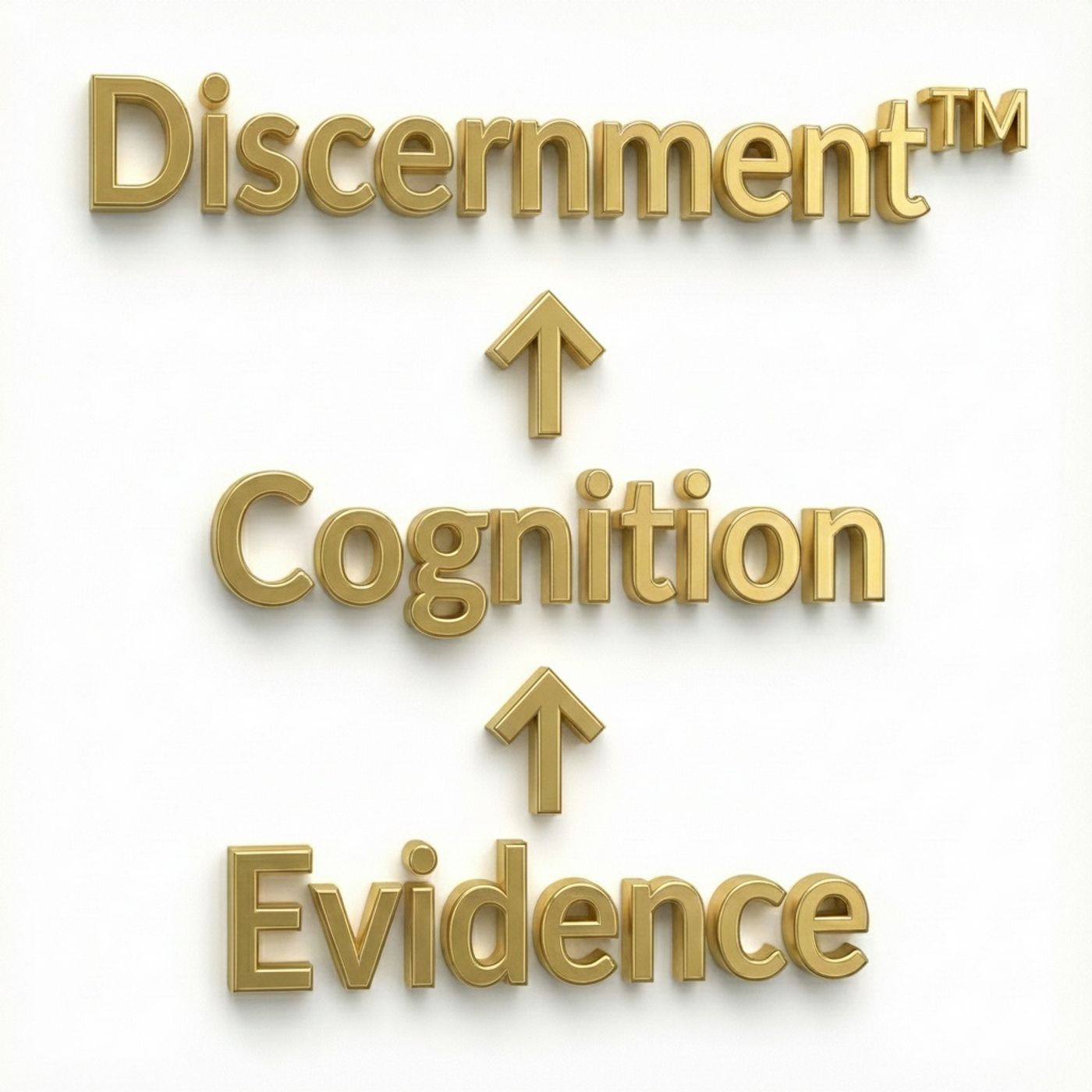
Evidence → Cognition → Discernment™️ - Your Pathway to AI LeadershipShow Notes
In this article, Greg Twemlow argues that human discernment must remain the cornerstone of learning and professional life to prevent generative AI from eroding our cognitive sovereignty. He introduces the Context & Critique Rule™, a framework inspired by Bruce Lee’s philosophy, which encourages users to "intercept" automated fluency with mandatory friction and intentional reasoning. The text highlights a growing crisis where entry-level employment is vanishing because basic tasks are now automated, leaving young workers without traditional opportunities to develop professional judgment. To counter this, the author proposes using Direction and Traction Plans to help students build portfolios based on real-world problem-solving rather than just static output. Ultimately, the source advocates for a shift in education and industry towards accountable AI usage, ensuring that individuals retain ownership over their choices and intellectual labour. Read the article.
About the Author - Greg Twemlow writes and teaches at the intersection of technology, education, and human judgment. He works with educators and businesses to make AI explainable and assessable in classrooms and boardrooms — to ensure AI users show their process and own their decisions. His cognition protocol, the Context & Critique Rule™, is built on a three-step process: Evidence → Cognition → Discernment — a bridge from what’s scattered to what’s chosen. Context & Critique → Accountable AI™. © 2025 Greg Twemlow. “Context & Critique → Accountable AI” and “Context & Critique Rule” are unregistered trademarks (™).
More from Evidence → Cognition → Discernment™️ - Your Pathway to AI Leadership
Greg Twemlow proposes Mathematical Constellation Mapping, an innovative educational methodology designed to transform how students learn mathematics by inverting traditional teaching approaches. Instead of memorising formulas and practising abstract procedures first, learners begin by investigating personally meaningful phenomena—such as music, ocean waves, or playground swings—that naturally spark their curiosity. Leveraging artificial intelligence, small student groups known as MCM Pods explore unexpected mathematical connections across diverse disciplines, developing critical thinking and independent intellectual agency. Teachers act as expert guides, helping pupils calibrate challenges and rigorously test their findings rather than blindly accepting machine-generated answers. Ultimately, this approach seeks to foster mathematical agency, empowering young people, particularly those who previously struggled, to see mathematics as a living instrument for understanding the world. Read the article.
Greg Twemlow's Medium article argues that artificial intelligence is eroding traditional entry-level jobs and undermining human formation, which is the lifelong process of developing sound judgement. Instead of addressing this developmental crisis, legacy educational institutions are relying on inflated diplomas and truncated degrees that fail to prepare students for a rapidly changing economy. Consequently, millions of workers face structural displacement and unpaved career pathways while productivity gains increasingly benefit senior personnel rather than junior staff. To navigate this modern labour landscape, the author contends that individuals must move beyond static career plans and adopt proactive traction architectures focused on verified capabilities. Ultimately, maintaining human agency requires deliberate cognitive protocols like Context & Critique to ensure people retain moral ownership over their work.
Greg Twemlow introduces Mathematical Constellation Mapping (MCM), a novel educational framework designed to transform how students learn mathematics using artificial intelligence. Instead of merely executing traditional calculations or passively consuming curriculum content, students work in small collaborative pods to proactively scan, test, and reveal unexpected mathematical relationships. By leveraging AI as an investigative partner rather than a shortcut, learners develop vital intellectual independence, critical judgement, and personal agency over their own academic path. The methodology relies on a disciplined Context and Critique approach, ensuring young people rigorously verify AI-generated insights and discard superficial or false connections. Ultimately, this framework provides educators with the rewarding opportunity to guide students as true mathematical explorers rather than just test-takers. Read the article.
Greg Twemlow’s article explores how generative artificial intelligence breaks down traditional barriers by allowing individuals to investigate unfamiliar ambitions and construct personalized pathways. By connecting Vannevar Bush’s 1945 vision of the Memex with modern technology, Twemlow introduces the concept of Breakout Autonomy, where AI helps people transcend previously accepted boundaries of thought. However, he stresses that true progress requires human collaboration, meaning users must actively establish personal context, critically evaluate AI outputs, and maintain personal responsibility rather than treating technology as a simple answer machine. Through a lifelong process termed Formation—which encompasses judgment, ownership, contribution, and navigation—individuals use these evolving life-maps to build genuine competence and self-confidence. Ultimately, the text argues that AI’s greatest promise lies in democratising human possibility, empowering people to discover how to begin journeys they never knew were theirs to undertake. Read the article.
The rapid advancement of artificial intelligence in generating research-level proofs has fundamentally shifted the nature of mathematical achievement, moving the summit of human value away from routine execution. Because machines can now automate symbolic derivations at scale, the discipline must evolve beyond mere computational speed and resist the superficial adoption of unverified algorithmic outputs, often described as vibe math. To maintain intellectual rigour, education must reframe manual calculation not as an economic end, but as a crucial cognitive apprenticeship that builds essential intuition and structural insight. Rather than acting as mere processors of numbers, human mathematicians must operate as Discerner Architects who thoughtfully frame problems, forge interdisciplinary connections, and rigorously audit machine-generated solutions. Ultimately, while technology can rapidly produce candidate resolutions, true mathematical understanding requires human judgment, intent, and the capacity to perceive the deeper harmonies of the universe. Read the article.