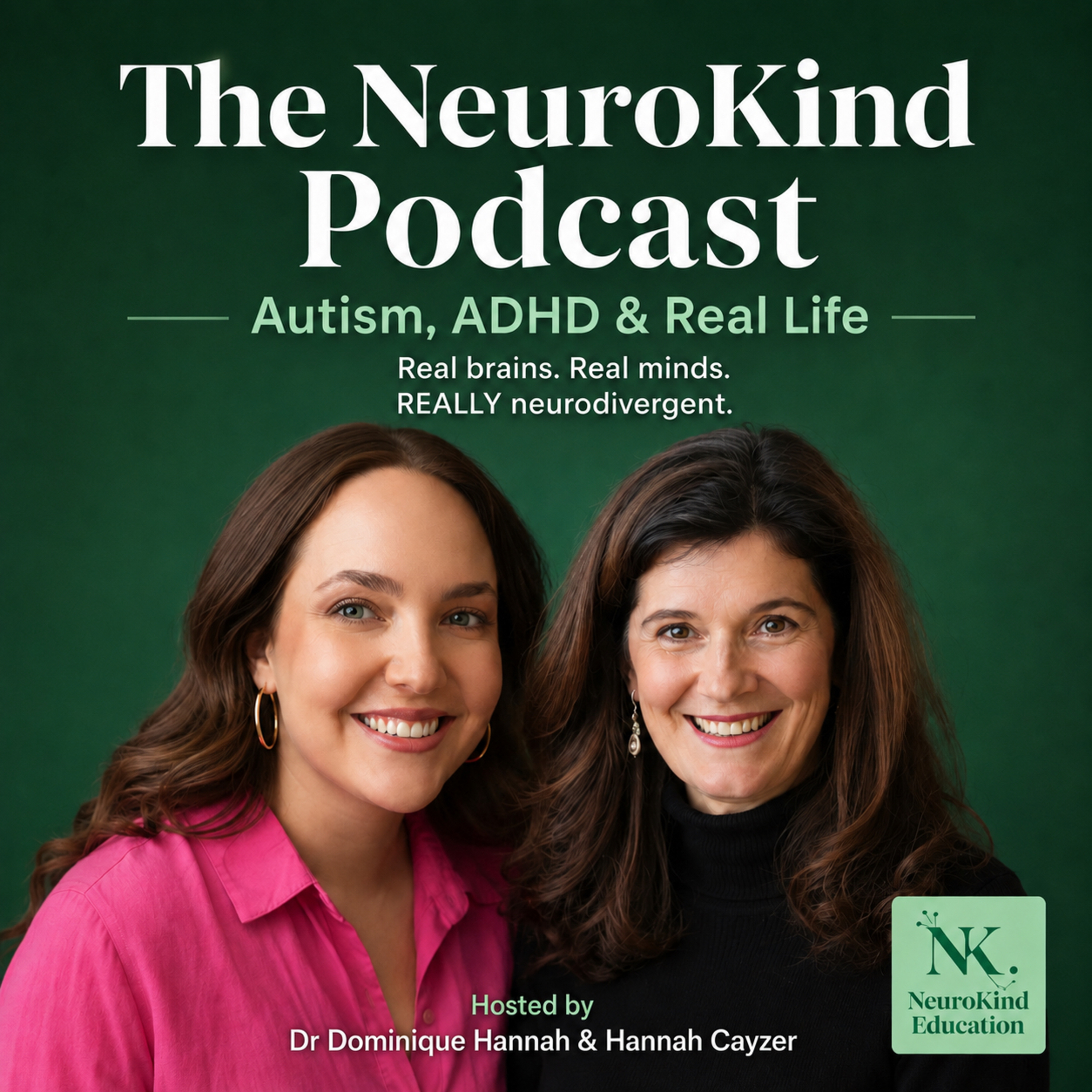
What Is Neurodiversity? (And Why Autism & ADHD Were Missed in Women)
The NeuroKind Podcast | Autism, ADHD and Real LifeShow Notes
What is neurodiversity — really? And why were so many women missed?
In this episode of It’s Not Just You, we break down what neurodiversity actually means, how our understanding has shifted from the medical model to the neurodiversity paradigm, and why autism and ADHD in women have historically been overlooked.
We explore the difference between neurodiversity vs neurodivergence, and what living in a neurodivergent brain can actually feel like — from sensory overwhelm and executive dysfunction to masking, burnout, and social exhaustion.
We also unpack: • Why early autism research was based on male presentations • How this led to missed and misdiagnosed women • The concept of masking and camouflaging (and its psychological cost) • Common misdiagnoses including anxiety, depression, and personality disorders • Why many women are only now being diagnosed in their 30s and 40s • The shift toward a social model of disability • How diagnosis can be reframed as understanding — not deficit
This episode is for anyone who has ever felt: “Why does everything feel harder for me?” “Why do I burn out when others don’t?” “Why do I feel like I’m performing just to keep up?”
If that’s you — this conversation may change how you see yourself.
Because as always: it’s not just you.
More from The NeuroKind Podcast | Autism, ADHD and Real Life
What if the trauma ended years ago — but part of you is still living as though it could happen again? In Part One of NeuroKind’s three-part series on Complex PTSD (CPTSD), psychiatrist Dr Dominique Hannah and Hannah Cayzer explore what happens when trauma isn’t a single event, but something prolonged, repeated or difficult to escape. Complex PTSD can affect far more than our memories of what happened. It can shape how we experience emotions, relationships, safety, shame and even our sense of who we are. You might constantly apologise, even when you’ve done nothing wrong. You might assume people are angry with you. You might struggle to relax without feeling guilty. You might be hyper-independent because relying on other people has never felt safe.You might find yourself intensely affected by rejection, criticism or conflict — or shut down completely when emotions become too much. And you may have spent years thinking these things were simply parts of your personality. In this episode, Dominique and Hannah unpack the psychology behind Complex PTSD and ask an important question: what happens when behaviours that once helped us survive follow us into environments where the original danger is no longer present? They explore the difference between PTSD and Complex PTSD, including the familiar trauma responses of re-experiencing, avoidance and an ongoing sense of threat or hypervigilance. But CPTSD can involve something more. The conversation explores three areas particularly associated with Complex PTSD: difficulties regulating emotions, a deeply affected or negative sense of self, and difficulties forming or maintaining relationships. Dominique also explains an important and often confusing issue for Australians seeking information about CPTSD: Complex PTSD is recognised as a distinct diagnosis in the World Health Organization’s ICD-11, but it is not a separate diagnosis in the DSM-5-TR, the diagnostic framework commonly used in Australian psychiatric practice. So what does that mean for people who recognise themselves in descriptions of CPTSD? And why does the language we use to understand trauma still matter, even when diagnostic systems differ? The episode also looks at the kinds of experiences that can contribute to complex trauma, including prolonged domestic and family violence, repeated childhood abuse, sexual abuse, physical abuse, coercive or threatening environments, and growing up in circumstances where escape or safety may have felt impossible. Importantly, this isn't a conversation about asking, “What is wrong with you?” It is about asking: “What happened to you — and what did your brain and body learn they needed to do to survive it?” Dominique and Hannah discuss how chronic threat can influence emotional regulation, the autonomic nervous system, self-worth and our expectations of other people. They also explore the profound shame, guilt and sense of failure that many trauma survivors carry — often despite having done nothing to deserve what happened to them. And that distinction matters. The shame of abuse does not belong to the person who experienced it. For some listeners, this episode may put language around experiences they have struggled to explain for years. For others, it may help them better understand someone they love. Not: “Why am I like this?” But: “What makes sense about the way I learned to survive?” 🎧 Complex PTSD, Part 1: It’s Not Just What Happened to You In this episode: Complex PTSD (CPTSD) explained • CPTSD vs PTSD • DSM-5-TR vs ICD-11 • childhood trauma • chronic and repeated trauma • domestic and family violence • emotional dysregulation • hypervigilance • shame and guilt • negative self-concept • trauma responses • relationships after trauma • the autonomic nervous system • mental health • trauma recovery. Content note: This episode discusses trauma, childhood abuse, sexual abuse and domestic and family violence. Please listen in whatever way feels safest for you.
Rejection Sensitivity Dysphoria (RSD): Why Rejection Feels So Painful in ADHD & Autism | NeuroKind Podcast Have you ever replayed a conversation for days, convinced someone secretly dislikes you? Felt physically sick after receiving criticism? Avoided opportunities because the possibility of rejection felt unbearable? You are not alone. In this episode of The NeuroKind Podcast, psychiatrist Dr Dominique Hannah and lawyer, autism & ADHD advocate Hannah McLaughlin explore one of the most misunderstood experiences in neurodivergence: Rejection Sensitivity Dysphoria (RSD). Although RSD is not currently a formal diagnostic criterion, countless autistic and ADHD individuals describe an intense emotional response to perceived criticism, exclusion, failure or rejection. For many, these experiences can influence friendships, relationships, careers, parenting and self-esteem in profound ways. Together, Dom and Hannah unpack the science behind RSD, what current research tells us, where the concept originated, and why so many neurodivergent adults feel seen when they finally discover there is a name for what they've experienced their entire lives. Drawing on clinical expertise, lived experience and plenty of humour, they discuss why rejection can feel physically painful, why masking often develops as a protective strategy, and how years of misunderstanding and criticism can shape a person's nervous system. The conversation also explores: What Rejection Sensitivity Dysphoria (RSD) actually is
The Wonderful World & Gifts of the Neurodivergent Brain (Autism, ADHD & AuDHD) What if the conversation around autism, ADHD and AuDHD has been missing half the story? For decades, neurodivergence has largely been discussed through the lens of challenges, deficits and disability. While those experiences are real and deserve recognition, they’re only part of the picture. In this uplifting and evidence-informed episode we explore something that’s often overlooked: the remarkable gifts, strengths and unique perspectives of the neurodivergent brain. Together, they unpack why autistic, ADHD and AuDHD minds have contributed to some of humanity’s greatest innovations, discoveries and creative achievements. They discuss why different ways of thinking aren’t flaws to be fixed, but valuable differences that have always played an important role in society. Throughout this episode, you’ll discover why curiosity, creativity, hyperfocus, pattern recognition, innovation, honesty, loyalty and a deep sense of justice are so commonly seen in neurodivergent people. The conversation explores why so many entrepreneurs, inventors, creatives and business founders appear to think differently, and why environments that recognise neurodivergent strengths are often the key to helping people thrive. You’ll hear why ADHD isn’t simply an attention deficit, but an attention regulation difference, how hyperfocus can become a remarkable asset, and why autistic monotropism allows many people to develop extraordinary expertise in subjects they love. Dominique also explains the evolution of our understanding of AuDHD, including why autism and ADHD couldn’t be diagnosed together until the release of DSM-5 in 2013, and what current research tells us about the significant overlap between these neurotypes. Together, they discuss how understanding both autism and ADHD can completely transform someone’s understanding of themselves. This episode also explores justice sensitivity, deep empathy, authentic relationships, creativity, resilience, environmental fit, psychological safety and why so many neurodivergent adults spend years believing they’re broken before finally discovering that their brains simply work differently. Hannah and Dominique discuss the importance of creating environments that recognise strengths instead of focusing exclusively on difficulties. Most importantly, this conversation challenges the idea that neurodivergence is something to be cured. Instead, it offers a hopeful, neuro-affirming perspective: that autism, ADHD and AuDHD are part of the natural diversity of human minds. As Dominique beautifully explains, neurodiversity isn’t a bug in humanity—it’s a feature. Different thinkers have always shaped our world, challenged convention and driven progress. Whether you’re autistic, ADHD, AuDHD, exploring a diagnosis, parenting a neurodivergent child, teaching in an inclusive classroom, working in healthcare, or simply wanting to better understand neurodiversity, this episode will leave you with a deeper appreciation of the extraordinary potential that exists within neurodivergent minds. • The strengths of autism, ADHD and AuDHD• Hyperfocus and monotropism• Creativity, innovation and entrepreneurship• Pattern recognition and different ways of thinking• Justice sensitivity and deep empathy• Loyalty, authenticity and meaningful relationships• The science of AuDHD and current research• Why environment matters more than deficits• Raising neurodivergent children with pride• Why different minds change the world Keywords: autism, ADHD, AuDHD, neurodivergent, neurodiversity, autistic adults, ADHD adults, ADHD podcast, autism podcast, neurodivergent strengths, autistic strengths, ADHD strengths, hyperfocus, executive functioning, late diagnosis, neurodivergent women, parenting ADHD, parenting autism, autism education, ADHD education, neuro-affirming, mental health, inclusion, educators, teachers, psychologists, psychiatrists, NeuroKind Podcast.
What happens when autism and ADHD exist in the same brain? For many people, the answer is confusion, contradiction, and decades of feeling like they don’t quite belong anywhere. In this episode of the NeuroKind Podcast, psychiatrist Dr Dominique Hannah and NeuroKind co-founder Hannah McLaughlin take a deep dive into AuDHD—the increasingly recognised presentation of co-occurring Autism and ADHD. For years, autism and ADHD were viewed as separate conditions. In fact, previous diagnostic systems did not allow both diagnoses to be given simultaneously. Modern research has transformed our understanding, revealing that many people experience characteristics of both neurotypes and that these traits often interact in unique and sometimes paradoxical ways. The conversation explores why AuDHD can feel so difficult to identify, particularly in adults who have spent their lives trying to understand themselves through only one lens. Many individuals report feeling “too autistic for the ADHD groups” and “too ADHD for the autism groups”—a feeling of existing between categories while fully belonging to neither. Dr Hannah explains how autism and ADHD can both complement and conflict with each other. The autistic desire for predictability, routine and structure can sit alongside the ADHD drive for novelty, spontaneity and stimulation. The result is often an internal push-pull that can be exhausting, confusing and difficult to explain to others. The episode examines common AuDHD experiences including: • Executive functioning difficulties• Hyperfocus and intense interests• Sensory sensitivities and sensory seeking• Social communication differences• Emotional regulation challenges• Demand avoidance and burnout• Masking and late diagnosis• The search for identity and self-understanding• Strengths associated with neurodivergent thinking Using historical examples and thought experiments, the discussion explores how neurodivergent traits may have influenced some of history’s most influential thinkers, scientists, artists and innovators. Importantly, the hosts discuss the limitations of retrospective diagnosis while examining the characteristics that often lead researchers and clinicians to speculate about neurodivergence in historical figures. The conversation also highlights an important issue often overlooked in discussions of history and science: the contributions of women. During a spontaneous discussion about the discovery of DNA, the hosts reflect on the crucial role played by Rosalind Franklin and the broader tendency for women’s achievements to be overlooked or forgotten. A central theme throughout the episode is that many late-diagnosed autistic and ADHD adults have spent years believing they were failing. They have tried harder, worked longer, become more organised, more disciplined and more self-critical in an effort to function in systems that were never designed for their brains. Dr Hannah offers a powerful alternative perspective: The problem was never a lack of effort. The problem was misunderstanding. Understanding one’s neurotype can transform self-perception, reduce shame and create opportunities to develop strategies that work with the brain rather than against it. The hosts introduce the concept of flexible structure—the idea that many AuDHD individuals thrive not with rigid routines or complete freedom, but with adaptable systems that balance predictability and autonomy. Above all, this episode is a message of validation. Whether you are newly diagnosed, questioning whether you may be neurodivergent, supporting a neurodivergent family member, or simply interested in the evolving science of autism and ADHD, this conversation provides an accessible and compassionate introduction to AuDHD. Neurodiversity research is still developing. Our understanding of AuDHD continues to evolve. Yet for many people, finally discovering that autism and ADHD can coexist offers a framework that makes sense of a lifetime of experiences.
In this episode of It’s Not Just You, Hannah McLaughlin and Dr Dominique explore the signs of autism in girls and women — not just what autism looks like from the outside, but what it feels like on the inside. We talk about why autistic girls are so often missed, how masking and social performance can hide distress, and why many women grow up feeling “different” without knowing why. This conversation explores: Autism in girls and women Late diagnosis and missed diagnosis Masking, camouflaging and social exhaustion Special interests that fly under the radar Friendship, boundaries and social confusion Interoception, alexithymia and emotional intensity The “good girl” and “problem child” presentations Burnout, anxiety and the cost of performing Why understanding your neurotype can change everything If you’ve ever felt like you were performing your way through life, or wondered why everything seemed harder than it looked, this episode is for you. It’s Not Just You is a NeuroKind podcast hosted by Dr Dominique Hannah and Hannah McLaughlin.