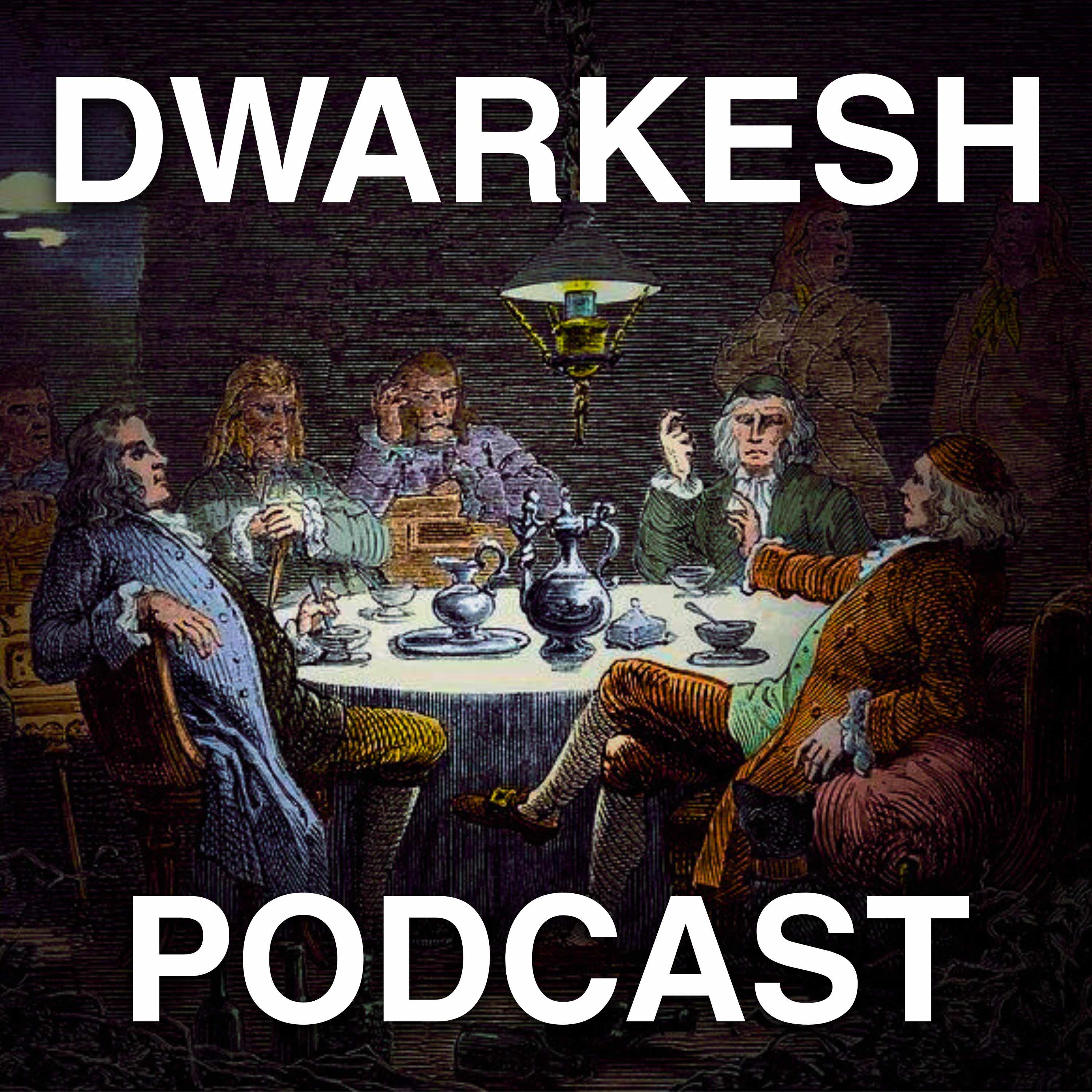
Why Leonardo was a saboteur, Gutenberg went broke, and Florence was weird – Ada Palmer
Dwarkesh PodcastShow Notes
Renaissance history is so much wilder and weirder than you would have expected. Very fun chatting with Ada Palmer (historian, novelist, and composer based at the University of Chicago). Some especially fascinating things I learned from the conversation and her excellent book, Inventing the Renaissance: Not only did Gutenberg go bankrupt in the 1450s (after inventing the printing press), but so did the bank that foreclosed on him, and so did his apprentices. This is because paper was still very expensive, and so you had to make this big upfront CAPEX decision to print a batch of 300 copies of a book - say the Bible. But he’s in a small landlocked German town where only priests are allowed to read the Bible - so he sells maybe 7 copies. It’s only when this technology ends up in Venice, where you can hand 10 copies to each of 30 ship captains going to 30 different cities, that it starts taking off. Speaking of which, the printing revolution wasn’t just one single discrete event, just as the computer revolution has been this whole century of going from mainframes -> personal computers -> phones -> social media, each with different and accelerating social impact. Books came first, but they’re slow to print, and made in small batches. The real revolution is pamphlets - much faster, much harder to censor. Pamphlet runners are how you can have Luther’s 95 Theses go from Wittenberg to London in 17 days. So much other wild stuff from this episode. For example, did you know that the largest and best-funded experimental laboratory in 17th century Europe was very likely the Roman one run by inquisitors? Ada jokes that the Inquisition accidentally invented peer review. The focus of the Inquisition is really misunderstood - it was obsessed with catching dangerous new heretics like Lutherans and Calvinists - it only executed one person for doing science. And this leads Ada to make an observation that I think is really wise: the authorities and censors are always worried about the exact wrong things given 20/20 hindsight. When Inquisition raids an underground bookshop during the French Enlightenment, they don’t mind the Rousseau, Voltaire, and Encyclopédie, but they lose their minds about some Jansenist treatises about the technical nature of the Trinity. More broadly, a lesson for me from this episode is that it’s just really hard to shape history in the specific way that you want to impact things. One of the most famous medieval scholars is this guy Petrarch. He survives the Black Death in the 1340s, watches his friends die to plague and bandits, and says: our leaders are selfish and terrible, we need to raise them on the Roman classics so they’ll act like Cicero. So Europe pours money into finding ancient manuscripts, building libraries, and educating princes on classical virtues. Those princes grow up and fight bigger, nastier wars than ever before with new deadlier technology. And this, combined with greater urbanization and endemic plague, results in European life expectancy decreasing from 35 in the medieval period to 18 during the Renaissance (the period which we in retrospect think of as a golden age but which many people living through it thought of as the continuation of the dark ages that had persisted since the fall of Rome). Anyways, the libraries Petrarch inspires stick around, the printing press makes them accessible to everyone, and 200 years later a generation of medical students is reading Lucretius and asking “what if there are atoms and that’s how diseases work?” which eventually leads to germ theory, vaccines, and a cure for the Black Death (Ada has longer more involved explanation of how cosplaying the Romans results through a series of many steps to the scientific revolution). Petrarch wanted to produce philosopher-kings that shared his values. Instead he created a world that doesn’t share his values at all but can cure the disease that destroyed his. Watch on YouTube; read the transcript. Sponsors * Jane Street is stil
More from Dwarkesh Podcast
I spent two days touring Intel’s most advanced fab and talking to its technical leadership to understand what the chips of the future will look like. A lot of what's coming next – gate-all-around transistors, backside power, CFET, hybrid bonding – is hard to follow without actually seeing it, so we made all the awesome animated explainers that I wish I had while I was prepping. I also asked Intel’s leadership how the semiconductor industry will cope with the enormous shock in demand from AI. AI compute has grown 3x a year for the last decade, but according to Intel's CTO, Intel could only double leading-edge wafer production with today’s global stock of chipmaking tools. What kinds of tricks can foundries pull to extend this crossover point where demand surges way ahead of supply? This was a totally new format for us - hope you enjoy! I also made flashcards for the concepts I had to learn to prep for this episode here. Watch on YouTube; read the transcript. Sponsors WorkOS helps you do business with enterprises. It gives you access to all the features most commonly required by enterprises: SSO, SCIM, RBAC, audit logs, and more. It’s easy to plug these features in — it only takes a few lines of code — and WorkOS is releasing new functionality all the time, including things like auth for agents. If you want to join the 3,000+ companies that rely on WorkOS, go to workos.com Jane Street built a powerful tool called magic-trace to help analyze and debug their trading systems. It only exists because one engineer noticed a feature on Intel chips called Processor Trace and thought it’d be valuable to build on top of. Now, traders and developers across Jane Street use magic-trace every single day! If you want to be trusted to pursue the ideas you think matter most, Jane Street is hiring. Go to janestreet.com/dwarkesh Antithesis’ testing platform lets you perfectly reproduce every single bug you find. That’s because it runs on a fully deterministic computer, which strips out all the unpredictability that can make certain bugs flaky and hard to pin down. To build it, Antithesis found every source of non-determinism in Intel’s x86 architecture and either sealed it off or replaced it with a controlled simulation. Learn more at antithesis.com/dwarkesh Timestamps (00:00:00) – Intro (00:00:47) – How Intel brings up a new process node (00:03:22) – What Intel learned from 10nm (00:06:28) – From planar transistors to gate-all-around (00:13:13) – Why High-NA EUV pays off for Intel but not TSMC (00:19:20) – Could chips have evolved completely differently? (00:23:33) – Inside Intel’s “Hot Topics” meeting (00:29:30) – Replacing copper wires with ruthenium (00:32:41) – Why stacked transistors take a decade to ship (00:39:45) – Hybrid bonding and the chip-to-chip bottleneck (00:48:00) – There aren’t enough tools to 10x chip production (00:53:14) – Can Intel catch up to TSMC? (01:01:02) – Terafab, and rethinking the fab from scratch
New episode with military historian Si Sheppard. The conquests of the Aztec and Inca empires might be the most shocking events in human history. Hernan Cortés and some hundreds of Conquistadors landed on a new continent they knew basically nothing about, and within 2 and a half years, conquered the 6 million strong Aztec empire. Then, a decade later, Francisco Pizarro did the same thing to an Incan Empire of some 10 million inhabitants. In both cases, the Conquistadors consistently beat native armies while being literally 100x (or even in some cases 1000x) outnumbered - and in many cases, did so without taking a single casualty. And they did this with 99% of their military forces being made up of the very natives they were trying to subjugate. We often forget how wild human history is. People talk about AI takeover as if it would be some crazy, unprecedented sci-fi outcome. But this would not be the first time an alien force whose motives the defenders barely understand use more advanced technology and diplomatic cunning to outmaneuver and then take over a much larger and long established existing order. Watch on YouTube; read the transcript. Sponsors * Jane Street’s intern projects are even more ambitious than I realized. One intern spent his summer researching LLM memorization, figuring out how to quantify and reduce it. This matters because, when Jane Street tests their models on historical data, they need to know that performance reflects predictive power, not just memorized outcomes. Another intern spent his time developing a new activation checkpointing scheme: his custom version ended up outperforming PyTorch’s native one. If you want to read about more 2026 intern projects or apply for Jane Street’s 2027 internships, go to janestreet.com/dwarkesh * Grok Bot can tackle the tasks you’ve been meaning to handle but just haven’t gotten around to. For example, SpaceXAI recently gave Grok Bot access to their procurement contracts, vendor spend, and usage data: it ended up identifying over $100,000 in potential savings for them. I decided to try this on my own spend, and Grok Bot found over $5,000 of savings for me, even though I run a pretty small team. Try it out yourself at x.ai/bot * Antithesis solves one of the biggest problems with traditional software testing: to test for a bug, you first have to be able to imagine it. Antithesis runs your system through thousands of parallel histories and steers your tests for you, injecting faults and generally trying to make everything as adversarial as possible. That way, your software gets tested against scenarios you’d never imagine but that could still arise in the real world. Learn more at antithesis.com/dwarkesh Timestamps (00:00:00) – Cortés’s conquest of the Aztecs (00:22:39) – Pizarro’s conquest of the Inca (00:26:59) – Explaining Conquistador military superiority (00:34:39) – Could the natives have beat the Conquistadors? (00:48:56) – The Aztecs and Incas did not get to learn from each other (00:56:11) – Why Spain still lost in the long run (01:07:47) – Why didn’t the Aztecs/Incas adapt better to European warfare? (01:14:16) – Conquistador motivation (01:26:22) – Why Mughal India also couldn’t play the Europeans off each other (01:33:42) – Diplomacy was just as important as technology
New episode with Noam Brown. We talk about multi-agent, Navier-Stokes, and what the current explosion of maths progress tells us about what happens once you automate AI research. And we also discuss how we will know if the models are actually aligned before we kick off RSI. Watch on YouTube; read the transcript. Sponsors * Jane Street has been interested in AI for a lot longer than you’d think, and not just for trading. In 2011, a full year before AlexNet and over a decade before ChatGPT launched, they hosted the first FOOM Debate between Eliezer Yudkowsky and Robin Hanson on whether AI would lead to an intelligence explosion. Now Jane Street is revisiting the question with a new panel: Daniel Kokotajlo, Ege Erdil, Ryan Greenblatt, and Jaime Sevilla, hosted by Ron Minsky in San Francisco this October. I expect it to be a truly excellent conversation. Register at janestreet.com/dwarkesh * Grok Bot has made handing off work super easy. It runs on its own cloud computer, where it installs the tools it needs to handle tasks end-to-end. For the podcast, we use Grok Bot to help produce our videos. You may have noticed that our ads feature animations of real websites. Getting these pixel-perfect used to mean running a convoluted, multi-step workflow ourselves. Now we just let Grok Bot handle it. Best of all, Grok Bot has learned all of our specs and preferences, so we don’t have to redescribe the task each time! Try Grok Bot for yourself at x.ai/bot * Antithesis gives you the confidence of a giant test suite without actually having to write one. Say you’re doing a major backend refactor: building enough tests to trust it could take weeks. Antithesis solves this by running your software through countless simulated worlds, injecting faults and hunting for failures. On any PR, you can turn a dial to decide exactly how much testing you want. And because every run is fully deterministic, agents can branch off the moment a bug appears, rewind it, inspect memory, and replay it, all while the original test keeps running. Learn more at antithesis.com/dwarkesh Timestamps (00:00:00) – Multi-agent and Navier-Stokes (00:15:28) – How will AI firms work? (00:22:02) – What math progress tells us about recursive self improvement (00:40:22) – Hugging Face and alignment (01:01:18) – The internal/external model gap (01:08:34) – Chain of thought is degrading (01:14:12) – How will we know when alignment is solved?
New episode with John Schulman, Beren Millidge and Charlie O’Neill. I got together with some of the most insightful AI researchers I know who are at the openish companies, because I wanted to hear the details of what's actually happening at the frontier and what comes next. Watch on YouTube; read the transcript. Sponsors * Antithesis helps you trust your code. As agents generate more and more of your software, the bottleneck shifts from your engineers actually writing code to verifying it. Antithesis does that testing for you. Ron Minsky, who co-leads Jane Street’s tech group, told me that Antithesis was able to help his team shake out bugs in software that had already undergone heavy review. If you want to see how it fits into your development process, go to antithesis.com/dwarkesh * Grok Bot has been a great way to hand off tasks. My team uses it as a producer: whenever my editor posts a rough cut of an interview in Slack, Grok Bot opens the transcript on its own computer, matches my notes to the exact moments they refer to, and uses a file of my preferences to suggest edits. Then it sends me its top clip candidates so I can review everything from my phone, which saves my editors from sorting through hours of footage. Try Grok Bot for yourself at x.ai/bot * Jane Street just launched its most ambitious competition yet: design a protocol-emulator ASIC. Basically, if you have a chip you want to test outside of a live system, you should be able to connect it to your design and have it simulate realistic traffic. Jane Street wants general-purpose, reprogrammable designs that can work across multiple protocols and remain useful as new ones emerge. The most novel submissions will actually get taped out, and the winners will receive a physical copy! The competition is open until January 18, 2027, and teams are encouraged. To get started download the template code at janestreet.com/dwarkesh Timestamps (00:00:00) – Steelmanning the case against RSI (00:18:39) – What’s driving the Chinese labs’ progress (00:28:06) – How will automated AI researchers be trained (00:33:51) – Will long-horizon RL elicit AGI? (00:45:24) – The sim-to-real gap (01:00:33) – How much progress is explained by data? (01:18:03) – Why is RL working so well? (01:24:54) – Move 37 and entropy collapse (01:28:32) – Rapid-fire timelines
Ajeya Cotra is a researcher at METR, where she works on threat modeling for loss-of-control risks from advanced AI. Before that, she led the technical AI safety program at what is now Coefficient Giving. She is one the three authors of METR and Redwood Research’s “Brief independent investigation of agents’ behavior, reasoning and collaboration in the OpenAI / Hugging Face hacking incident”. We go through not only what she and her coauthors discovered during this investigation, but what it means for how we should train future, smarter AIs which might be involved in the process of recursive self-improvement. Watch on YouTube; read the transcript. Sponsors * Jane Street’s ML engineering internships start with an intense four-day bootcamp: PyTorch, autograd, writing kernels, profiling workloads… all the things that Jane Street engineers need to know for their daily work. After that, interns tackle real projects, things the firm actually wants in its codebase. If you want to apply, or if you want to watch my recent conversation with Axel, one of Jane Street’s ML engineers, go to janestreet.com/dwarkesh * Cursor, which is now part of SpaceX, noticed that their MoE layers were eating more than half of total training time. So they wrote and open-sourced Mixture-of-Kittens, which is a custom megakernel for training MoE models on NVL72s. This kernel sped up an end-to-end run across 512 GPUs by 1.4x, from about 760 to over 1000 tokens per second per GPU. If you want to read more about the ML research that Cursor and SpaceX are doing, go to cursor.com/dwarkesh * Antithesis hands you (or your agents) a bug’s root cause so you can avoid days of manual debugging. If your test run crashes, Antithesis rewinds, branches off hundreds of slightly varied rollouts, and checks in how many of them the crash still appears. Then it rewinds further and does this all again. As Antithesis rewinds, it eventually finds the spot where the frequency of the crash plummets: that’s where the root cause lives! If you want to see it in action, go to antithesis.com/dwarkesh Timestamps (00:00:00) - Agents get kicked off (00:06:45) - Self-sacrificing behavior (00:13:43) - Potemkin villages (00:23:27) - The Hugging Face attack (00:35:23) - The slopvestigation (00:52:02) - Understanding the AI's motives (01:05:31) - The actual dangers of anthropomorphizing (01:14:30) - What smarter models might do (01:30:29) - The implications for recursive self-improvement (01:38:10) - Is this the case for open source? (01:53:04) - How do we prevent this in the future? (02:15:58) - The clearest warning shot we might ever get