Show Notes
It’s been 47 years since the last time a man stepped on the moon, and yet now a host of countries – from the US, to Russia and China – are racing to send astronauts back there, and set up base.
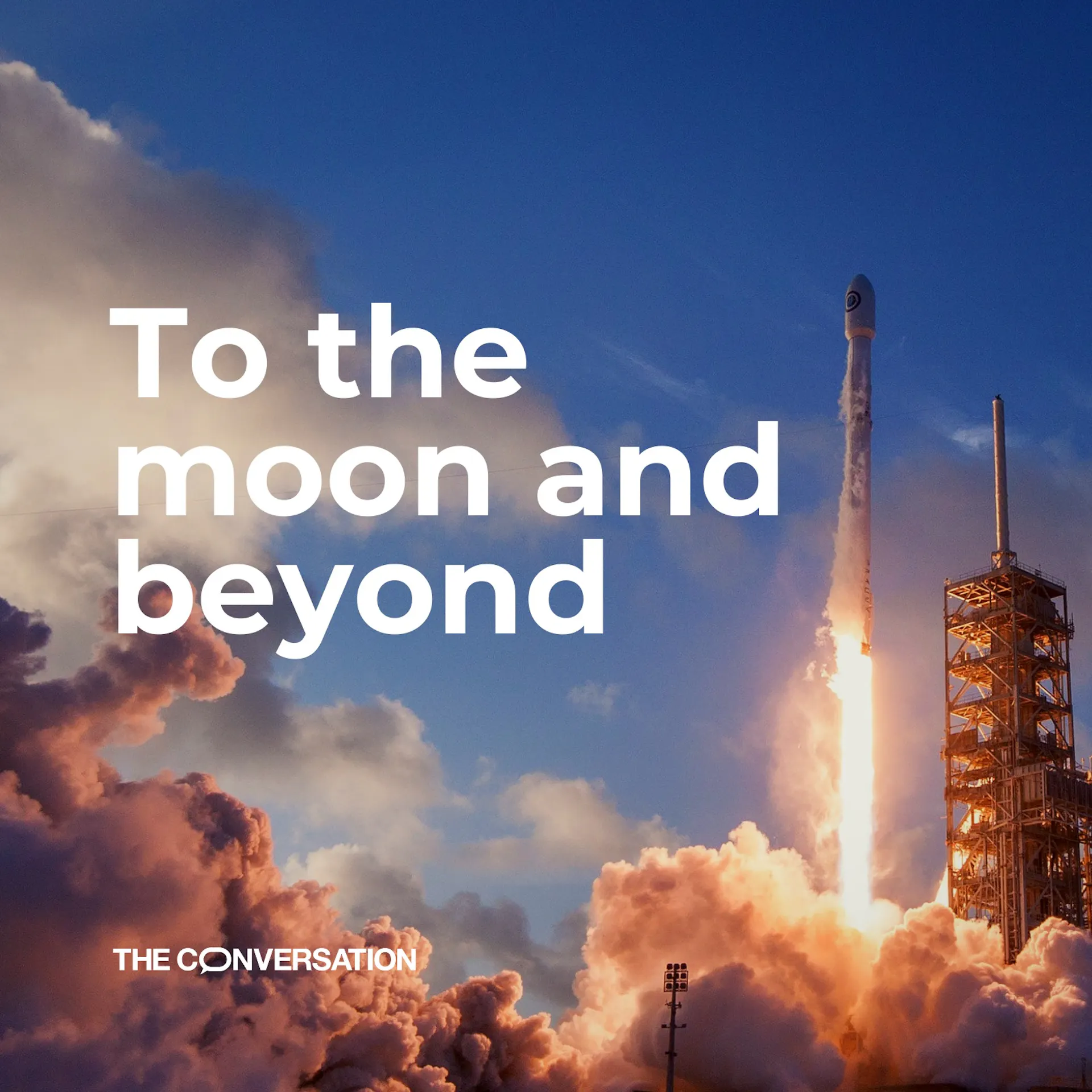
In the fourth episode of The Conversation’s To the moon and beyond podcast, we delve into why there’s a renewed drive to put humans back on the surface of the moon. What’s there to go back for? And what are the practical, legal and ethical questions facing those who want to set up a base there – and potentially start mining the moon.
We find out that while no one country owns the moon – a principle set out in the Outer Space Treaty of 1967 – the question of who owns the resources on the moon is more complicated. Tanja Masson-Zwaan, an assistant professor of space law at Leiden University in The Netherlands, explains that another international agreement, the Moon Treaty, which entered into force in 1984, has only been ratified by 18 countries, and by none of the major space powers. The big sticking point is the principle that the moon and its natural resources are the “common heritage of mankind” – the exact meaning of which is unclear.
Does it mean that everything that a company could have in profits from exploiting resources in outer space has to be split among all countries? What exactly it means is unclear and that is why many states don’t don’t like it and will not ratify it.
Masson-Zwaan says that while a new international treaty is unlikely, a new set of guidelines are needed to govern exploitation of the moon’s resources.
Part of the attraction of going back lies in what’s under the moon’s dusty surface. Katherine Joy, a Royal Society university research fellow at the University of Manchester in the UK, explains some of the elements that could potentially be found on the moon – from water and oxygen to Helium 3 – and what they could be used for.
The great question we have next is not so much in terms of how can we go to mine the moon but first of all we need to understand the potential resources and where they’re located, how they’re accessible and we need to also develop the technology to be able to detect them and extract them to make them into usable products.
She explains that she’d love to get her hands on a piece of water ice from the moon’s surface back in her lab – but that this might not be so simple as no mission so far has plans to bring one back cryogenically.
But even if a country or company could overcome the many technical hurdles of mining on the moon, there’s no global police force able to punish those breaking any new rules. We asked Frans von der Dunk, professor of space law at the University of Nebraska-Lincoln in the US, whether he could envisage a space war breaking out and what it might look like.
It will probably start first on the level of a trade war … but that can already do a lot of damage to everyone around. But if things further escalate as we’ve seen in the past, economic wars can also then escalate into real fighting and I can only say I hope that never happens.
He also discusses some of the other questions raised by mining on the moon – including whether it’s ethical that those who can afford to go and mine the moon do it, and those who can’t, don’t.
And even if all these practical and legal challenges are overcome, what would it actually be like to live there? Frédéric Marin, an astrophysicist at the University of Strasbourg in France, explains just how inhospitable it would be to live in an environment with such low gravity, covered in abrasive dust. And Rowena Christiansen, a medical educator and doctor at the University of Melbourne in Australia, talks through some of the side effects that spending prolonged amounts of time in space can have on the human body.
Your muscles start to lose mass because they don’t have to work against gravity anymore and that includes the heart, which is basically just made up of muscle. And also your bone mineral density tends to decrease.
More from To the moon and beyond
What will space exploration look like in 2069, a century after the first moon landing? In the fifth and final episode of podcast series, To the moon and beyond, we speak to space scientists about the missions they are dreaming about and planning for the future.
From Algeria to Vietnam, there are 72 countries with some sort of space programme. And the new space race involves a number of private companies too, that are becoming increasingly crucial to national missions.
In the second episode of The Conversation’s To the moon and beyond podcast series, we take a look at the impact going to the moon had on humanity – and why it generated so many conspiracy theories.
blank Welcome to the first episode of To the moon and beyond, a brand new global podcast series from The Conversation marking 50 years since the first moon landing in July 1969.
It’s been 50 years since Neil Armstrong made his giant leap for mankind by becoming the first person to set foot on the lunar surface. While the historic event was followed by six further crewed missions – five of which landed – nobody has been back to the moon since the astronauts of Apollo 17 bid their goodbyes in 1972.