Show Notes
We welcome Professor Gayle Letherby, a pioneering sociologist whose deeply personal and academic work has transformed how we think about childlessness, grief, identity, and storytelling. Gayle reflects on her journey, beginning with a miscarriage in the 1980s that altered her life trajectory and became the foundation of a groundbreaking academic career. Her research into involuntary childlessness, pregnancy loss, and the status of parenthood spans decades and she’s still going strong About Professor Gayle Letherby
Having worked as a nursery nurse prior to the miscarriage (in the early 1980s) of my, to my knowledge, one and only pregnancy, one and only baby, I gave up my job and listlessly, sometimes desperately, wandered through my own life feeling that I had no purpose and no future. Finding Sociology saved me with an A Level at a local FE college being followed by an undergraduate degree, a PhD and 30+ years of teaching, researching, writing and mentoring. The significance of mother or not has always been part of my academic labour and I have undertaken research and written much on the experience of those who do and those who do not mother (and father) and the implications and impact of this. My PhD was specifically concerned with the identity and experience of ‘infertility’ and ‘involuntary childlessness’ (which I write in quotation marks to highlight problems with definition). I interviewed and corresponded with more than 80 individuals, mostly women but some men too, and when writing up my thesis included some of my own experience in the text. Alongside other academic work I have also conducted a number of auto/biographical research projects on reproductive loss and on pregnancy and early motherhood (parenthood). Fifteen years ago I began to also write fiction and memoir, for both academic and lay audiences. My personal experience and my research interests are often the stimulus for the fiction I write and my significant others regularly appear in my memoir pieces. This includes my baby, the child who died months before her or his expected birth date, and also my mother, Dorothy, and father, Ron, and my husband John (all deceased). I find this writing both cathartic and energising. My own, and others’, experience of Covid-19 and of ‘growing older’ has led me to reflect on, not least, the differences between solitude and loneliness and the experience of growing older as a childless not by choice individual. In addition to my academic writings I publish some of my work on the open site ABCtales.com writing as gletherby.
More from The Full Stop
We're joined by two researchers, Dr Nicola Spurling and Professor Cristina Archetti, for a conversation that goes right to the heart of why the Full Stop exists. Nicola is a sociologist at Lancaster University who's turned her attention to childlessness. Cristina is a professor, psychotherapist, and the author of two books on involuntary childlessness, including her brand-new release, The Trauma of Infertility. Together they talk about what it really means to bring your story into your research, why childlessness isn't a single moment but a process that runs through an entire life Meet Our Guests Nicola Spurling Senior Lecturer in Sociology, Lancaster University "In my current work I explore how, over the past fifteen years, childless people have increasingly used autobiography and storytelling to share experiences, develop knowledge and make sense of childless lives collectively. I'm interested in what happens when social researchers take that knowledge seriously — not simply as material for research about childlessness, but as something that can raise new questions and reshape what researchers think it is important to study." 🔗 Nicola's Lancaster University profile 📄 Nicola's papers (both open access — free to read). A note for listeners: these are written for an academic audience, so the language is quite dense, especially in the opening sections. Nicola is happy to answer any questions if you'd like to dig in.
What if the question "why don't you have children?" was one you spent your doctorate trying to answer for yourself? That's exactly what Dr Naomi Menahem did. And what she found wasn't the misery she'd half expected. It was something nuanced and defiant, and ultimately more hopeful. In Episode 89, Naomi joins us from Byron Bay to share her research on circumstantial childlessness, the concept of the Deferral Iceberg, and why she's chosen "robust pragmatism" over the quiet resignation of "acceptance." She also tells us about Childless Conversation — her new monthly in-person gathering for women who've been silent for too long.
In this episode, Michael, Sarah and Berenice are joined by poet Kate Smith — known on Instagram as Millie the Poet and writing under the name Kathryn Millington — to talk about her poetry pamphlet Imprint (Fawn Press), which explores childlessness, IVF and grief. Kate reads three poems live on the episode and talks candidly about her own fertility journey, the process of writing about deeply personal experience, and what it's meant to bring that work into the world. Meet our Guest Kathryn ‘Millie ’Millington is a poet, performer and activist based in Sheffield. She ran the poetry charity ‘Nine Lives Poetry’, creating a stage for emerging local poets. Millie’s poetry tells us a story of grief as a result of involuntary childlessness. It takes us on a journey “…into a world that feels niche, but is anything but…” (Wendy Pratt), to a place of acceptance of a future without children and ultimately a creative and fulfilling life. “You will know someone like me. We are everywhere: at your workplace, within your family, and your friendship groups. It’s such a lonely place. I want to inhabit that place and be that voice, to show that we can create.” Millie has shared the stage with Helen Mort, Michael Pedersen, Toria Garbutt and Leyla Josephine. Her poem ‘Imprint’ was shortlisted for the Bridport Prize. Her debut Pamphlet ‘Imprint’ received praise from Benjamin Zephaniah "I have no words, because you've used them all". Millie is published by Fawn Press and her poetry is available to buy online. You can also buy direct from her, pop her a message via Instagram @milliethepoet or email Recommended Books About Poetry/becoming a creative person
Katy Schnitzler returns to The Full Stop five years on — now fresh off submitting her PhD — to dig into one of the thorniest workplace issues for people who are childless not by choice: holidays, leave, and boundaries. The conversation moves from the personal (the strange non-celebration of finishing a PhD, the "full stop" feeling of an ending without ceremony) into the structural: school-holiday leave bias, rota and shift unfairness, "informal favours" for parents, and the particular pressures faced by teachers, midwives and nurses who are childless. Katy shares findings from her doctoral research and her Pronatalism at Work project, and the group works through practical, non-judgemental ways organisations can make leave, language and culture fairer for everyone, without taking anything away from parents. We're talking about ...
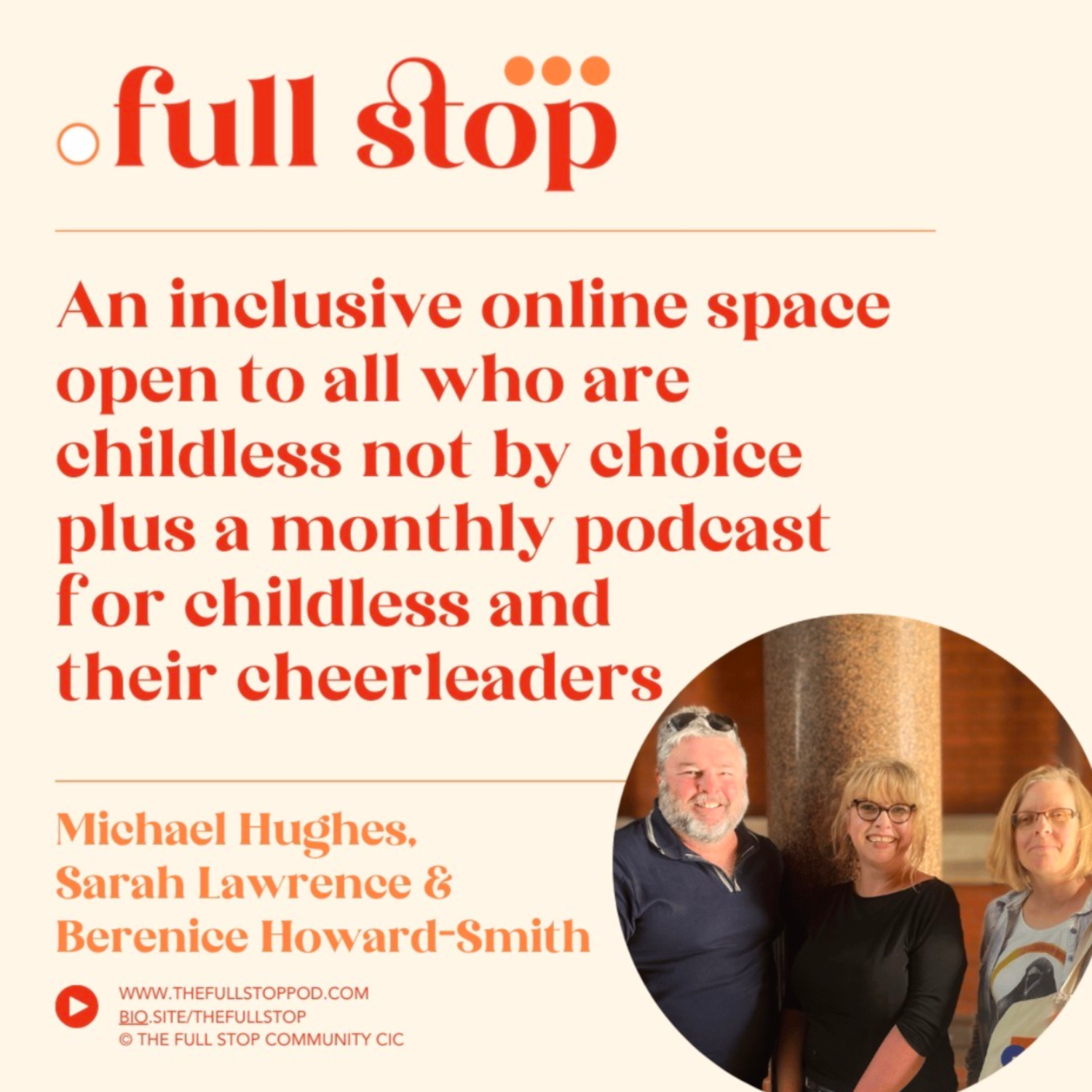
Seven years ago, Michael hit record, Sarah spoke and Berenice published episode 1 of the Full Stop pressed publish on the first episode. It was 20 minutes and 20 seconds long. There were 108 downloads. And neither of us had any idea what we were doing. Episode 86 brings us together to mark seven years of honest conversation about childless life. Join us to listen back, reflect, and look forward. In this episode: