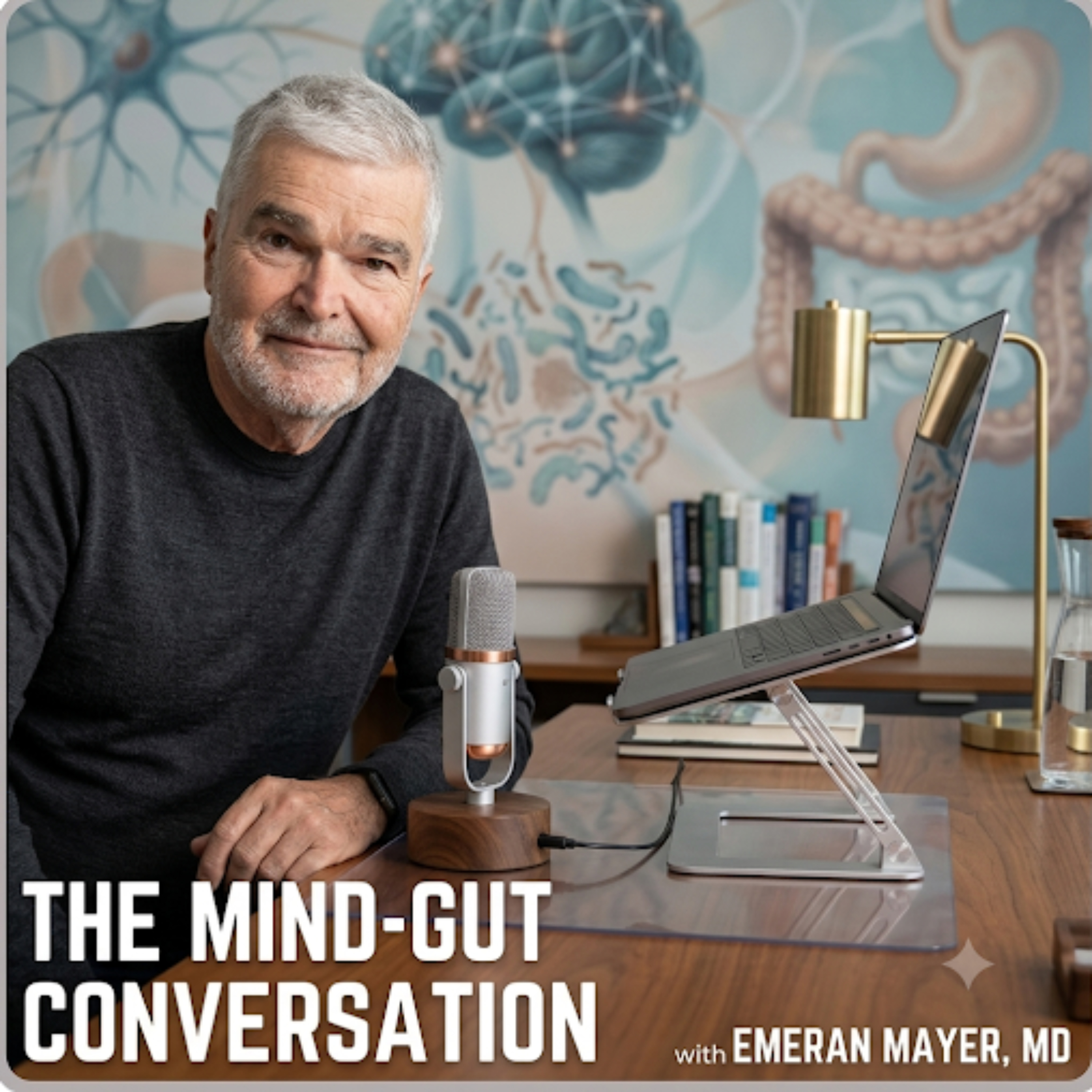
Psychedelics for IBS: Inside the First Clinical Trial with Erin Mauney, MD
The Mind-Gut Conversation PodcastShow Notes
For most of the last forty years, irritable bowel syndrome was treated as a problem of the gut alone. The idea that the brain plays a central role took decades to gain acceptance, and it remains contested today.
In this episode of The Mind-Gut Conversation, Dr. Mayer is joined by Dr. Erin Mauney, a pediatric gastroenterologist and researcher at Harvard and Massachusetts General Hospital, who has completed one of the first clinical trials of psilocybin-assisted therapy for patients with treatment-resistant IBS.
They discuss why a compound acting primarily on the brain might change how the gut is experienced, what happens when the brain’s prediction machinery becomes locked into a cycle of pain and anticipation, and why the therapy surrounding the dosing sessions may matter as much as the molecule itself.
The conversation also takes on the harder questions. How do you run a placebo-controlled trial when every participant knows they received the drug? Can the psychedelic experience be engineered out of psychedelic medicine, and what is lost if it is? And what can practices used ritually for millennia still teach a reductionist Western model of care?
This is early-stage science, and Dr. Mauney is refreshingly clear about the limits of what is currently known. It is also a glimpse at what the next chapter of brain-gut medicine might look like.
Topics discussed include: • Why IBS is best understood as a disorder of gut-brain interaction • How the brain’s predictive coding can become locked into chronic pain • What psilocybin-assisted therapy actually involves, session by session • Whether the psychedelic experience itself is essential to the benefit • The placebo problem in psychedelic trials, and why it may be unsolvable • How long the benefits appear to last after treatment ends • Where psychedelic research in gastroenterology may be headed
This is a careful, evidence-based conversation for anyone interested in IBS, chronic pain, and the future of brain-gut medicine.
Chapters: 0:00 - Introduction 3:23 - IBS as a Brain-Gut Disorder 7:40 - Entering Psychedelic Research 13:22 - How Psilocybin Could Affect the Gut 15:43 - Inside the Trial 17:50 - The Brain and Pain Prediction 21:18 - Side Effects and Patient Experience 25:40 - Does the Psychedelic Experience Matter? 29:57 - Ritual and Western Medicine 32:15 - The Placebo Question 36:33 - Combining Therapies 39:10 - Brain Imaging 40:56 - Practical Challenges 44:07 - Durability of Benefits 47:23 - Overlap With Other Conditions 49:28 - Where the Research Goes Next 54:11 - Looking Ahead
More from The Mind-Gut Conversation Podcast
Nutrition advice seems to change every week, but Dr. Christopher Gardner says the core of what we know has barely moved in fifty years.
Over the past century, average lifespan in Western countries has grown by about 30 years. The years we spend in good health have not kept pace.
After 45 years of research on how the brain and the gut communicate, the question Dr. Emeran Mayer hears most often is not about mechanisms or studies. It is much simpler than that. People tell him they understand the science, they just do not know how to live it.
Modern medicine has never been better at keeping people alive. So why are we spending more of our lives unwell?
Millions of people take a daily probiotic without ever asking a basic question: does any of it survive long enough to do anything?