Show Notes
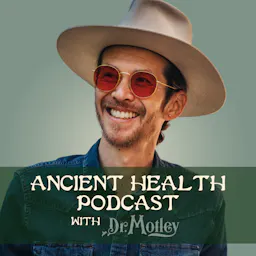
At 34, Dr. Stephen Hussey had a zero calcium score and a heart attack six months later. Dr. Chris Motley talks with him about what his tests missed, infrared light, structured water, and his case that the heart is more than a pump. Sources in the show notes. Remember: chest pain means call 911. Educational only, not medical advice.
00:00 Zero calcium score, heart attack at 34
00:24 Welcome to the Ancient Health Podcast
00:33 Meet Dr. Stephen Hussey 01:38 Hives, asthma, and type 1 diabetes at nine
03:04 Fit, healthy, perfect labs, then a heart attack
04:42 Alone in the hospital with 11 prescriptions
06:34 A blocked leg artery after the heart cath
08:55 Why he bought an infrared sauna
11:18 Half of sunlight is infrared, and we live indoors
14:09 Structured water, explained and disputed
18:42 What makes blood clot: Virchow's three conditions
22:43 Stop the heart and the blood keeps moving?
25:43 Red light panels, and how much is too much
30:08 Is the heart really a pump?
30:39 A quick word on LDL
31:51 Three roles of the heart, starting with the pump question
35:14 A heart that twists
37:40 Sponsor: Timeline
39:05 Role two: the heart as a brake
41:08 Role three: the heart as a sensor
46:06 Heart rate variability and the ability to adapt
48:54 Chinese medicine: the heart governs the blood
50:15 Grounding: how much is enough
53:36 Three books
55:48 Why he stopped practicing to teach full time
57:34 Wrap-up 58:18 Disclaimer
Key Takeaways
A zero calcium score is good news, not a guarantee. It measures calcified plaque only. Dr. Hussey says so himself (3:40): it does not see soft plaque, and it cannot see a clot that forms on a clean artery wall.
Heart attacks are not all plumbing. Stress cardiomyopathy and coronary artery spasm are real, recognized events that do not start with a blocked artery.
Get outside. About half of sunlight is infrared, and Americans spend about 93 percent of their time indoors or in vehicles (NHAPS, 2001).
Light has a dose. Red and infrared light help up to a point, then stop helping. Dr. Hussey calls it a "bell curve" (26:52), and the research agrees.
The heart twists as it contracts, and heart rate variability matters. Both are well measured. Low heart rate variability tracks with heart failure and depression.
Chinese medicine says the heart governs the blood and houses the spirit. Dr. Motley connects that classical idea to Dr. Hussey's argument that the heart is more than a mechanical pump (48:54 to 50:11).
Remember: Don't stop or change heart medications without your cardiologist.
Chest pain, pressure, or shortness of breath: call 911, whatever your last scan said.
Want more of The Ancient Health Podcast? Subscribe to the YouTube Channel.
Follow Doctor Motley!
TikTok
Website
Follow Dr. Stephen Hussey
https://resourceyourhealth.com/
https://www.instagram.com/drstephenhussey/
Buy the book Understanding the Heart: https://a.co/d/0ib1tvZH
*Take Timeline’s Longevity Quiz and you’ll get a FREE sample of Mitopure gummies (if you’re not on the Mitopure train yet, this is the perfect opportunity to try them out! https://tinyurl.com/ujbj4r57
*Join Doctor Motley’s newsletter for TCM insights and regular podcast updates https://www.doctormotley.com/
*Do you have a ton more in-depth questions for Doctor Motley? Check out his course on emotions and the body in his membership. You’ll find other courses full of his expertise and clinical wisdom, plus bring all your questions to his weekly lives! To try risk-free for 15 days click here https://www.doctormotley.com/15 Learn more about your ad choices. Visit megaphone.fm/adchoices
More from Ancient Health Podcast
Treated the infection and it came back? Look at your spouse and your house. Dr. Chris Motley talks with Drs. Michael and Noah Lebowitz about how fast mold grows after a leak, why humidity alone is enough, and why to replace your pillow. They also cover the questions to ask about when you got sick, Typhoid Mary and the carrier who feels fine, Leviticus on mold and a week of isolation, and Lyme in a 5,300-year-old mummy.
A 15-herb cleanse gives you only about 30 to 50 mg of each herb, and a lot of people feel worse on it. Dr. Chris Motley sits down with Drs. Michael and Noah Lebowitz to talk about total load, why chasing one infection misses the rest, the milk thistle mycotoxin problem, and what “other ingredients” on a label really means. They also cover what’s on your organic produce, including a 2026 Texas settlement with Sprouts.
Spinning attacks, a full ear, a roar you can’t shut off: that’s the classic Ménière’s picture. But a migraine that never causes a headache can mimic it almost exactly. Dr. Chris Motley explains the one test that tells them apart (the audiogram), why every Ménière’s treatment seems to work (in the biggest drug trial, the placebo group got better too), what Chinese medicine wrote about the spinning room 1,800 years ago, and four steps to take before anyone treats your ear. Sources are in the show notes. Educational only, not medical advice.
The viral fungus numbers are real: about 7,300 deaths and 130,000 hospitalizations a year, per the CDC. But those figures count fungal infections, not the mold behind your shower. Dr. Chris Motley explains what damp buildings probably do to health (asthma, wheeze, cough, respiratory infections), why a urine mycotoxin test can't tell you if your home is making you sick, how Chinese Medicine describes "dampness," and the step that matters most: find the water.
Tight jaw, shoulders up by your ears, waking at 3 a.m.? Somatic movement teacher Liz Tenuto, author of When the Body Speaks, joins Dr. Chris Motley to explore where the body holds stress, why she favors tiny, lazy movements over force, why animals shake it off, and how to recognize when you’re still bracing. Dr. Motley adds the Chinese Medicine perspective on the jaw and waking at 3 a.m.