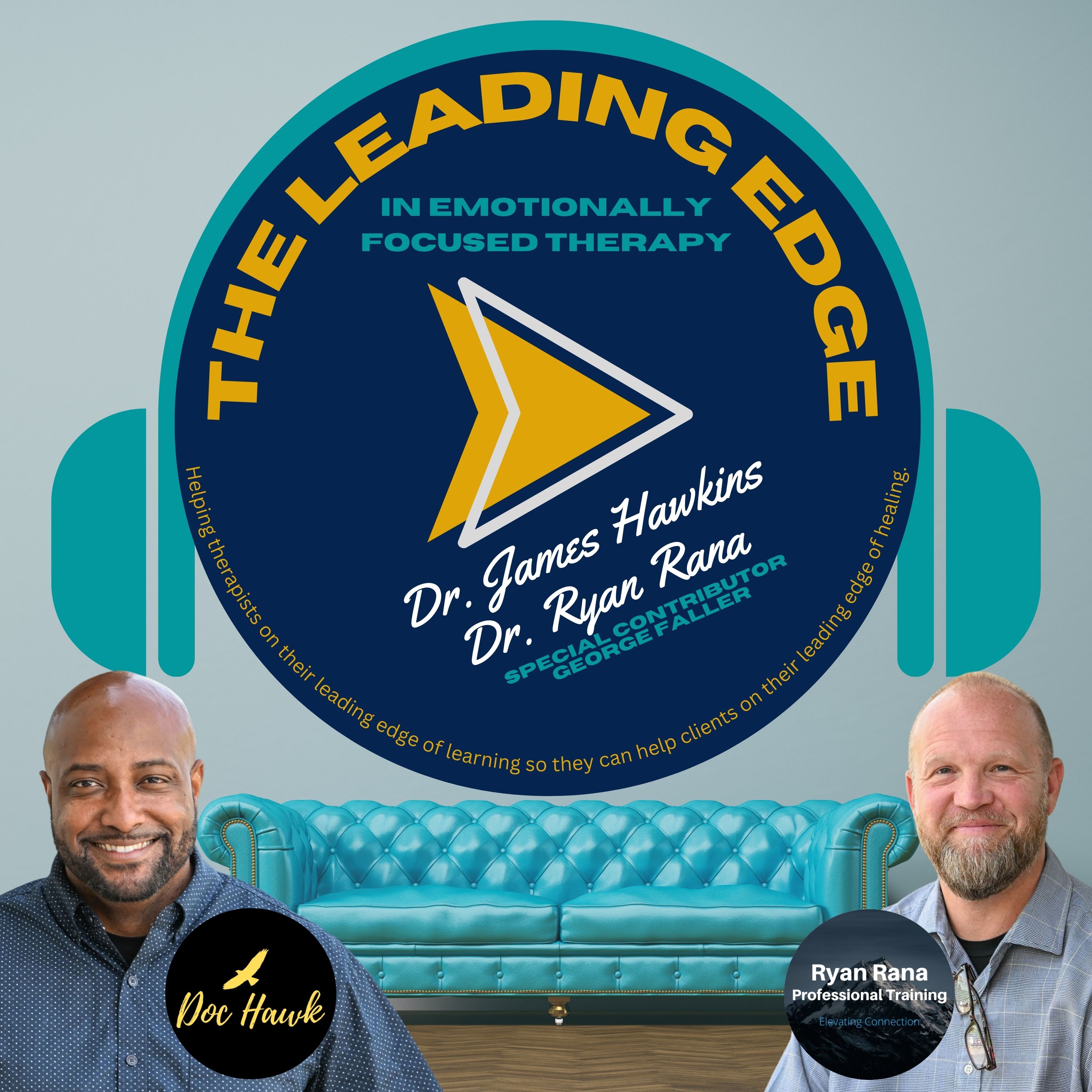
142. Stage 2 Series: The Sequela of the Burnout Pursuer: Hope Scenes, Holdouts, and Healing in Stage Two
The Leading Edge in Emotionally Focused TherapyShow Notes
Welcome to the Leading Edge in Emotionally Focused Therapy, hosted by Drs. James Hawkins, Ph.D., LPC, and Ryan Rana, Ph.D., LMFT, LPC—Renowned ICEEFT Therapists, Supervisors, and Trainers. We're thrilled to have you with us. We believe this podcast, a valuable resource, will empower you to push the boundaries in your work, helping individuals and couples connect more deeply with themselves and each other. In this episode of The Leading Edge in Emotionally Focused Therapy, James and Ryan explore the “sequela” — the long-term fallout — of the burnout pursuer and how that shows up in both Stage 1 and Stage 2 EFT. They unpack what it means to truly witness a burned-out pursuer’s journey instead of trying to “get them to move,” why holdouts are such a powerful (and costly) survival strategy, and how to work with the unique shame of someone who feels, “I hate myself for still loving you.” You’ll hear practical ways to:
Stay grounded with a pursuer who’s done protesting and now just shows up with crossed arms Do the kind of historical witnessing that feels more like a series of emotional “massages” than a quick intervention Use hope scenes and the “big three” moments of failed hope in Stage 2 to create deep limbic revision Support re-engagement without accidentally reenacting the very patterns that burned them out in the first place
Top 10 Points from the Episode
“Sequela” as a frame:Ryan uses “sequela” (the long-term consequences) to describe what we’re really dealing with in a burnout pursuer—not just current behavior, but the accumulated fallout of thousands of drops, failed bids, and unresolved pain.
Burnout pursuer = mixed signals + survival strategy:Burnout pursuers send mixed messages to their partner, the therapist, and themselves. What looks like manipulation or a “power move” is actually an adaptive survival strategy to cope with feeling helpless and repeatedly dropped.
Historical witnessing is non‑negotiable:Stage 1 work with burnout pursuers requires slow, repeated, historical witnessing—not “forget the past, let’s start over.” The therapist invites them to tell the journey of how they got this burned out, and stays with the horror and grief of it instead of talking them out of it.
The “holdout” dynamic:A burnout pursuer may show up in therapy with arms crossed, essentially saying, “I’m here, but I’m not moving until my partner proves it.” That holdout protects them, but also rigidly locks the cycle in place, sometimes even raising the bar as the withdrawer improves.
Therapist stance: release the need to make them move:James names a crucial shift: the therapist must let go of the internal pressure to get the pursuer to move. The more the therapist pushes, the more the pursuer’s nervous system feels pressured and unsafe. The work becomes: “James, just be with what is. Give witness to their journey.”
Stage 1 as repeated “emotional massage”:Ryan likens the work to a series of massages—one session won’t undo years of knots. The therapist returns multiple times to witnessing, validating, and grieving with the pursuer, even as this can be very hard on the withdrawer who’s just starting to “get it.”
Unique shame of the burnout pursuer:There’s a specific shame: “Fool me once, shame on you; fool me thousands of times… shame on me.” Many burnout pursuers feel, “I love you, and I hate myself for the fact that I love you.” Without naming and working this shame, they can’t risk hope again.
Stage 2: asking them to care‑give again is huge:When the couple “dumps over” into Stage 2, the burnout pursuer is often asked to sit with and respond to their partner’s vulnerability first. This can re-evoke the old experience: “Once again, it’s not about me.” Naming how much is being asked of them is essential.
The “big three” hope scenes as core Stage 2 work:Effective Stage 2 softening with burnout pursuers often requires revisiting 2–3 symbolic “big hope” moments (e.g., an elaborate romantic trip) where they risked
More from The Leading Edge in Emotionally Focused Therapy
Welcome to the Leading Edge in Emotionally Focused Therapy, hosted by Drs. James Hawkins, Ph.D., LPC, and Ryan Rana, Ph.D., LMFT, LPC—Renowned ICEEFT Therapists, Supervisors, and Trainers. We're thrilled to have you with us. We believe this podcast, a valuable resource, will empower you to push the boundaries in your work, helping individuals and couples connect more deeply with themselves and each other.
What happens when one partner needs emotional connection before sex, while the other experiences sex as one of the primary ways they feel emotionally connected? Too often, couples—and even therapists—get caught trying to decide which need should come first. In this episode, Dr. James Hawkins sits down with Dr. Laurie Watson, coauthor of Brave Love, Great Sex, for a rich conversation about why the emotional and sexual bonds in romantic relationships cannot be separated. Laurie explains how couples can become caught in two interconnected pursue-withdraw cycles: an emotional cycle and a sexual cycle. One partner may pursue emotionally while withdrawing sexually, while the other withdraws emotionally but reaches for connection through sex. Underneath both are familiar attachment questions: Do you want me? Do I matter to you? Will you respond to me? Am I safe needing you? James and Laurie explore how attachment history, childhood experiences with touch, body image, sexual functioning, anxiety, shame, and vulnerability can all shape what happens between partners in the bedroom. They also discuss why sexual withdrawal is not simply a lack of desire and sexual pursuit is not simply wanting more sex—both can be attempts to manage deeply vulnerable relational needs. Link to Brave Love Great Sex Podcast Amazon Link for Brave Love Great Sex Book Welcome to the Leading Edge in Emotionally Focused Therapy, hosted by Drs. James Hawkins, Ph.D., LPC, and Ryan Rana, Ph.D., LMFT, LPC—Renowned ICEEFT Therapists, Supervisors, and Trainers. We're thrilled to have you with us. We believe this podcast, a valuable resource, will empower you to push the boundaries in your work, helping individuals and couples connect more deeply with themselves and each other.
Welcome to the Leading Edge in Emotionally Focused Therapy, hosted by Drs. James Hawkins, Ph.D., LPC, and Ryan Rana, Ph.D., LMFT, LPC—Renowned ICEEFT Therapists, Supervisors, and Trainers. We're thrilled to have you with us. We believe this podcast, a valuable resource, will empower you to push the boundaries in your work, helping individuals and couples connect more deeply with themselves and each other.
Welcome to the Leading Edge in Emotionally Focused Therapy, hosted by Drs. James Hawkins, Ph.D., LPC, and Ryan Rana, Ph.D., LMFT, LPC—Renowned ICEEFT Therapists, Supervisors, and Trainers. We're thrilled to have you with us. We believe this podcast, a valuable resource, will empower you to push the boundaries in your work, helping individuals and couples connect more deeply with themselves and each other.
Welcome to the Leading Edge in Emotionally Focused Therapy, hosted by Drs. James Hawkins, Ph.D., LPC, and Ryan Rana, Ph.D., LMFT, LPC—Renowned ICEEFT Therapists, Supervisors, and Trainers. We're thrilled to have you with us. We believe this podcast, a valuable resource, will empower you to push the boundaries in your work, helping individuals and couples connect more deeply with themselves and each other. In this episode, Dr. James Hawkins and Dr. Ryan Reyna walk into the heart of Stage 2 EFT and ask a hard question: How do you get the most out of YOU when every path forward involves pain? Drawing on stories from haunted houses, combat medicine, and oncology surgery, they unpack what it means to be the stronger, wiser other—not as a top-down expert, but as a steady, emotionally present guide when clients’ eyes are begging, “Please don’t make me go there.” You’ll hear how to: